Before the word "radar" existed (1886–1934)
In 1886 Heinrich Hertz showed that radio waves bounce off solid objects, the same way light reflects off a mirror. In 1904 the German engineer Christian Hülsmeyer patented the Telemobiloskop, a device that used reflected radio waves to warn ships of nearby vessels in fog. It worked, but nobody bought it. The idea sat for thirty years.
Through the 1920s and early 1930s, researchers in the US, UK, France, Germany, the Soviet Union, Italy, Japan, and the Netherlands all independently noticed the same thing: aircraft passing between a radio transmitter and receiver caused a flutter in the signal. By 1934 every major military power was quietly working on it.
Who invented radar?
There is no single inventor. The honest answer is that radar was invented in parallel in at least eight countries between 1934 and 1939. The names that matter most:
- Robert Watson-Watt (UK, 1935) — built the first practical air-defence radar and the Chain Home network that ringed Britain by 1939. Usually credited as "the father of radar" because his system actually shipped.
- Rudolf Kühnhold (Germany, 1934) — demonstrated ship detection at 600 metres. Led to the Freya and Würzburg radars.
- Robert Page (US Naval Research Lab, 1934) — built the first pulsed radar in the US, the basis for every modern radar.
- Henry Tizard's committee (UK, 1935) — the political glue that turned a lab demo into a national air-defence system in four years.
World War II — radar grows up in five years
In 1939 a state-of-the-art radar was a wooden hut full of valves that could spot a bomber at 100 miles if the operator was lucky. By 1945 radar fit inside a fighter's nose, guided anti-aircraft shells to within 20 metres of a moving target, and mapped the ground through cloud at night. Almost every concept in modern radar — pulsed transmission, the cavity magnetron, the PPI display, IFF (friend-or-foe), Doppler velocity readout, monopulse tracking — was invented or matured between 1939 and 1945.
The single most important breakthrough was the cavity magnetron, built by John Randall and Harry Boot at Birmingham in 1940. It made microwave-frequency radar small enough to fit in an aircraft and powerful enough to be useful. The British handed the design to the Americans in the Tizard Mission later that year — historians often call it "the most valuable cargo ever brought to American shores."
Where radar went after the war
- Civil aviation (1946–) — surplus military radar became the first air traffic control. The PPI sweep you still see in every ATC tower is essentially a 1944 design.
- Weather radar (1947–) — operators noticed rainstorms cluttering their displays. Within two years that "clutter" became a forecasting tool. Doppler weather radar followed in the 1970s.
- Police speed radar (1954) — John Barker's Doppler gun. Same physics as a fighter intercept radar, scaled down to a handheld.
- Synthetic aperture & space radar (1978–) — Seasat mapped the oceans from orbit. Today every weather satellite carries radar.
- Automotive radar (2000s–) — adaptive cruise control and emergency braking use 77 GHz radar that would have been science fiction in 1945.
Why the radar sweep still looks the same
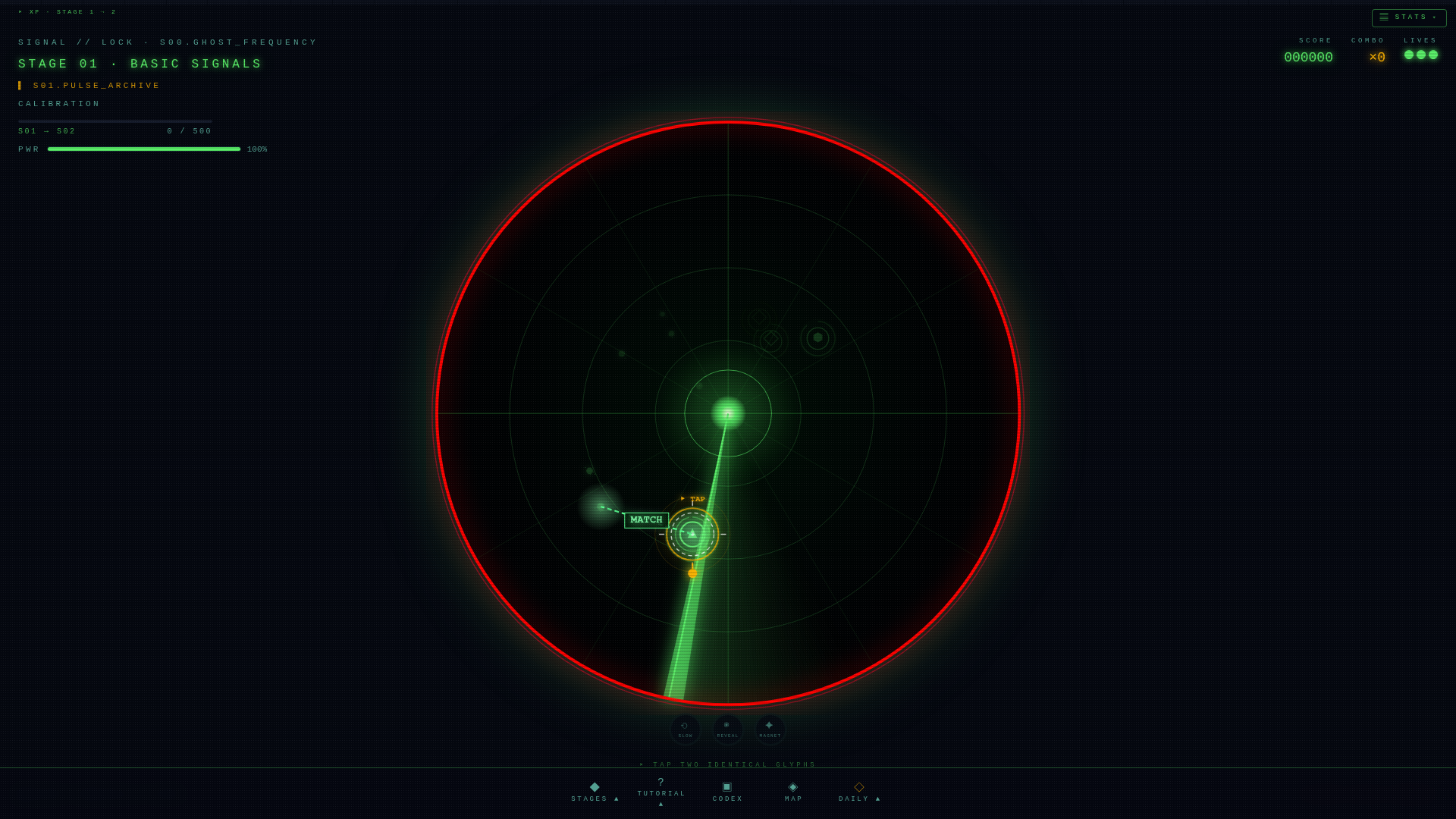
The rotating green sweep is not nostalgia — it is the most efficient way to display a rotating directional antenna's returns over time. The phosphor afterglow on old CRT scopes happened to match the rotation period, so a contact stayed visible for one full sweep before fading. Modern radars are mostly electronically scanned and could draw anything, but operators still prefer the PPI because it maps directly to "where the antenna is looking right now." That visual language is also why arcade radar games — and the radar in Signal//Lock — feel instantly readable.
Related reading
- How radar actually works (pulse, echo, range)
- Signal//Lock mechanics — radar terms in a game context
- Open the radar
The pre-war foundations
Radar's foundational physics — that electromagnetic waves reflect from metallic surfaces — was demonstrated by Heinrich Hertz in 1886 and recognised as a detection mechanism by Christian Hülsmeyer in 1904, whose Telemobiloskop patent described a ship-collision-avoidance system using reflected radio waves. Hülsmeyer's device worked but found no commercial market; the idea sat dormant for nearly three decades until the geopolitical pressure of the 1930s drove parallel development programs in the UK, Germany, the US, the USSR, France, Italy, and Japan.
Britain's Chain Home network, operational by 1939, was the first integrated radar early-warning system and arguably decided the Battle of Britain. It used wavelengths around 10 metres — long by modern standards — which limited resolution but allowed transmitters and receivers to be built from broadcast-radio components. The wavelength choice was as much an industrial decision as a physics one: the UK could build long-wave equipment quickly with existing suppliers.
The cavity magnetron and the wartime leap
The single most important radar invention was the cavity magnetron, demonstrated at the University of Birmingham in February 1940 by John Randall and Harry Boot. It generated kilowatts of microwave power at wavelengths around 10 cm — roughly 100x shorter than Chain Home, which meant antennas could shrink from football-pitch dimensions to dish sizes that fit on aircraft and ships. The technology was handed to the United States via the Tizard Mission later in 1940, and MIT's Radiation Laboratory turned it into the radar systems that defined the second half of the war.
By 1945 the Rad Lab had produced over a hundred distinct radar systems and a 28-volume series — the Rad Lab Series — documenting microwave engineering as a discipline. Almost every modern radar lineage descends from a Rad Lab design.
Postwar civil and scientific radar
After 1945 the technology fanned out into civilian air-traffic control (the first PPI displays in commercial ATC appeared by the late 1940s), weather radar (the WSR-57 entered US service in 1957), radio astronomy (the Jodrell Bank dish, completed in 1957, was originally designed for radar studies of cosmic ray air showers), and planetary radar (the first radar return from Venus was obtained in 1961). The cultural image of radar — the green sweep on a dark background — was set in this period and remains the dominant visual shorthand for detection in games, films, and television sixty years later.