The radar horizon advantage
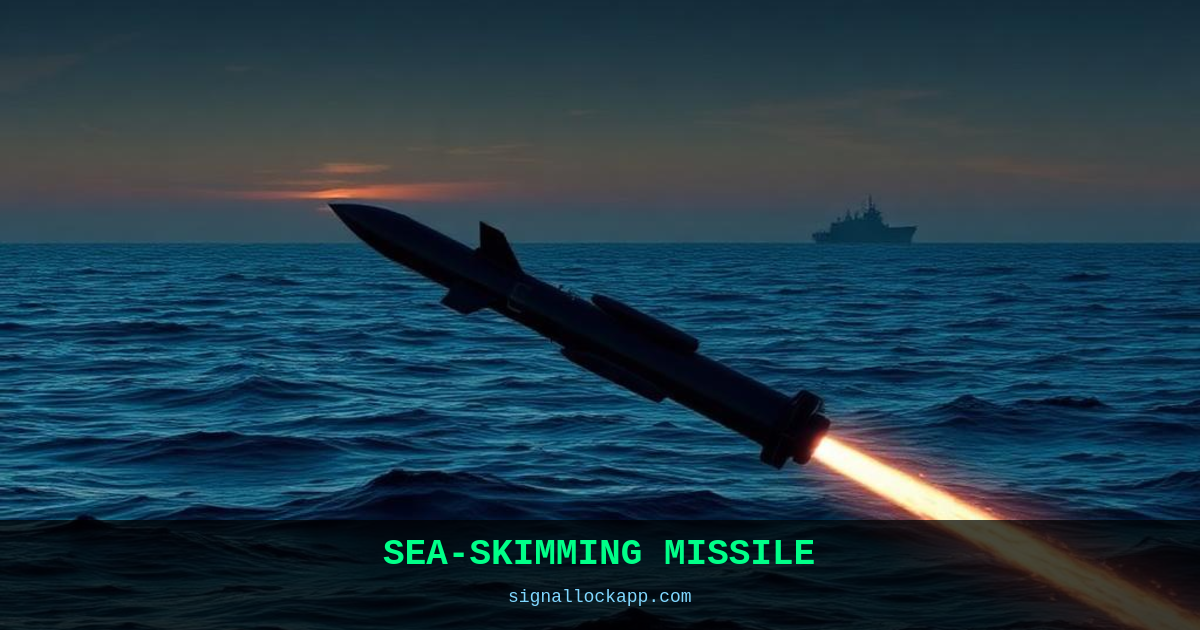
A missile flying at 5 m above the waves is below the radar horizon until it is within about 15 km of the ship. For a target moving at Mach 0.9, that's about 50 seconds of warning. At Mach 3, it's 15 seconds. The Sheffield had less than a minute. Many modern systems have even less.
Clutter and multipath
Even when above the horizon, the missile is in heavy sea clutter — waves reflecting radar energy back to the receiver. Multipath adds reflections from the sea surface, creating fading and ghost tracks. The missile itself is small, often with reduced RCS. Separating it from the background is one of the hardest problems in naval radar.
Defence layers
Modern ships use layered defence: long-range air-search radar (sometimes on a helicopter), mid-range tracking radar, short-range point-defence radar, and finally close-in weapon systems (CIWS) like Phalanx or Goalkeeper. Each layer has seconds to act. The missile-defence problem is a race between radar detection, fire-control solution and interceptor flight time.
Stealth skimmers and hypersonics
The next generation includes missiles with stealth shaping and ramjet propulsion at Mach 5+. Hypersonic sea skimmers compress the engagement timeline to seconds. Directed-energy weapons (lasers) and railguns are being developed precisely because conventional interceptors cannot close the distance fast enough. The race continues.
The ducting effect and super-refraction
In specific maritime environments, the interaction between water vapor and temperature gradients creates an evaporation duct—atypical atmospheric conditions that can trap radar energy near the surface. While this sometimes allows a ship's radar to see beyond the geometric horizon, it more frequently works in the favor of the sea-skimmer. The missile can stay nested within this duct, which bends radiation toward the earth’s curvature, effectively masking the missile’s presence until it exits the waveguide or hits the near-field of the defender's sensing suite. This phenomenon makes reliable detection ranges inconsistent and unpredictable.
Predicting these ducting layers requires high-resolution meteorological data gathered in real-time. Systems must account for the refractive index of the air, which varies with humidity and pressure. Without this data, radar operators may misinterpret signal loss as interference or find their tracking lock broken by 'ducting fades.' This technical nuance was a critical factor during several 20th-century naval engagements in the Persian Gulf and Atlantic, where environmental conditions proved just as influential as raw transmitter power in determining whether a missile track was successfully maintained or lost to the surface noise.
Signal processing and MTI techniques
To isolate a sea-skimmer from the surrounding chaos of the ocean, modern radar relies on Moving Target Indication (MTI) and Pulse-Doppler processing. These techniques measure the frequency shift caused by the missile's relative velocity, filtering out the low-velocity 'clutter' of the waves. However, when a missile approaches at a shallow angle and high speed, the radial velocity relative to the ship creates a narrow Doppler window. If the missile performs terminal maneuvers—such as a 'pop-up' or 'weave' profile—the sudden change in radial velocity can cause a momentary loss of track, forcing the radar's computer to re-verify the target's identity.
The shift from mechanical scanning to Active Electronically Scanned Array (AESA) technology has fundamentally changed this dynamic. Unlike the rotating antennas of the Cold War era, AESA systems can dwell on specific sectors with high-update rates, providing the continuous illumination required to track small targets in high-clutter environments. By using multiple independent sub-arrays to look at different parts of the horizon simultaneously, these systems reduce the time-to-track from several seconds to milliseconds. This speed is essential when countering modern threats like the P-800 Oniks or the BrahMos, where every millisecond of processing delay increases the probability of a successful hit.
The Terminal Pop-up Maneuver
While low-altitude flight provides concealment, it complicates the missile's own terminal guidance. Many sea skimmers, such as the RGM-84 Harpoon, incorporate a 'pop-up' maneuver in the final seconds of flight. By climbing abruptly and then diving onto the target, the missile can strike the ship's less-armored upper decks rather than the reinforced hull at the waterline. This maneuver also improves the seeker's look-down angle, reducing the impact of sea clutter reflections that might otherwise cause the missile to fly into the water before impact. However, this ascent temporarily exposes the missile to a ship's defensive systems, increasing its vulnerability to hard-kill measures.
Modern counter-measures have forced a shift away from these predictable pop-up patterns. Highly agile missiles, like the P-800 Oniks, now utilize high-G weaves and corkscrew maneuvers while staying as low as possible. These unpredictable flight paths are designed to exhaust the tracking algorithms of fire-control radars. By continuously changing the line-of-sight rate, the missile prevents a CIWS from calculating a consistent lead point. This forces the defending system to constantly re-evaluate the intercept solution, consuming precious seconds of the already narrow engagement window available before the missile reaches the hull.
Frequency Agility and ECCM
To counter the difficulty of sea-skimming detection, naval radars have evolved to use K-band and Ka-band frequencies for terminal tracking. These higher frequencies offer superior resolution and narrower beamwidths, which help isolate the missile from the surrounding sea clutter. However, higher frequencies suffer more from atmospheric attenuation, particularly in high-humidity maritime environments. To mitigate this, modern phased-array radars utilize Electronic Counter-Countermeasures (ECCM) and frequency agility. By hopping across a wide spectrum of frequencies, the radar can find the optimal window for signal returns while simultaneously making it harder for the missile's own active seeker to jam the ship's defenses.
The historical shift toward digital beamforming has also revolutionized the rejection of 'glint'—the rapid shifting of the apparent center of a target. In early Cold War engagements, sea skimmers could effectively disappear by flying so low that the radar could not distinguish the physical target from its reflection on the water. Modern signal processing uses vertical polarization and complex Doppler filtering to differentiate between the true kinetic energy of the incoming missile and the stationary or slow-moving chaotic energy of the ocean waves. This technical arms race remains the central focus of contemporary destroyer and frigate sensor suite development.