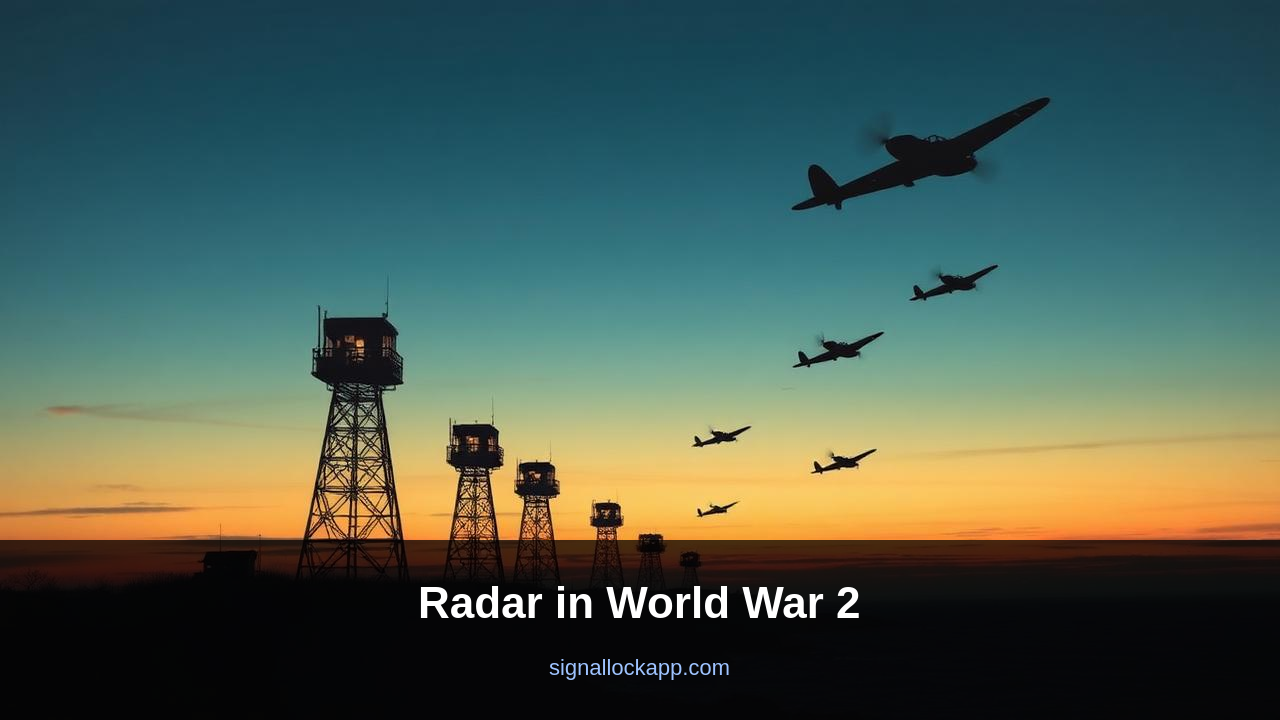
Chain Home and the Battle of Britain
Britain's Chain Home network — 21 transmitting stations along the south and east coasts by July 1940 — gave RAF Fighter Command something no air force had ever had: 20 minutes of warning before a raid arrived. The radar itself was crude. It used 12-metre wavelengths and could not measure altitude reliably. But combined with the Dowding System, which fused radar tracks with observer reports and routed them through a single command, it doubled the effective strength of Fighter Command.
Without Chain Home, the RAF would have had to keep a third of its fighters airborne at all times just to be sure of catching incoming bombers. With it, fighters scrambled only when a raid was confirmed. That single efficiency probably won the Battle of Britain.
Airborne intercept — radar in the cockpit
The cavity magnetron made microwave radar small. By 1942, the British AI Mk. VIII fit inside a Beaufighter's nose. The pilot could chase a Heinkel through cloud at night using a tiny green CRT. By 1944, the US SCR-720 was in P-61 Black Widows over Europe and the Pacific. German night-fighter losses to RAF Bomber Command were largely the work of three things: Window (chaff), Monica (tail-warning radar), and the H2S ground-mapping radar that let bombers find cities through 10/10ths cloud.
The proximity fuze — radar inside a shell
Possibly the most extraordinary radar of the war: a complete pulse-doppler radar squeezed into the nose of an artillery shell, robust enough to survive 20,000 g of acceleration, cheap enough to throw away. The VT (variable time) fuze detected when the shell passed within 20 metres of a target and detonated. It quadrupled the lethality of US anti-aircraft fire and was decisive against V-1 cruise missiles in 1944.
What didn't change
By 1945 every concept in modern radar — pulse, Doppler, PPI display, IFF, monopulse tracking, synthetic aperture, electronic countermeasures — had been invented or proven in combat. The last 80 years have been refinement, miniaturisation and software. The core physics is 1944.
The Battle of the Atlantic — microwave radar and the U-boat
In 1941, German U-boats operated with near-impunity beyond the reach of shore-based aircraft. Early metric-wavelength radar (ASV Mark II) was easily detected by German Metox receivers, giving captains time to dive. The arrival of the cavity magnetron changed this dynamic overnight. Operating at the 10-centimeter S-band, the new ASV Mark III radar was invisible to existing German sensors and provided such high resolution that it could detect a submarine's periscope or snorkel at several miles. This technological leap destroyed the U-boats' primary defense: their ability to remain unseen on the surface while recharging batteries at night.
By 1943, the combination of microwave radar and Leigh Lights—powerful searchlights slaved to the radar's rangefinder—meant that a surfaced U-boat could be detected, tracked, and illuminated in total darkness. Admiral Karl Dönitz, commander of the U-boat fleet, admitted that the 'loss of the Battle of the Atlantic' was due to a single technical factor: the enemy’s superior use of centimetric radar. By the end of the war, the Allies had sunk nearly 800 U-boats. The transition from 1.5-meter to 10-centimeter wavelengths turned the Bay of Biscay from a safe transit zone into a graveyard for the Kriegsmarine.
H2S and the invention of synthetic vision
Before 1943, nighttime bombing was largely guesswork. Crews relied on 'dead reckoning' and visual sightings of landmarks, leading to the 1941 Butt Report's discovery that only one in three bombs fell within five miles of the target. The H2S system revolutionized navigation by providing the first ground-mapping radar. By rotating a microwave beam downward, the system created a glowing map on a Plan Position Indicator (PPI) scope. Because water, land, and urban steel reflect radar pulses differently, navigators could 'see' the crystalline outline of a city or the dark curve of a river through thousands of feet of solid cloud cover.
The technical challenges were immense, particularly the 'cosecant-squared' antenna design which ensured the radar return was even across different distances. Despite fears that the Germans would capture a magnetron from a downed bomber—which they eventually did at Rotterdam in 1943—the British deployed H2S extensively. It allowed the RAF to maintain the bomber offensive regardless of weather. This was the direct ancestor of modern Synthetic Aperture Radar (SAR) and terrain-following systems used in contemporary aviation, proving that radar was not just for finding targets in the air, but for visualizing the world below.
IFF — Telling friend from foe
As radar screens became crowded with hundreds of blips, the inability to distinguish friendly aircraft from enemy raiders became a critical vulnerability. The solution was IFF (Identification Friend or Foe), the direct ancestor of modern secondary surveillance radar. By 1940, the British developed the Mark I IFF, a primitive transponder that received a radar pulse and automatically broadcast a coded response back to the ground station. Without this handshake, radar operators could only track movement, not intent, leading to frequent 'friendly fire' incidents and requiring complex, manual coordination between flight controllers and anti-aircraft batteries.
The technology evolved rapidly with the Mark III system, adopted as the Allied standard in 1943. Unlike earlier versions that only worked with specific radar bands, the Mark III operated on a dedicated frequency independent of the primary radar. This allowed naval ships and ground controllers to sweep the sky and receive clear, coded identities from every Allied plane within range. By 1945, this electronic interrogation had become the backbone of air traffic control, proving that radar was not just a tool for detection, but the foundational layer for a global system of signal-based identification that governs civil aviation today.
The Kammhuber Line and the Wurzburg radar
While Britain focused on defensive warning, Germany developed the most sophisticated tactical radar of the early war: the FuMG 65 Würzburg. Operating on a 53 cm wavelength with a parabolic dish, it provided far greater precision than the sprawling masts of Chain Home. These units were the heart of the Kammhuber Line, a defensive belt stretching from Denmark to central France. Each sector, or 'Himmelbett' (four-poster bed), used a Würzburg-Riese (Giant Würzburg) to track a single British bomber and another to guide a German night fighter onto its tail with mathematical accuracy.
The technical superiority of the Würzburg forced the evolution of electronic countermeasures. When the RAF first deployed 'Window'—strips of aluminum foil cut to half the Würzburg's wavelength—over Hamburg in July 1943, the German radar screens were completely blinded. The resulting firestorm demonstrated that radar was no longer an absolute advantage, but the start of a permanent arms race between signal and noise. This shift from physical armor to electromagnetic dominance remains the defining characteristic of modern electronic warfare (EW), where the battle for the spectrum is as vital as the battle for the terrain.