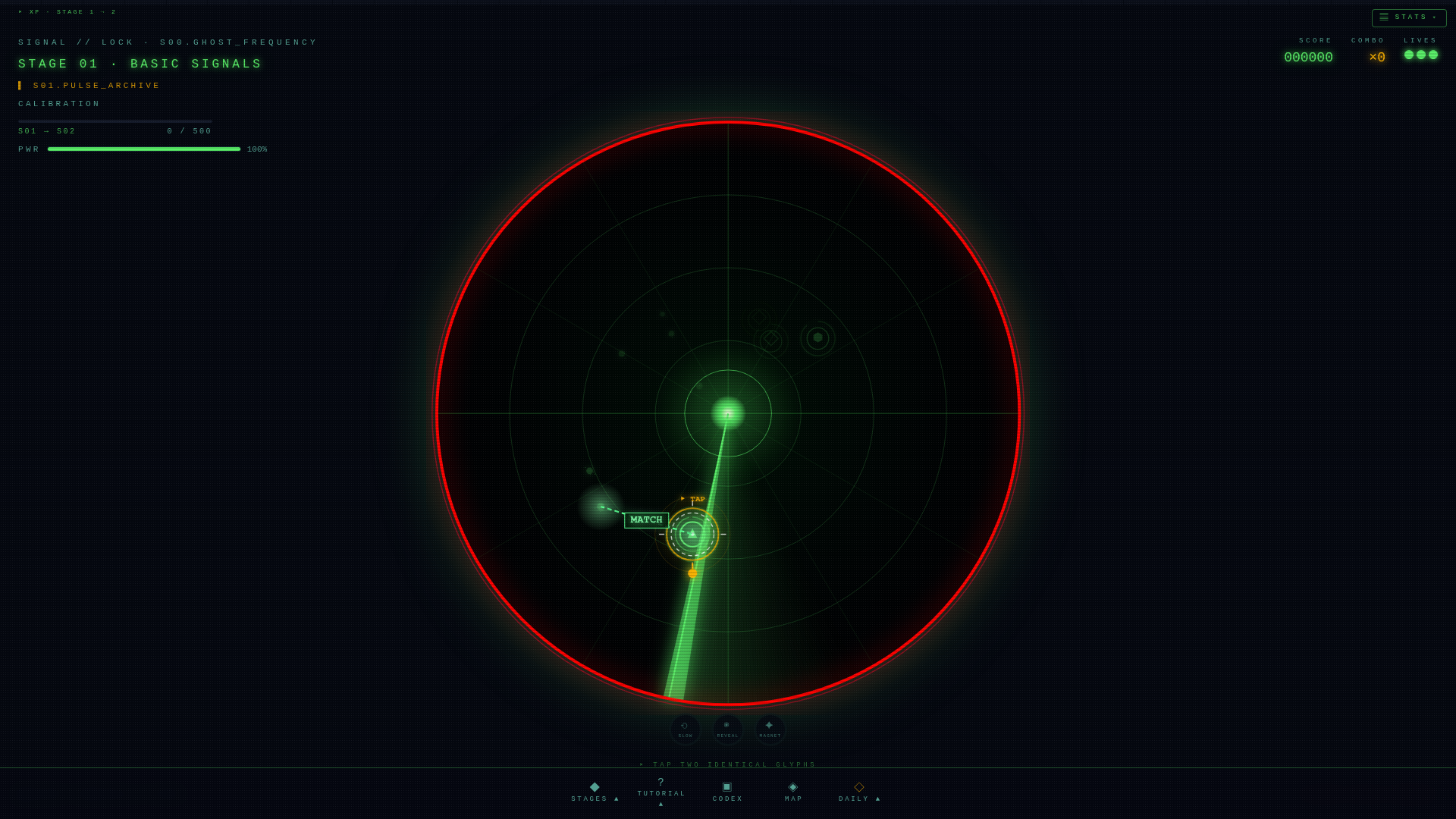
Most "radar games" are top-down shooters with a circle in the corner. Signal//Lock is the opposite — the radar is the game. Every contact is a phantom on a 60Hz sweep, every decision is made under a moving sweep line, and every miss leaks into a saturation meter that eventually overloads the dish. There is nothing else on the screen.
How a round plays
- A sweep rotates around the dish at a fixed period. Contacts only become visible as the line passes over them.
- You lock matched pairs by tapping or clicking before they decay. Locks chain into combos; combos build a salvo charge.
- Every missed signal pushes the phase saturation meter higher. At 100% the dish overloads and you lose a life.
- Survive long enough and the radar swaps mode entirely — fever streaks, vector overflow, parachute drift, classified intercepts. Each stage is a different rule set on the same dish.
Why it works as a radar game
- The sweep is real. Information arrives in waves, not all at once. You learn to anticipate the line.
- Contacts decay. Doing nothing is never neutral — every uncaught signal costs you saturation.
- Sound matters. The audio engine plays positional tones, lock-on beeps, and a low orbital hum. Headphones genuinely help.
- No filler. No score-multiplier shop, no daily quests, no login wall. Open the tab, start the run.
Built for short sessions
A typical run is two to five minutes. The game is designed for the gap between meetings — long enough to feel a real arc, short enough that you don't lose an afternoon. Stages rotate fast, so you rarely play the same rule set twice in a row.
Nine radar modes, one dish
Signal//Lock isn't a single radar puzzle on repeat. The dish reskins itself across nine different modes — vector overflow saturates the screen with persistent lines, fever turns the sweep into a torrent, parachute mode adds wind drift, classified intercepts flip the radar 180° and demand recall. The radar stays; the rules don't.
Start playing
Open the radar — no signup, nothing to install. Or read the full mechanics guide first if you want to know what every overlay means before you sit down.
More to read
- Compared to ATC games — what overlaps, what doesn't.
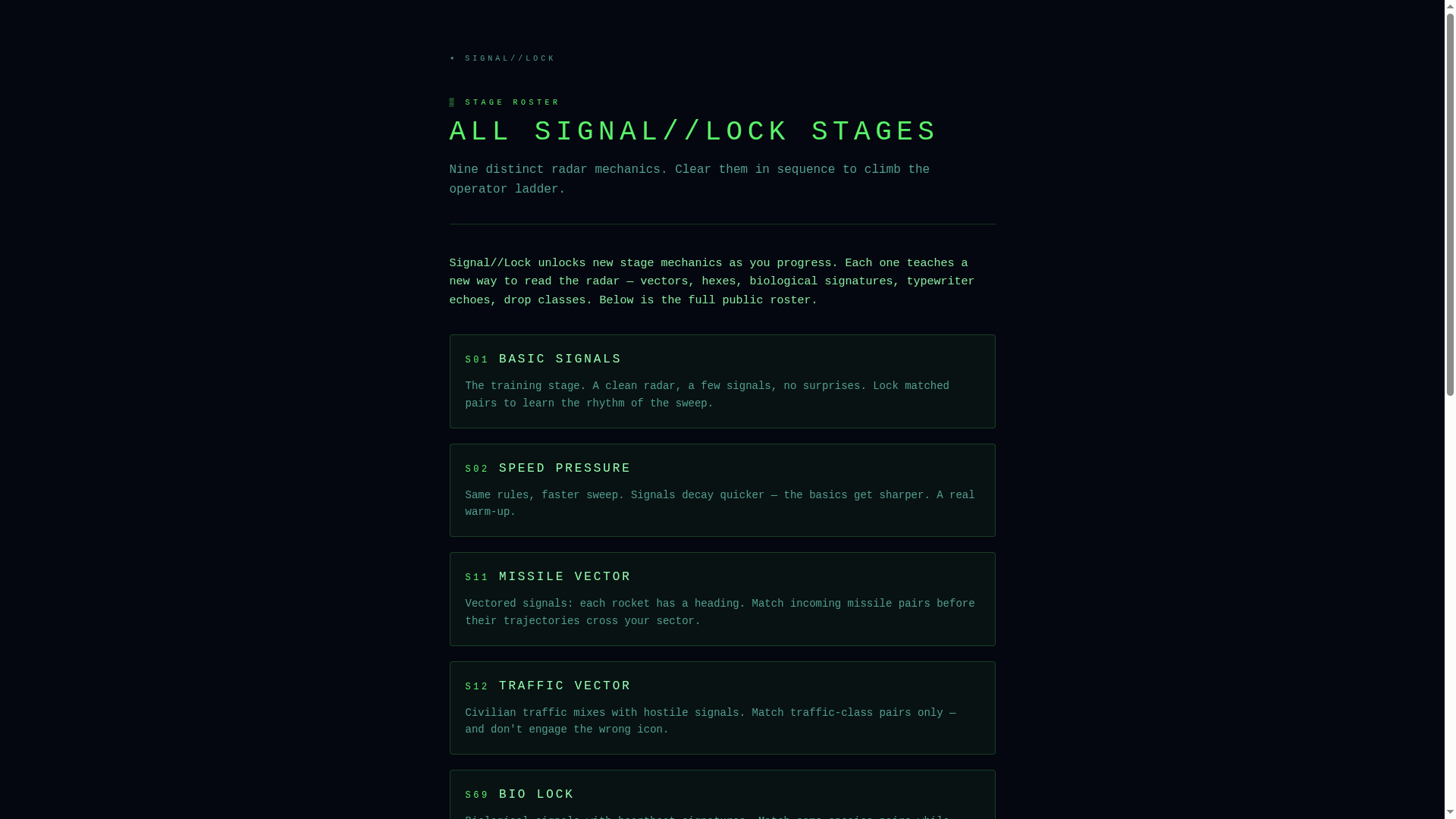
- All nine stages — full rule sets.
- FAQ — common questions about the game.
What sets a real radar game apart
A genuine radar game treats the dish as the playfield, not a HUD decoration. That means three things must be true at once: information arrives in sweeps, contacts decay when ignored, and the operator's attention is the bottleneck — never reflexes alone. Signal//Lock holds all three. The 60Hz sweep is rendered from the same polar geometry a 1960s PPI display used, the decay curve is tuned so that doing nothing always costs you, and locks are a deliberate act: you commit to a pair, the dish commits to a tone, and the saturation ring tracks the cost of every hesitation.
Contrast that with most "radar" entries on web portals — top-down shooters with a circle in the corner, or hidden-object games dressed in green phosphor. They borrow the look without the loop. The test is simple: turn off your monitor for one sweep period. If the game state meaningfully changes — contacts decay, saturation drifts, salvos charge — it's a radar game. If nothing happens until you click, it's a shooter.
The sweep, the decay, the saturation
Sweep
The sweep is a single rotating line, one full revolution every 4 to 6 seconds depending on stage. Contacts are invisible between illuminations — a property real PPI radars share, where the phosphor's persistence is the only memory the operator has of where a target was last seen. Signal//Lock renders that persistence as a slow fade rather than a hard cut, so experienced players can predict where the next ping will appear by extrapolating from the trail.
Decay
Every contact carries a decay timer that starts the moment the sweep first illuminates it. Miss the window and the contact fades — but it also dumps a percentage of its remaining energy into the phase saturation meter. The percentage scales with stage difficulty, so a single miss on stage 9 can cost as much saturation as five misses on stage 2.
Saturation
Phase saturation is the dish's heat budget. Every miss adds to it, every successful lock removes a small amount, and a perfect salvo clears 15-25%. At 100% the dish overloads: the screen distorts, audio clips, and you lose a life. The meter is the single most important thing on the screen and the only resource that connects every stage.
How Signal//Lock compares to other browser radars
Most web radar games fall into three buckets. Air-traffic sims (route planes between waypoints; calm pacing, no decay), missile-defense clones (predictive aiming on incoming arcs; reflex-driven, no sweep), and sub-hunt clones (sonar pings with passive listening; closer in spirit, but usually turn-based). Signal//Lock sits between sub-hunt and missile-defense: the sweep is continuous like sonar, the locks require commitment like missile-defense, and the saturation meter is a pacing mechanic neither tradition has. The closest historical relative is the 1979 arcade title Missile Command — see our missile command comparison for the full lineage.
Frequently asked
- Is Signal//Lock free to play?
- Yes. The full game — all nine stages, all radar modes, all audio — runs free in any modern browser. No account, no install, no time-limited demo.
- Do I need a fast machine?
- No. Signal//Lock renders to a single Canvas at 60fps and runs comfortably on integrated graphics from the last decade. Mobile Safari and Chrome on Android are fully supported.
- Does it work on mobile?
- Yes. Touch input is treated as a click on the contact under your finger. The HUD scales to portrait orientation and the saturation ring is always visible at the edge of the dish.
- How long is a run?
- A typical complete run is 8 to 15 minutes across all nine stages. Short failure runs are 2 to 5 minutes. Stages can be replayed individually from the stage selector.
- Is there an offline version?
- Signal//Lock is a progressive web app — once loaded, it caches the assets needed to play without a connection. Add the page to your home screen on iOS or Android to launch it fullscreen.
Why the polar display, in 2026
The polar plan-position-indicator (PPI) — a rotating sweep on a circular field — was standardised on Allied radar consoles by 1942 and has barely been challenged since. Eighty-four years later, every air-traffic display, every weather-service nowcast, and every naval combat console still uses the same polar metaphor. The reason is human: the sweep gives the operator temporal context for free. A contact's trail tells you how long it's been there; a contact's brightness tells you how recently it pinged. A grid of pixels cannot communicate this without an additional UI layer.
Signal//Lock leans into the format rather than modernising past it. Modern dashboards layer Cartesian heatmaps and time-series charts on top of PPI to satisfy desk-bound supervisors, but the operator who has to commit under time pressure still works from the polar view. The browser dish here is the operator view, full stop.
The mathematics of decay
Contact decay in Signal//Lock follows an exponential curve, not a linear one. The energy of a contact at time t after first illumination is roughly E₀ · exp(−t/τ), where τ is a per-stage time constant between 1.2 seconds (Fever Streak) and 4.8 seconds (Basic Signals). Exponential decay has one useful property: the half-life is constant. Whether a contact is at 100% energy or 25% energy, the time to lose half its remaining energy is the same. Players who learn this intuitively start estimating decay by halving — "this contact has about two halvings left before it disappears" — and their lock timing improves measurably.
The saturation cost of a missed contact is proportional to its remaining energy at the moment of decay. A contact that fades with most of its energy intact costs more than a contact that fades fully. This makes late commits systematically more expensive than no commits — a counter-intuitive lesson the game teaches without explanation.
The audio engine in technical detail
Signal//Lock's audio is fully procedural. There are no .mp3 or .ogg assets — every tone is synthesised at runtime from Web Audio API oscillators. Contact pings are sine waves with a fast attack and an exponential decay envelope, panned according to the contact's angular position on the dish. Lock confirmations layer a square-wave click over a brief sine-burst. The low background hum is a sub-100-Hz triangle wave modulated by the saturation meter — as saturation rises, the hum's frequency modulates higher and its amplitude grows, giving the operator a sub-conscious sense of how close to overload they are even when not looking at the ring.
The total audio payload is zero kilobytes — the engine ships only its synthesis code, which compresses to under 8 KB gzipped. The same approach was standard on 1980s arcade boards (the SN76489 chip on a Master System, the YM2612 on a Mega Drive) and has aged into a legitimate compression strategy on the modern web.