If you came here looking for a deep ATC simulator with handoffs, departures, and stack management, Signal//Lock is not that. Those games take real time to learn. Signal//Lock keeps the part most people actually wanted from ATC games — reading a radar under pressure — and strips the rest. The result plays in five minutes and demands the same kind of attention.
What it shares with ATC games
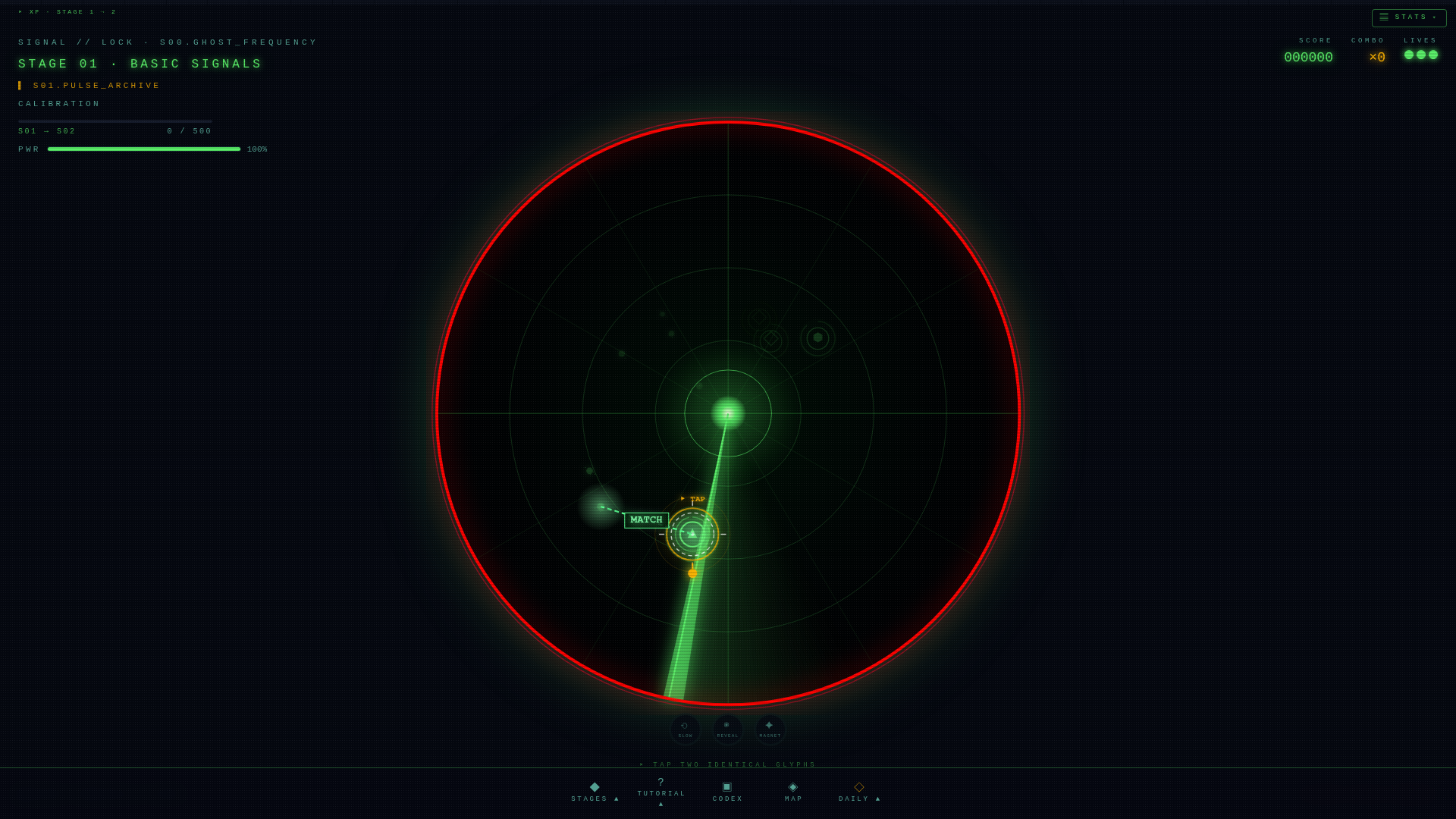
- A sweeping radar dish. Contacts are only visible as the sweep line passes over them. You learn to plan ahead.
- Saturation as the loss condition. Real ATC loses control when the screen gets too dense. Signal//Lock has the same meter, made explicit.
- Audio cues that mean something. Lock-on beeps, alert tones, low-hum ambient. You can play partly by ear.
- Stage modifiers. Wind drift on parachute stages, vector overflow that saturates the screen, classified intercepts that flip the radar — the same kind of "the rules just changed" pressure ATC controllers know.
What it deliberately leaves out
- No flight plans, no clearances, no callsigns to type.
- No multi-screen sectors. The whole game fits one round dish.
- No accumulating career or campaign. Each run starts clean.
Who it's for
Players who like the feel of an ATC scope — the sweep, the density, the moment a screen tips from "manageable" into "behind" — but want a five-minute arcade run instead of a forty-minute shift. If you've spent time with the more serious ATC simulators and want something to keep your reading speed sharp between sessions, this is built for that.
How a round goes
- The sweep rotates. Contacts appear as the line touches their bearing.
- You identify matched pairs and lock them before they decay.
- Each unlocked contact pushes the saturation meter up.
- Hit 100% saturation and the dish overloads — life lost. Three lives per run.
- Survive enough stages and the rule set rotates: vector overflow, fever streaks, parachute drift, classified recall.
Open the radar
Start a run now — no install, no account. Or read the full mechanics guide if you want every overlay explained first.
More to read
- Why it works as a radar game — the sweep, the decay, the saturation meter.
- All nine stages — full rule sets per stage.
- Vector Overflow strategy — surviving the densest stage.
What ATC games get right — and where Signal//Lock diverges
Classic air-traffic-control games — Kennedy Approach (1985), ATC Simulator, Endless ATC, the various Flight Control mobile titles — share a recognisable loop: planes appear at the edge of a sector, the player assigns headings and altitudes to route them to waypoints, and conflicts (two aircraft on convergent paths) must be resolved before they trigger a separation loss. Pacing is generally calm. Failure is rare and dramatic. Information is complete: you always know where every aircraft is.
Signal//Lock keeps the radar aesthetic but inverts almost every element. Contacts decay rather than persist. Information arrives on a sweep, not continuously. You don't route signals to waypoints; you commit to a lock and the dish resolves it. Failure is frequent and cheap — a single missed contact rarely ends the run, but a chain of misses pushes saturation past 100%. The pacing is closer to Missile Command than to Kennedy Approach.
The Traffic Vector stage
One Signal//Lock stage — Traffic Vector — explicitly references the ATC tradition. Contacts arrive on linear approach paths with published vectors (heading + speed) visible in a small tag, the same way real radar tags annotate aircraft on a controller's scope. Locks resolve along the predicted path rather than at the current position. Players who have spent time with ATC sims tend to do unusually well on this stage because the mental model of extrapolating from a vector tag transfers directly. Players coming from arcade backgrounds learn the stage faster than the rest of the game because the rule is unusually transparent.
Cognitive load: how many contacts can a human track?
Real ATC research puts working-memory capacity for simultaneous aircraft tracking at roughly 7±2 — the classic Miller number, which controllers extend with chunking and pattern recognition. Signal//Lock stages are tuned around the same range: early stages cap at 4-5 simultaneous active contacts, late stages push to 12-15 but rely on the player chunking pairs and triplets rather than tracking every contact individually. The saturation meter is the safety valve — if you fall behind on tracking, the meter tells you before the run ends.
Frequently asked
- Is Signal//Lock an air-traffic-control simulator?
- No. It borrows the radar display but the verbs are different — you lock contacts, you don't route them. The Traffic Vector stage is the closest stage to a true ATC game; the other eight diverge significantly.
- Can I learn ATC skills from playing?
- Some pattern-recognition transfers — reading vector tags, mentally extrapolating paths, prioritising under load. The procedural side of ATC (phraseology, separation minima, approach plates) is not in the game.
- Are there real airports or call signs?
- No. The signals are deliberately abstract. A future stage may add named call signs as a flavour layer, but the game design avoids tying contacts to real-world entities.
- Does the game model wind, weather, or aircraft performance?
- Parachute Drift stage adds a wind component to contact movement. Aircraft performance and weather are not modelled; the signals follow simple kinematic rules.
Why real ATC games are mostly American
The recognisable ATC-sim canon is overwhelmingly American or American-influenced: Kennedy Approach (Microprose, 1985, US sectors), Tower! (Wilco, 1998, KORD/KSFO), Tower Simulator 3D (FeelThere, 2017, US-heavy roster). The reason is historical: the FAA's airspace structure (Class B/C/D/E airspace, standardised approach plates, ICAO phraseology with US variants) is unusually well-documented in publicly accessible materials, and developers based outside the US still tend to ship US sectors first because the research is cheaper. Signal//Lock's Traffic Vector stage is sector-agnostic — there are no airports and no call signs — which sidesteps the research burden entirely.
Separation minima as a gameplay constraint
Real ATC enforces hard separation minima: typically 3 nautical miles laterally and 1,000 feet vertically within terminal airspace, expanding to 5 nm and 1,000 ft en-route. A "loss of separation" is a reportable safety event. ATC games encode the minima as a hard fail state. Signal//Lock's Traffic Vector stage uses a softer rule: contacts on convergent vectors raise local saturation faster than isolated contacts. The penalty is gradient, not binary — losing 100% saturation overall is the only fail state, not any one pair coming close.
Workload curves and the ATC controller's day
Real-world ATC research tracks workload rather than traffic count. A sector controller working 8 simultaneous aircraft on routine vectors has lower workload than a sector controller working 4 aircraft with one in-flight emergency. The Signal//Lock saturation meter encodes the same idea — it's a workload proxy, not a traffic count. Stages with high contact density but predictable vectors generate less saturation per unit time than stages with fewer contacts but unpredictable modifier behaviour.