Chain Home (1939)
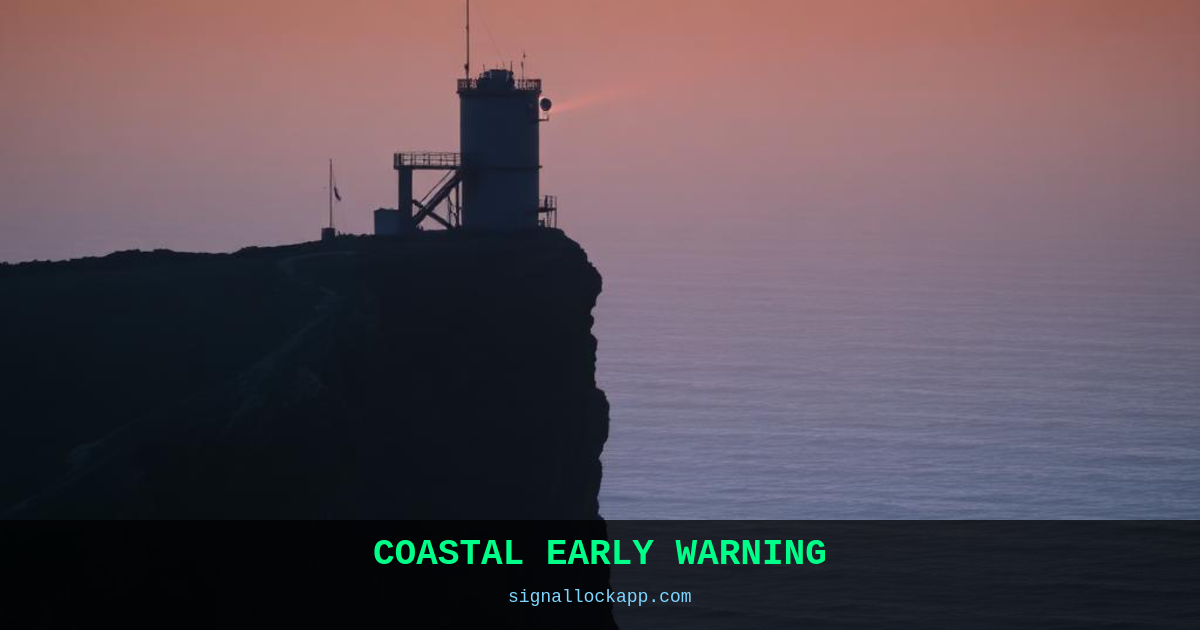
Britain's first operational radar network: 20 stations along the east and south coasts, transmitting at 20–50 MHz from 100 m towers. They detected German raids while still forming over France, giving Fighter Command the minutes needed to scramble Spitfires. Chain Home Low and Chain Home Extra Low filled the gaps for low-altitude attackers. The network won the Battle of Britain before a shot was fired.
Cold War expansion
After WWII, every NATO member built coastal early-warning radars. The US DEW Line across the Arctic (1957), the Pinetree Line, the Mid-Canada Line — each layer designed to detect Soviet bombers and later missiles. Coastal radars added naval surveillance, fishing-boat tracking and drug-interdiction roles as civilian applications grew.
Modern coastal networks
Today, coastal surveillance blends shore-based radar, AIS ship transponders, unmanned aerial systems and satellite AIS. Systems like Blighter in the UK, CEA in Australia and various ELM-2000 derivatives provide kilometre-scale detection of small boats, drones and low-flying aircraft. The threat is no longer Soviet bombers; it is rubber dinghies with explosives and swarm drones.
Civil-military fusion
Coastal radar data feeds port traffic control, search and rescue, fisheries management and border enforcement. The same sensor network serves multiple agencies. Integration is the challenge — military classification, civilian data sharing laws, and the technical standards that let a coast-guard cutter read a navy radar track in real time.
Over-the-Horizon (OTH) Backscatter Physics
Traditional coastal radars are limited by the line-of-sight horizon, typically restricted to approximately 40 kilometers for surface targets. To overcome this, modern coastal chains utilize Over-the-Horizon Backscatter (OTH-B) technology. By operating in the High Frequency (HF) band between 3 and 30 MHz, these systems bounce radio waves off the ionosphere, reflecting them back to Earth deep behind the physical horizon. This allows a single coastal installation to monitor maritime and aerial activity up to 3,000 kilometers away, effectively turning the upper atmosphere into a massive radar reflector for long-range early warning.
The technical challenge of OTH-B lies in the 'clutter' of the ocean surface and atmospheric shifts. Unlike the stable 1940s Chain Home frequencies, modern systems like the Australian JORN or the US ROTHR require immense computational power to filter out sea-state noise from actual vessel returns. These installations utilize massive phased-array receive sites, often kilometers long, to provide the necessary angular resolution. By analyzing the Doppler shift in the reflected signal, operators can distinguish between the rhythmic movement of waves and the steady velocity of a distant littoral combat ship or a low-flying cruise missile.
The Rise of Passive Coherent Location
A significant evolution in coastal defense is the transition from active emitters to Passive Coherent Location (PCL). While traditional radar towers are easy targets for anti-radiation missiles due to their high-energy output, PCL systems remain 'dark.' They do not emit signals themselves; instead, they monitor the interference patterns in existing ambient signals such as commercial FM radio, digital television, and cellular transmissions. When a ship or aircraft moves through these pre-existing fields, it creates a unique 'shadow' or reflection that the passive sensors can triangulate to determine the target's precise position and speed.
This shift to 'silent' coastal monitoring provides a strategic advantage in contested littoral zones. Because the sensors are passive, an adversary cannot detect that they are being tracked through electronic support measures (ESM). Furthermore, passive systems are inherently more effective against stealth designs optimized to deflect specific X-band or S-band pulses. By utilizing lower-frequency commercial broadcasts already saturating the shoreline, coastal nations can maintain a persistent surveillance picture without providing a fixed target for enemy suppression, representing the most significant leap in coastal awareness since the invention of the magnetron.
The Pulse-Doppler Shift in Littoral Clutter
One of the greatest engineering challenges for coastal radar was the problem of sea clutter—the return energy from moving waves that masks small targets. Traditional pulse radars struggled to differentiate between whitecaps and a surfacing periscope or a low-profile smuggling vessel. The implementation of Pulse-Doppler processing revolutionized this by measuring the frequency shift caused by a target's velocity relative to the sensor. By filtering out zero-velocity returns and the specific spectral signature of wind-driven waves, modern coastal arrays can extract high-fidelity tracks from high-clutter environments where older systems would be effectively blinded.
To manage this data, modern installations use adaptive thresholding and Constant False Alarm Rate (CFAR) algorithms. These systems dynamically adjust their sensitivity based on real-time sea states, ensuring that a storm surge or high tide does not trigger a cascade of false positives in the command center. This technical refinement allows for the integration of solid-state transmitters that operate on lower power but with much higher duty cycles than the magnetron-based systems of the mid-20th century, providing continuous, high-resolution surveillance of the immediate shoreline and beyond.
Frequency Agile Waveforms and Electronic Counter-Countermeasures
In the contemporary maritime domain, coastal radar networks must operate in an increasingly congested electromagnetic spectrum. The transition from fixed-frequency systems to frequency-agile wideband radars allows coastal defense networks to 'hop' between channels, evading both intentional electronic jamming and unintentional interference from civilian telecommunications. By utilizing Gallium Nitride (GaN) based active electronically scanned arrays (AESA), these coastal stations can simultaneously perform horizon-wide search and high-priority tracking of multiple independent targets without the mechanical delay of a rotating pedestal.
Beyond simple detection, these networks now utilize LPI (Low Probability of Intercept) waveforms. By spreading the radar energy across a wide bandwidth or using complex modulation schemes, the signal appears to an adversary’s intercept receiver as background noise rather than a coherent radar pulse. This stealthy operation prevents an attacker from locating the coastal radar site for physical or electronic suppression. This shift from 'loud' high-peak-power pulses to 'quiet' continuous-wave signals represents the most significant paradigm shift in shoreline protection since the invention of the cavity magnetron.