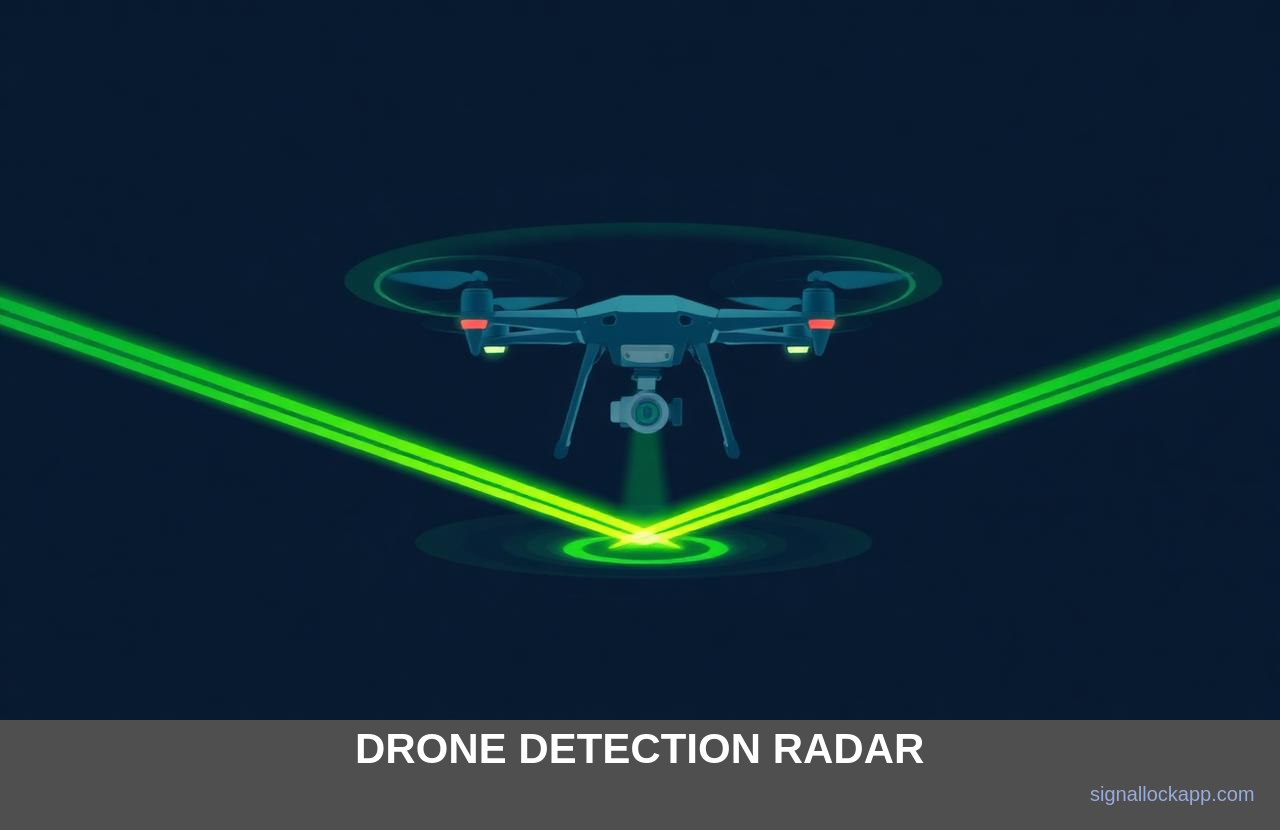
Why drones are hard
Small RCS (0.01 m² is typical for a DJI Phantom). Slow speed (10–20 m/s — radar clutter filters often reject anything that slow). Low altitude (under terrain masking and bird flocks). Mostly plastic, with only the motors and battery returning significant energy.
The new generation: 3D Ku-band staring radar
Companies like Echodyne, Robin Radar and DeTect built X- and Ku-band electronically scanned arrays that stare continuously at the protected volume instead of spinning. Coupled with machine-learning classifiers, they tell a quadcopter from a crow with ~95% accuracy.
Multi-sensor fusion
Drone detection is rarely just radar. RF sensors listen for the 2.4 / 5.8 GHz control link. Acoustic arrays pick up rotor whine. EO/IR cameras visually confirm. A modern counter-drone system fuses all four; radar provides the early track, the others provide the classification.
Then what?
Detection is half the problem. Mitigation — jamming the control link, GPS spoofing, net guns, kinetic interceptors — is the harder half, and legally restricted in most countries to military and approved law-enforcement use.
Micro-Doppler Signatures: The Fingerprint of Rotors
While a drone's airframe provides a tiny radar cross-section, its propellers create a distinct phenomenon known as the micro-Doppler effect. As the rotors spin at high RPMs, they induce periodic frequency shifts in the reflected radar signal, separate from the drone's overall forward velocity. These shifts appear as 'sidebands' around the main return. Advanced signal processing algorithms analyze these modulations to identify the specific number of blades and their rotation speed, allowing the system to distinguish a quadcopter from a fixed-wing bird with high confidence even when the platform is hovering stationary.
This micro-Doppler analysis is the primary defense against 'velocity gate' rejection, where traditional pulse-Doppler radars might ignore a slow-moving target as ground clutter. By focusing on the high-speed motion of the motor components rather than the fuselage, modern Ku-band and X-band systems can maintain a lock on a drone that is virtually motionless in the air. This technical leap moved drone detection from simple movement tracking to complex target characterization, effectively turning the drone's propulsion system against its own stealth profile.
The Gatwick Incident: A Catalyst for Deployment
The vulnerability of modern infrastructure was starkly illustrated during the December 2018 Gatwick Airport incident. Over a period of three days, repeated reports of drone sightings led to the cancellation of approximately 1,000 flights, affecting 140,000 passengers and costing an estimated £50 million. At the time, the airport lacked a dedicated counter-UAS (C-UAS) radar suite, relying instead on visual sightings and standard primary surveillance radar that struggled to resolve small, low-altitude targets against the complex background of the airfield.
The Gatwick event served as a global wake-up call, accelerating the transition of military-grade thermal cameras and staring radars into the civilian sector. Following the crisis, major international hubs began installing systems like the AUDS (Blighter) and Falcon Shield. These installations shifted the industry's focus from reactive 'jamming' to proactive 'detect and track.' The legacy of 2018 is a mandatory integration of specialized drone-detection layers within the broader air traffic management architecture, ensuring that a single hobbyist can no longer paralyze a nation's transportation network.
FMCW Modulation and Range-Doppler Trade-offs
Modern drone detection systems frequently utilize Frequency Modulated Continuous Wave (FMCW) modulation rather than traditional pulsed waveforms. Unlike pulsed radar, which requires high peak power and expensive hardware to resolve small targets at close range, FMCW systems transmit a continuous chirp. By measuring the frequency difference between the transmitted signal and the reflected return, the system can determine range with centimeter-level precision. This is critical for differentiating a drone hovering near a structure from the structure itself. However, this precision introduces a computational burden; the processor must perform a Fast Fourier Transform (FFT) on every range bin to extract velocity data, requiring high-performance FPGA or GPU integration to maintain real-time tracking of high-speed racing drones or FPV platforms.
The primary challenge in FMCW implementation is the dynamic range required to detect a 0.01 m² target in the presence of massive 'ground bounce' or stationary clutter. To solve this, advanced systems use digital beamforming to nullify reflections from known static objects. This allows the radar to maintain a high sensitivity floor, which is essential for detecting fixed-wing resin or carbon-fiber drones that lack the distinct micro-Doppler modulation of rotary-wing aircraft. By optimizing the sweep bandwidth—often exceeding 500 MHz in the K-band—operators can achieve the range resolution necessary to separate two drones flying in a tight 'swarm' formation, a tactic often used to saturate legacy defense systems that perceive a swarm as a single, larger point target.
The False Positive Problem: Biological Clutter
Even with high-resolution 3D radar, the 'bird-to-drone' false alarm rate remains the most significant operational hurdle. Large birds, such as geese or herons, possess a Radar Cross Section (RCS) almost identical to mid-sized consumer drones. Furthermore, their flight patterns—circling, gliding, and sudden bursts of speed—mimic loitering munitions. Early systems at Heathrow and Changi airports struggled with 'angel echoes,' where atmospheric anomalies or bird migrations triggered repeated security lockdowns. To mitigate this, engineers developed biological classification algorithms that look for 'wing-beat modulation.' Just as a quadcopter has a micro-Doppler signature from its rotors, a bird produces a low-frequency modulation from its flapping wings, typically ranging between 2 Hz and 20 Hz depending on the species.
Correcting this misconception requires understanding that radar alone is a probability engine, not a visual identifier. In a 2021 test at a European test range, several high-end systems initially failed to distinguish a specific heavy-lift drone from a large bird of prey because the drone was gliding with its motors idling to conserve power. This technical gap is why modern C-UAS (Counter-Unmanned Aircraft Systems) utilize 'clutter maps' that learn the local ecosystem. By recording the typical flight paths of local avian populations over several weeks, the radar software creates a statistical baseline. Any object moving in a trajectory that deviates from this biological norm is immediately flagged for thermal camera verification, reducing the manual workload for security operators.