Two modes
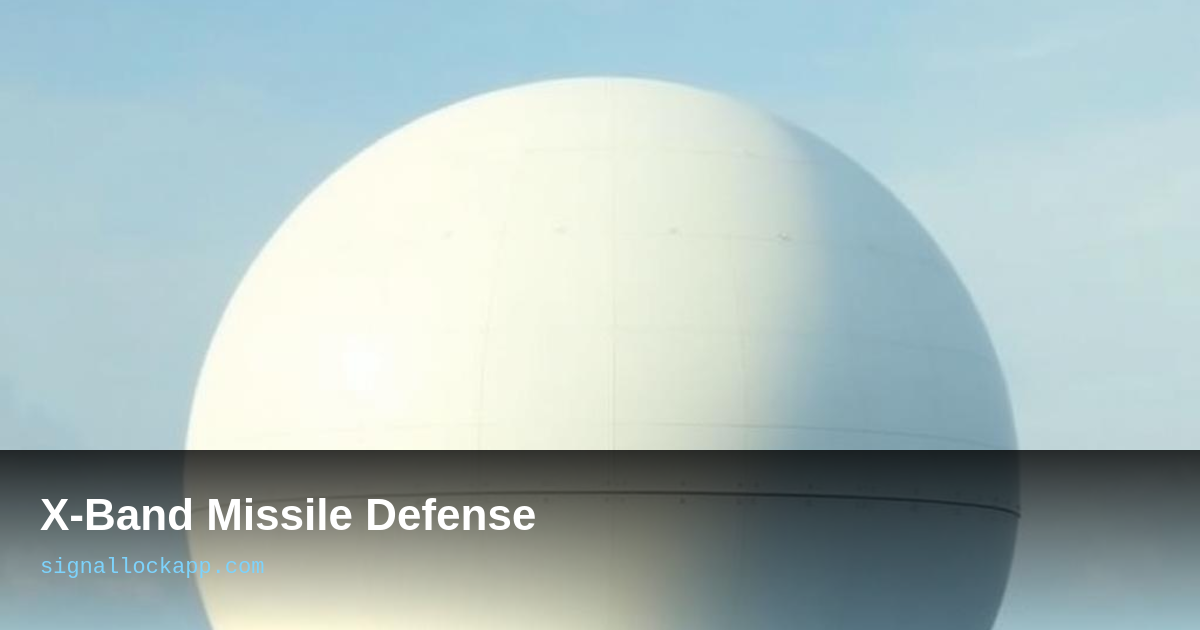
Terminal mode: the radar that THAAD batteries use to guide interceptors in the final phase. Forward-based mode: pointed up and out, watching for missile launches over the horizon, cueing other systems. Same hardware, different software, different tilt.
The numbers
X-band (8–10 GHz). Estimated detection range against a baseball-sized RCS: 1,000+ km. Against a missile booster: 4,000+ km. The radar can resolve a warhead from its decoys — the holy grail of missile defence.
Where they live
Japan (Shariki, Kyogamisaki), South Korea (Seongju with THAAD), Israel, Turkey (Kürecik), Qatar, UAE. Each panel costs about $1 B. Each is a strategic asset whose siting decisions make the news.
Limits
A truck-mounted radar with a single panel only sees one direction. You need several to cover an arc. Atmospheric ducting and ionospheric storms degrade it. And once a warhead reaches terminal phase, you have 30 seconds before impact.
Discrimination and the X-Band advantage
The primary reason for selecting the X-band frequency (8 to 12 GHz) over lower frequencies like L or S-band is the resolution required for target discrimination. While S-band radars excel at broad-area surveillance due to lower atmospheric attenuation, their longer wavelengths often see a missile and its associated debris cloud as a single, blurred return. The AN/TPY-2 utilizes its short wavelength to perform high-resolution imaging, allowing the system to distinguish the actual lethal reentry vehicle from discarded booster stages, separation debris, and intentional penetration aids like inflatable decoys.
To achieve this, the radar employs sophisticated signal processing algorithms that analyze the micro-Doppler signatures of the targets. Every object in space has a unique 'wobble' or precession based on its mass and shape. Because the AN/TPY-2 can detect these minute variations in motion, it provides the fire control system with the data needed to ignore harmless junk and focus interceptors on the high-threat warhead. This capability is what transforms a simple detection sensor into a critical component of the mid-course and terminal defense phases.
The GaN revolution
Modern iterations of the AN/TPY-2 are transitioning from older Gallium Arsenide (GaAs) semiconductors to Gallium Nitride (GaN) technology for their transmit/receive modules. This technical shift significantly increases the power density and thermal efficiency of the 9.2-square-meter antenna array. GaN allows the radar to operate at higher voltages with less heat generation, effectively extending the detection range and increasing the sensitivity without expanding the physical footprint of the mobile trailer. This upgrade is essential as ballistic threats become faster and more maneuverable.
The logistical footprint of the system remains substantial despite its mobility. A single AN/TPY-2 battery requires a dedicated Prime Power Unit (PPU), an Electronic Equipment Unit (EEU), and a cooling system to dissipate the heat generated by the thousands of active elements. Historically, the first deployment to Japan in 2006 at Shariki Communications Site proved that the system could be airlifted via C-17 and operational within hours, establishing the 'Forward-Based' precedent that defines current US Pacific and European defensive postures.
Interfacing the BMDS
The AN/TPY-2 does not operate in a vacuum; it is the sensory cornerstone of the Ballistic Missile Defense System (BMDS). Using Link 16 and Integrated Fire Control (IFC) protocols, the radar feeds high-fidelity tracks to the Command, Control, Battle Management, and Communications (C2BMC) network. This connectivity allows a radar stationed in Turkey to provide precise 'cueing' data to an Aegis destroyer in the Mediterranean or a GMD silo in Alaska. By offloading the initial search requirement from interceptor-linked radars, the TPY-2 allows those systems to remain in 'sleep' mode or focus exclusively on engagement, significantly reducing the adversary's ability to map out the defensive sensor grid through electronic signals intelligence.
The data rate is the critical differentiator here. Because X-band operates at higher frequencies than the S-band found on Aegis ships, the TPY-2 provides much higher resolution, which is essential for discriminating between the Reentry Vehicle (RV) and the 'threat complex' of debris, booster fragments, and intentional decoys. When the radar is in Forward-Based Mode, it transmits 'fire-quality' data—information precise enough that an interceptor can be launched before the interceptor's own organic radar has even acquired the target. This 'launch-on-remote' capability effectively doubles the protected footprint of existing missile batteries by buying back precious seconds of flight time that would otherwise be lost to sensor acquisition delays.
The Cooling and Power Challenge
Managing the thermal output of over 60,000 Gallium Nitride (GaN) or Gallium Arsenide (GaAs) modules requires an industrial-scale infrastructure that belies the system's 'mobile' designation. Each radar unit is supported by a Prime Power Unit (PPU) and an Electronic Equipment Unit (EEU) that houses the signal processors. The cooling system must dissipate massive amounts of waste heat to prevent frequency drift and hardware degradation during high-duty-cycle operations. This is achieved through a closed-loop liquid cooling system that circulates coolant directly behind the antenna face. In extreme environments like the Negev Desert or the Qatari sands, the logistics of maintaining a constant 1.1-megawatt power supply and thermal stability are as complex as the radar's code.
A common misconception is that the radar panel itself is the entire system. In reality, a standard deployment requires five heavy-duty trailers and a dedicated security perimeter. The mobility feature is designed for strategic repositioning via C-17 aircraft rather than tactical 'shoot-and-scoot' maneuvers. Once emplaced, the system requires a specialized Heavy Expanded Mobility Tactical Truck (HEMTT) to move the 9-meter antenna. The power requirements are so steep that the PPU alone consumes hundreds of gallons of fuel per day when not connected to a local grid. This massive energy throughput is the price paid for the 'narrow beam' precision that allows the TPY-2 to track objects moving at Mach 15 with centimeter-level accuracy.