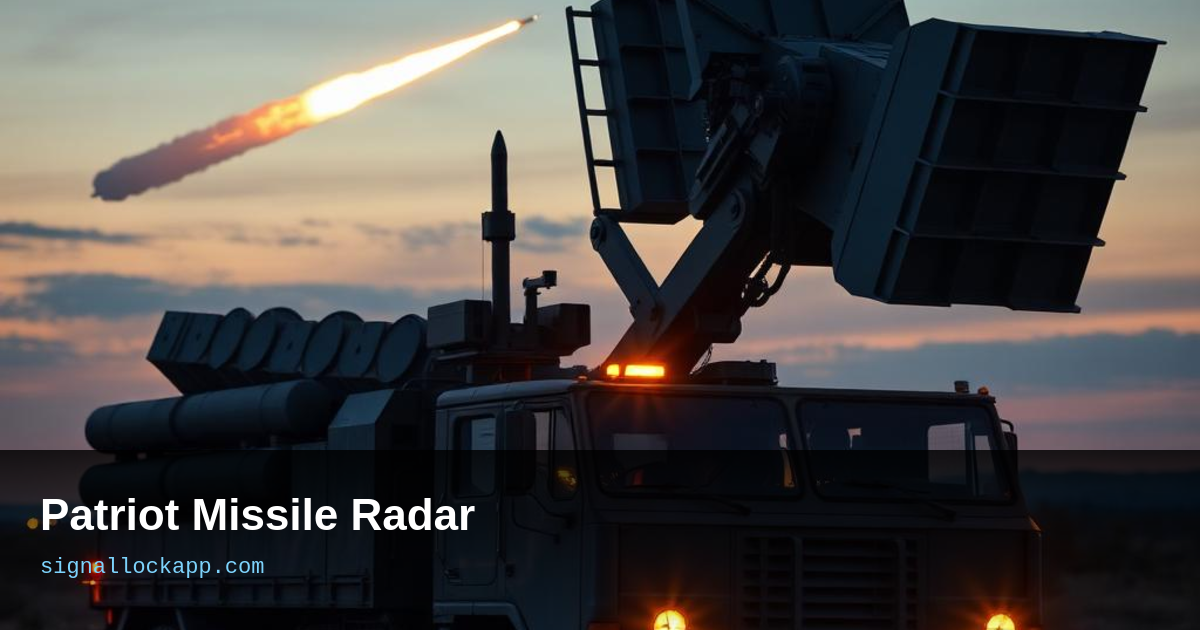
The AN/MPQ-65 radar
A C-band phased array on a trailer, 5,000+ elements, beam-steering in microseconds. Search, track and missile-guidance commands all share the same antenna. Range against fighter-sized targets is 100+ km; against ballistic missiles, less.
TVM guidance
Track-Via-Missile: the missile has a seeker but no autopilot brain. It relays what it sees to the ground radar, which computes corrections and uplinks them. PAC-3 added hit-to-kill — no warhead, just kinetic energy.
Combat record
1991: PAC-2 vs. Scud — disputed; original 96% kill claim later revised down to under 50%. 2003: friendly-fire incidents shooting down a Tornado and an F/A-18. 2014–2023: Saudi PAC-3s vs. Houthi missiles — mixed. 2022+: Ukrainian PAC-3 intercepts of Russian Kinzhal and ballistic missiles — strong public record.
Why it's hard
A ballistic missile re-enters at Mach 5+. The radar has seconds. Decoys, manoeuvring warheads, GPS-jammed engagements — every intercept is a near-miracle of timing. Patriot is good; it isn't magic.
The Sectoral Limitation
A common technical critique of the Patriot system is its fixed-azimuth radar architecture. Unlike systems like the S-300 or S-400 that utilize rotating masts for 360-degree coverage, the AN/MPQ-65 is a stationary phased array that monitors a 120-degree sector. This design choice reflects its Cold War origins, where it was intended to face a clear front line in Europe. To achieve all-around protection, a battery must be carefully positioned to face the most likely threat axis, or multiple sets must be networked together. This requires a level of tactical foresight that makes 'pop-up' threats from flanking directions difficult to engage without external sensor data.
The limitation is currently being addressed via the Lower Tier Air and Missile Defense Sensor (LTAMDS). This next-generation replacement for the MPQ-65 utilizes Gallium Nitride (GaN) technology and adds two smaller side-facing arrays to eliminate the sector-scan blind spots. GaN technology provides significantly higher power density and thermal efficiency than the older Gallium Arsenide components, allowing the radar to detect smaller, faster targets at twice the distance of the legacy hardware. This upgrade transforms the Patriot from a traditional front-facing shield into a modern, omnidirectional integrated air defense asset capable of tracking hypersonic cruise missiles.
The Software Clock Anomaly of 1991
One of the most significant technical failures in the Patriot's history occurred on February 25, 1991, in Dhahran, Saudi Arabia. An Iraqi Scud missile struck a US Army barracks, killing 28 soldiers. Investigation revealed a floating-point calculation error in the radar's internal clock software. The system had been running for 100 consecutive hours; the small timing drift—approximately 0.34 seconds—translated into a tracking error of over 600 meters. Because the radar looked for the incoming missile in the wrong segment of the sky based on its predicted velocity, the interceptor never launched. This disaster highlighted the extreme precision required for terminal ballistic missile defense.
The patch was actually in transit when the strike occurred, illustrating the lag between identifying a digital bug and deploying a physical fix in a combat zone. Modern PAC-3 systems utilize much more robust timing architectures to prevent such drift, but the Dhahran incident remains a foundational case study in military software engineering. It proved that defense hardware is only as capable as its most minute line of code. Today, the system undergoes rigorous 'hardware-in-the-loop' testing to ensure that cumulative errors in signal processing do not degrade the accuracy of the track-via-missile or hit-to-kill engagement sequences.
The Integrated Air and Missile Defense (IAMD) transition
Modern Patriot batteries are evolving from stand-alone systems into nodes within the Integrated Battle Command System (IBCS). Historically, a Patriot battery was confined to its own organic AN/MPQ-65 sensor, creating a 'stovepipe' architecture where the radar and the engagement control station were inseparable. The move toward IAMD allows the system to engage targets using data from external sensors, such as the Sentinel radar or even F-35 fighter jets, via the Integrated Fire Control Network (IFCN). This transition effectively decouples the shooter from the sensor, mitigating the sectoral limitations of the fixed-panel radar by utilizing a distributed network of eyes across the battlespace.
This architectural shift also addresses the high-value target profile of the Patriot radar itself. In traditional operations, the radar's constant emission makes it a magnet for Anti-Radiation Missiles (ARMs) like the Kh-31. By integrating with the IBCS, the battery can remain 'silent' while receiving telemetry from remote nodes, only activating its own C-band array at the terminal phase of an intercept. This reduces the electronic signature and increases the survivability of the expensive hardware. The technical goal is to transform Patriot from a singular defensive battery into a modular component of a much larger, multi-domain sensor mesh.
The transition from Gallium Arsenide to Gallium Nitride
The technological leap from the AN/MPQ-65 to the newer LTAMDS (Lower Tier Air and Missile Defense Sensor) marks a shift from Gallium Arsenide (GaAs) to Gallium Nitride (GaN) semiconductors. GaN technology allows for significantly higher power density and better thermal efficiency. In practical terms, this means the radar can transmit more energy into the atmosphere without overheating, extending detection ranges against low-RCS (Radar Cross Section) targets like stealth aircraft or cruise missiles. While the legacy Patriot radar moved its beam electronically, it was still physically fixed in one direction; the new GaN-based arrays offer a 360-degree sensing capability through a primary forward array and two smaller rear panels.
Increased sensitivity also improves the system's ability to discriminate between actual threats and clutter or decoys. In the 1991 Gulf War, the system frequently struggled with 'ghost' targets caused by atmospheric conditions or debris from disintegrating Scuds. The transition to GaN-based Active Electronically Scanned Arrays (AESA) provides the processing bandwidth to filter these anomalies in real-time. This upgrade is not merely incremental; it changes the mission profile from a point-defense system to a wide-area surveillance asset, capable of tracking high-velocity ballistic threats and maneuvering hypersonic glide vehicles across a much larger volume of defended airspace.