If you grew up tapping trackballs at missile command and you've been hunting an online version that doesn't open into a popup ad, this is it. Signal//Lock is free, opens in any browser, and starts a run the moment the dish loads. No login, no install, no shop.
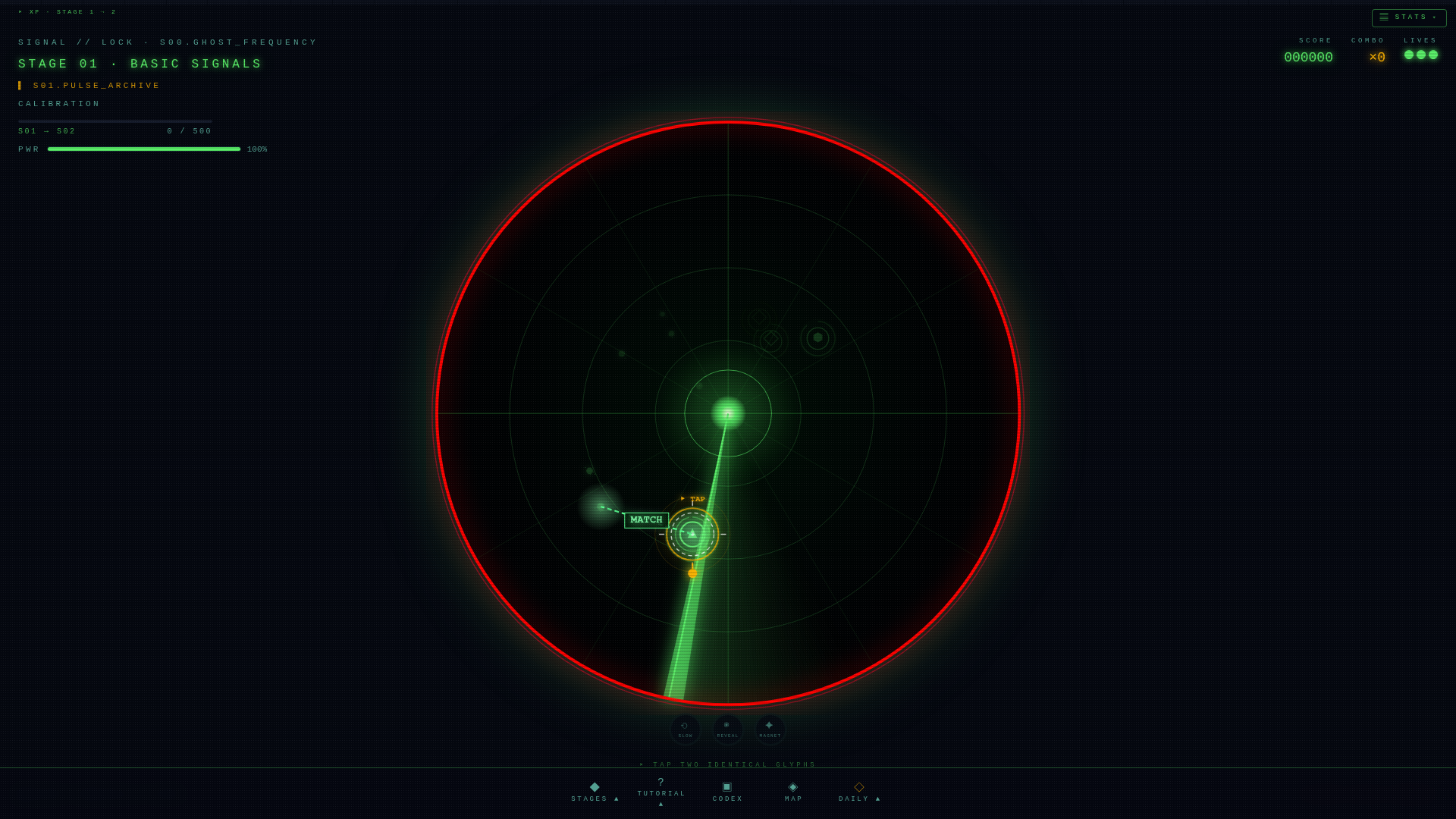
What carries over from the original
- Defense, not offense. You don't fly anything. You read incoming signals and intercept them before they break through.
- A meter you can lose. The Atari version killed your cities. Signal//Lock raises a phase-saturation meter — let it hit 100% and the dish overloads, same outcome.
- Wave structure. Stages get faster and denser, rule sets shift mid-run, the difficulty curve is the game.
What's different
- A real sweep. Information arrives in waves as the line passes over each contact. You can't see everything at once — you have to anticipate.
- Matched-pair locks. Targets come in colored pairs; locking three of one color in a row triggers a salvo flash that purges the dish.
- Nine rule sets, not three. Vector overflow stacks persistent lines, parachute mode adds wind drift, classified intercepts flip the radar 180°. The dish stays — the rules don't.
How to play (60-second version)
- Open the radar. Sweep starts immediately.
- Tap or click matched pairs as the sweep reveals them. Don't lock everything — lines persist on harder stages.
- Chain three same-color locks for a salvo flash. The flash drops the saturation meter.
- At 85%+ saturation, hunt color streaks only. One purge resets the bar.
Free, no install, works on mobile
Signal//Lock runs in any modern browser — phone, tablet, laptop. Touch and mouse both feel native. A typical run is two to five minutes, designed for the gap between meetings rather than a thirty-minute commitment.
Start a run
Open the radar — go straight into a stage. Or read the full mechanics guide first.
Related pages
- What makes it a radar game — the design rationale.
- All nine stages — every rule set on one page.
- Vector overflow strategy — the densest stage in the game.
The Missile Command lineage
Atari's Missile Command shipped in 1980, designed by Dave Theurer in response to the political anxiety of the early Cold War period. The cabinet's trackball control, six cities to defend, and three missile batteries created a defensive-only loop unusual for arcade games of the era — most cabinets rewarded aggression, and Missile Command rewarded triage. The game became famous for ending with the word THE END rather than GAME OVER, a design choice that quietly committed to the fiction's stakes.
The mechanical descendants of Missile Command — Atomic Bomberman's defensive variants, Plants vs. Zombies' lane defense, the entire tower-defense genre — all inherit the triage problem: more threats than you can address, ranked by consequence rather than reflex. Signal//Lock's salvo system is in that lineage. Charging a salvo locks multiple targets at once; ranking which targets to include is the same cognitive task a Missile Command operator solved with the trackball.
What Signal//Lock keeps and what it changes
Kept: the radar-style display, the triage problem, the defensive-only framing (you never attack, you only defend the dish), the slow tonal soundtrack that escalates with stage intensity, and the cold ending — saturation overload doesn't say GAME OVER, it shows the dish frequency dropping to zero. Changed: cities become a single saturation meter, the trackball becomes a point-and-click commit, missiles become locks resolved by the dish rather than ballistic arcs, and the stage rotation moves the ruleset around every few minutes rather than holding a single ruleset across the whole game.
How a modern web build improves on the cabinet
The original cabinet had a fixed 19-inch CRT and a single input device; ergonomics depended on the cabinet being level and the trackball being clean. A browser build can adapt to any screen, accept touch or pointer or keyboard, and persist state across sessions. The trade-off is the loss of the CRT's natural phosphor persistence and the cabinet's acoustic profile. Signal//Lock emulates both — a scanline shader for persistence, a procedural audio engine for the cabinet sound — but neither is the real thing. If you ever get the chance to play a working Missile Command cabinet, do.
Frequently asked
- Is this a Missile Command clone?
- No. Signal//Lock is a different game with a different core loop. The Missile Command comparison is about lineage — the triage problem and the defensive-only framing — not about mechanics.
- Can I play the original Missile Command online?
- Atari has published official browser ports of several classic titles. Signal//Lock is not affiliated with Atari and doesn't host the original game.
- Is there a trackball mode?
- No. Pointer, touch, and keyboard cursor are the supported inputs. A trackball would still work because the browser treats it as a pointer.
- Does Signal//Lock have an ending?
- Completing all nine stages displays a frequency-zero screen — the dish's equivalent of THE END. Runs are repeatable; there's no save-game lock-out.
The trackball that made Missile Command unique
The 1980 Missile Command cabinet shipped with a 4.5-inch Happ Controls trackball — a control device most arcade-goers had never used. Trackball input is analog and direction-agnostic; unlike a joystick it has no neutral position and no notched directions, which let the player aim with sub-pixel precision and rotate smoothly through 360°. Dave Theurer specifically requested the trackball because no joystick could give defensive aiming the precision the design needed. The trackball aged into the canonical Missile Command control method and is the single biggest reason home ports of the game (Atari 2600, Atari 5200) felt diminished — they shipped with joysticks and the precision was gone.
The Theurer trilogy
Dave Theurer designed three Atari cabinets in succession that shaped arcade history: Missile Command (1980, defensive aiming), Tempest (1981, vector wireframe shooter on a spinning playfield), and I, Robot (1984, the first commercial 3D shaded-polygon arcade game). All three rejected the prevailing arcade design template — Theurer favoured stark visual languages, anxiety-laden pacing, and non-standard input devices. The lineage from Missile Command's trackball aim through Tempest's spinner-driven rim defence to Signal//Lock's commit-and-resolve loop is direct.
What Missile Command got right about its era
Missile Command shipped in 1980, four years before The Day After aired on US television and at the height of the late-Cold-War nuclear-anxiety period. The game's defensive-only framing, its city-by-city loss state, and its THE ENDscreen instead of GAME OVER read as deliberate commentary; Theurer has said in interviews that he developed chronic nightmares during production. The cabinet was a political object in a way few arcade games before or since have managed. Signal//Lock's defensive-only framing is a quieter descendant of the same impulse.