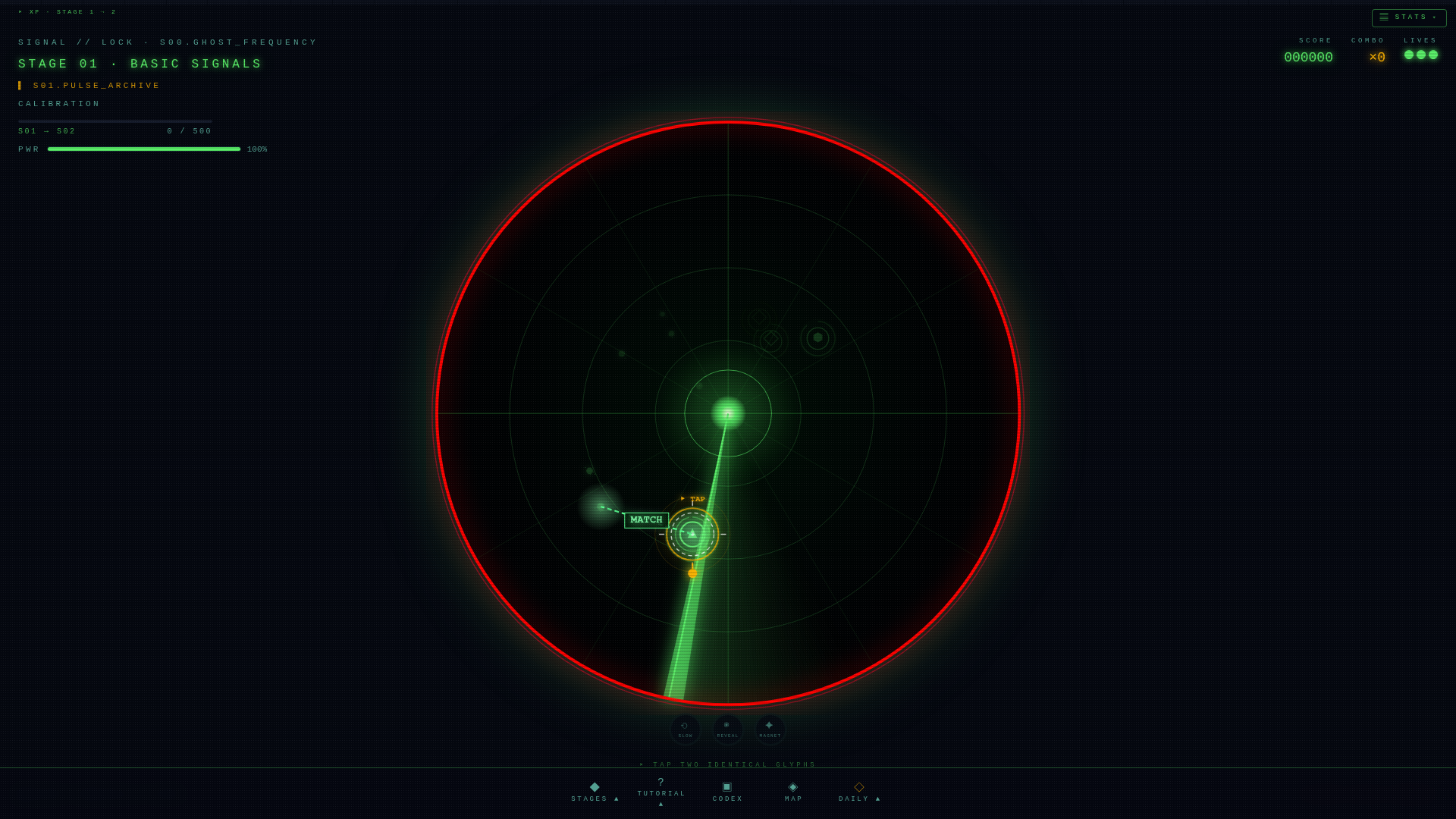
Open the page, plug in headphones, and the sweep starts. Contacts ping when the line passes over them; matched pairs answer with a different chord. Miss too many and the hum rises until the dish overloads. The visual radar is real, but you can play long stretches on audio alone.
What makes it a sonar game
- Positional pings. Each contact's tone is panned and pitched by its position on the dish. You learn where things are without looking straight at them.
- Sweep-gated information. Like real sonar, you only get a return when the line passes the contact. Between sweeps, you're guessing.
- A saturation drone. The longer you let signals decay, the louder the orbital hum gets. Audio is the warning system.
- Lock-on chirps. A correct match plays a two-tone uplink ping. Wrong-order penalties play a deeper, slower tone — you hear your mistakes.
Headphones strongly recommended
Laptop speakers work, but most of the audio design lives in stereo width and low-end body. On phone speakers you'll lose the saturation drone and the positional cues. Anything with a real left and right channel restores the full game.
Free, no signup, browser-only
Nothing to download, no account to create, no ads between rounds. Open the tab, the dish loads, the sweep starts. A run takes two to five minutes; nine stages keep the rule set rotating.
Start a run
Open the radar — straight into a stage. Or read the full mechanics guide for what every overlay means.
Related pages
Sonar vs radar: the same loop, a different medium
Sonar and radar share the same essential loop — emit a pulse, wait for the echo, plot the bearing and range — but they differ in one critical way that shapes any game built on them: sound is slow. Light-speed radar pulses return in microseconds; sound in seawater travels at about 1,500 m/s, so a single ping cycle for a target 10 km out takes over 13 seconds round-trip. Real sonar operators wait. They listen. They make decisions on stale information. A sonar-style game that respects this lives or dies on how it handles the wait.
Signal//Lock's sonar-adjacent stages collapse the real wait into a playable sweep period while preserving the consequence: you commit to a lock based on a stale ping, the contact may have drifted in the interval, and the salvo resolves with the contact's predicted position, not its current one. That single mechanic — committing to stale data — is the most authentic thing a browser sonar game can do.
Active ping, passive listen, false return
Real sonar splits into two modes. Active sonar emits a ping and reads the echo — accurate but gives away your position to anything listening. Passive sonar listens for noise the target itself makes — invisible to the target but only works if the target is loud. The third element, false returns, comes from biologics (whales, shrimp), thermoclines (layers of water that bend sound), and the seabed itself. Operators spend years learning to dismiss them.
Signal//Lock encodes all three. Active locks are loud — they raise saturation faster but resolve instantly. Passive locks are slow but leave the saturation untouched. False returns appear as decoy contacts that look identical to real ones until the moment of commit; locking on a decoy costs a salvo charge. The stage rotation moves between the three so no run leans on one technique.
Why headphones change the game
Signal//Lock's audio engine plays positional tones around a stereo field that maps to the dish. A contact at the 3 o'clock position plays in the right channel; a contact at 9 o'clock plays left. On headphones this is immediately useful — you can hear a contact before you see it, and experienced players begin to track multiple contacts by ear during the dead time between sweeps. On laptop speakers the spatial information collapses to mono and the game becomes purely visual. It still works; it's just a different game.
Frequently asked
- Is Signal//Lock a submarine game?
- It isn't a vessel sim — there's no hull, no crew, no torpedo physics. It's a sonar-operator game: you sit at the display, contacts appear, you decide what to lock. The genre is closer to Hunt for Red October's sonar cabin than to Silent Hunter's bridge.
- Are the contacts ships, subs, or something else?
- The fiction is deliberately abstract. Contacts are 'signals' — they could be vessels, biologics, debris, or pure phantoms. The game is about reading the display, not identifying the source.
- Can I play without sound?
- Yes. Every audio cue has a visual equivalent. The game is fully playable muted, but you'll miss the positional information that makes dense stages easier.
- What's the difference between sonar mode and radar mode?
- Mechanically the sweep is similar; the audio is different (low pings vs. high sweeps), the false-return rate is higher in sonar stages, and salvo resolution accounts for drift in sonar but not in radar.
The thermocline problem
Real ocean sonar has a physical enemy: the thermocline, a layer of water where temperature drops sharply with depth. Sound waves bend (refract) as they cross the boundary, creating a shadow zone where contacts can hide. Cold War submarine doctrine explicitly used thermoclines as tactical cover — running below the layer made you nearly invisible to surface sonar above it, and vice versa. The 1981 USS Nautilus collision with the JDS Nadashio was, in part, a thermocline-shadow incident.
Signal//Lock's sonar-flavoured stages encode this as periodic "shadow arcs" — wedges of the dish where contacts briefly disappear before re-emerging. The shadow arc is silent in the audio engine too: contacts inside it don't ping. Operators learn to anticipate contact re-emergence by extrapolating from the last known bearing and the typical drift rate, the same skill real sonar operators develop.
Why sonar games are rare
The genre is small. Silent Hunter (1996, Strategic Simulations), Sub Command (2001, Sonalysts), Dangerous Waters (2005, the spiritual successor), Cold Waters (2017, Killerfish) — these and a handful of smaller titles are most of the modern sonar-sim canon. The difficulty is structural: sonar's interesting decisions happen on time scales (minutes to hours) that don't translate naturally to game pacing, and the visual surface (a waterfall display, a bearing plot) is alien to most players. Signal//Lock takes the opposite path — radar pacing, dish visual, but sonar's commit-on-stale-data ethic — and ends up in a niche of one.
Hydrophone arrays in the wild
The world's biggest hydrophone array isn't on a submarine — it's the SOund SUrveillance System (SOSUS), a network of seabed microphones laid by the US Navy across the North Atlantic and North Pacific from 1954 onwards. SOSUS could track Soviet submarine transits at thousands of kilometres. It's now partially declassified and partially repurposed for marine biology — the same arrays that listened for nuclear submarines now track blue whale migrations. The radar-vs-sonar lineage in Signal//Lock acknowledges this dual-use history.