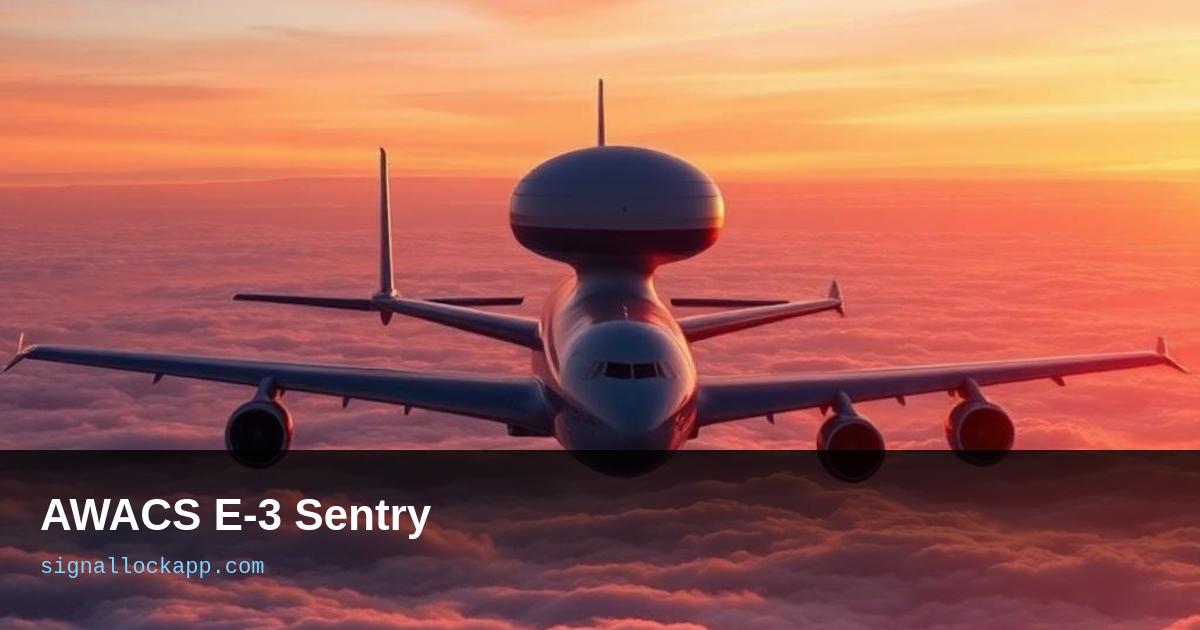
The rotating dome
The E-3's most visible feature is the 9-metre radome sitting atop the fuselage like a flying saucer. Inside, the AN/APY-1/2 pulse-Doppler radar rotates at 6 rpm, looking down through the earth's surface clutter to pick up aircraft flying below. It can track 600+ targets and guide friendly interceptors to them.
Look-down, shoot-down
Before AWACS, an interceptor had to climb above its target to see it on radar — otherwise ground clutter blinded the seeker. AWACS looks down from above, filtering out terrain returns with pulse-Doppler processing. Now fighters can shoot at targets below them, changing air combat doctrine forever.
NATO's eye in the sky
The NATO E-3A Component at Geilenkirchen, Germany, has been flying since 1982. Saudi Arabia, France, the UK and the US all operate variants. In every major NATO operation from Desert Storm to Baltic air policing, AWACS has been the command and control backbone.
Replacing the platform
The E-3 fleet is aging. The US is moving to the E-7 Wedgetail, based on the 737, with a fixed AESA array instead of a rotating dome. The UK and Australia already fly Wedgetail. The mission — airborne battlespace management — remains the same; only the hardware evolves.
The Pulse-Doppler mechanism
The primary challenge for an airborne radar is the 'ground return'—the massive reflection from the Earth's surface that masks low-flying targets. The E-3 Sentry overcomes this through Pulse-Doppler processing, which exploits the frequency shift of moving objects. By comparing the phase of reflected signals against a stable local oscillator, the radar identifies velocity changes. This allows the system to ignore the static ground while tracking a fighter jet maneuvering against the landscape. The AN/APY-2 variant further refined this with its Maritime Surveillance Mode, utilizing very short pulses to detect surface vessels even in high sea states, effectively extending its mastery from the sky down to the ocean surface.
To manage this data, the aircraft acts as a flying data center rather than just a sensor platform. Early versions used the IBM 4PI CC-1 computer, capable of 740,000 operations per second—a staggering figure for the 1970s. Modernized airframes now utilize high-speed internal local area networks and satellite links to distribute the 'Common Relevant Operational Picture' to ground stations and ships. This integration means the Sentry is not just watching; it is calculating intercept vectors, fuel status, and weapon loads for dozens of friendly assets simultaneously, functioning as a distributed node in a wide-area network of sensors and shooters.
The transition to Electronic Support Measures
While the rotating radome defines the Sentry's profile, its passive capabilities are just as critical. In the 1990s, the Passive Detection System (PDS) was integrated, allowing the E-3 to track enemy radar emitters without transmitting its own signals. This Electronic Support Measures suite can identify the specific type of an enemy surface-to-air missile site or an incoming fighter by its 'electronic fingerprint' from hundreds of kilometers away. By triangulating these signals, the crew can build a comprehensive Electronic Order of Battle without alerting the enemy to their presence, providing a strategic advantage in stealth-dependent environments.
This evolution transformed the E-3 from a simple radar picket into a signals intelligence powerhouse. During long-duration missions, which can exceed 18 hours with aerial refueling, the mission crew of up to 19 specialists analyzes thousands of signals. This includes identifying non-cooperative targets that are deliberately keeping their own active radars turned off to avoid detection. The synergy between active pulse-Doppler scanning and passive SIGINT ensures the AWACS remains the primary coordinator for Suppression of Enemy Air Defenses (SEAD) missions, marking the critical targets for strike aircraft to neutralize before a corridor is opened in contested airspace.
The challenge of sea surveillance
While air tracking is the E-3's primary role, the AN/APY-2 variant introduced significant enhancements for maritime operations. Surface vessels present a different radar cross-section challenge compared to aircraft, often obscured by sea state clutter and waves. The 'Maritime Mode' utilizes a shorter pulse width and a different pulse repetition frequency to distinguish slow-moving ships from the surrounding ocean surface. This capability allows the Sentry to coordinate naval strikes and monitor shipping lanes across thousands of square miles of open water, effectively bridging the gap between carrier-based assets and land-based command centers.
Early iterations of the radar struggled with the backscatter from whitecaps and heavy swells, but the transition to the APY-2 integrated a dedicated Beyond-the-Horizon (BTH) mode. This mode bypasses the Doppler filters used for high-speed aircraft to detect the larger, slower signatures of maritime vessels. By integrating this sea-surface data with the E-3’s existing air picture, operators gain a holistic view of the theater, allowing for the simultaneous management of both air superiority and maritime interdiction missions in complex coastal or blue-water environments.
Passive detection and the ESM mission
Modern AWACS operations rely as much on what they hear as what they see. The inclusion of Electronic Support Measures (ESM) hardware, specifically the AN/AYR-1 system housed in the distinctive cheek fairings, allows the Sentry to function as a massive passive sensor. These sensors detect and identify electromagnetic emissions from enemy radar installations and communication nodes without the E-3 ever having to emit its own radar pulses. This 'silent' detection provides the crew with the identity and location of hostile air defense systems while maintaining a lower electronic profile.
This integration of passive and active sensing corrects a common misconception: that the AWACS is always a loud beacon for enemy missiles. By cross-referencing passive ESM hits with active radar returns, the E-3 can confirm identity via IFF (Identification Friend or Foe) and electronic signatures. This multi-spectral approach ensures that the command staff has a verified Electronic Order of Battle (EOB), identifying not just that a target is present, but exactly what type of aircraft or surface-to-air missile battery it represents before a single shot is fired.