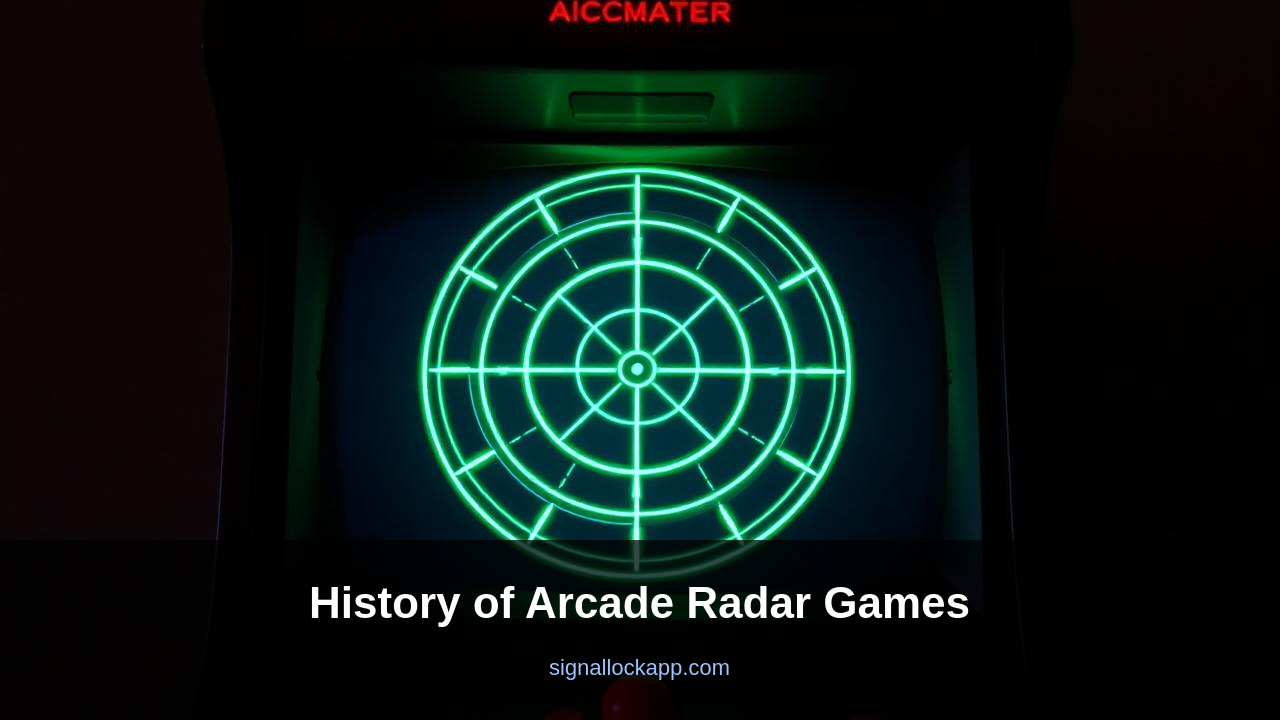
Before radar games — vector arcade origins (1977–1980)
Atari's Lunar Lander (1979) and Asteroids (1979) used vector monitors instead of raster. The phosphor glow of a vector beam was the same green-on-black aesthetic as a military radar. When designer Dave Theurer started prototyping a missile-defence game in 1980, he reached for that same look — and Missile Command was born.
Missile Command (1980) — the first radar game
Players defended six cities from a rain of ICBMs using three anti-missile batteries. The trackball gave precise targeting. The countdown clocks, the city-by-city loss, and the famous final 'THE END' instead of 'GAME OVER' made it feel like an unwinnable Cold War simulation — because it was. Theurer reportedly had nightmares while developing it.
Tempest, Star Wars, Battlezone (1981–1983)
Atari's vector hardware enabled a wave of radar-adjacent games: Tempest (1981), Star Wars: The Arcade Game (1983, with its famous 'Stay on target' targeting reticle), and Battlezone (1980) — the latter actually used by the US Army as a tank gunner trainer.
The 90s pause and the browser revival
Vector hardware died in the mid-80s as raster graphics improved. Radar games migrated into sub-modes inside larger titles — the minimap in Doom, the radar HUD in Command & Conquer. The genre only returned as a primary mechanic in the 2010s, first in mobile (Missile Command remakes) and then in HTML5 browser titles. Signal//Lock is part of that revival — pure radar play, no install, modern feel, ancient aesthetic.
The PPI Transition and Hardware Innovations
While Missile Command used a standard CRT, the 1980s saw engineers attempting to replicate the Plan Position Indicator (PPI) sweep seen on naval ships. The most notable technical achievement was the incorporation of the radial sweep, where a beam rotates 360 degrees around a center point to reveal targets. Sega's Subroc-3D (1982) utilized a unique periscope display system to simulate this depth and sonar-radar hybrid interface. Engineers had to innovate within the memory constraints of early 8-bit processors, often using look-up tables for sine and cosine values to calculate coordinate positions on a circular grid without overtaxing the central processing unit.
This era also popularized the 'blip' psychology, where a target's position is only updated once per revolution of the sweep. This mechanic introduced a distinct tension different from the real-time movement of Asteroids. By forcing the player to predict an enemy's trajectory based on a fading phosphor trail, developers like those at Namco and Taito mimicked the cognitive load of actual radar operators. These early technical limitations eventually became intentional design pillars, defining the 'scan-line' wait time that still characterizes radar-simulation subgenres in modern indie titles today.
The Rise of Specialized Radar Peripherals
As the 1980s progressed, the hardware evolved from simple buttons to dedicated consoles that mimicked military command centers. The 1982 game Star Trek by Sega featured a 'Galactic Chart' which functioned as a secondary long-range radar display. This required a dual-logic approach: one for the tactical immediate view and another for the strategic radar sweep. This separation of concerns mirrored real-world Electronic Warfare (EW) stations, where operators separate detection from engagement. These consoles were often housed in massive 'cockpit' cabinets to enhance the immersion of operating a high-stakes sensor suite.
In terms of numbers, the resolution of these radar displays was remarkably low by modern standards, typically 256x240 pixels. However, the use of high-persistence phosphors in vector monitors allowed for the 'trace' effect—a slow-fading line that indicated the history of a target's movement. This was not a software trick but a physical property of the CRT glass. Modern browser-based radar games like Signal//Lock simulate this persistence through alpha-blending and particle decay, honoring the specific analog behavior of the hardware that defined the genre’s golden age.
The Shift from Vector to Raster-Based Radar Simulation
While early titles like Battlezone relied on vector X-Y monitors to draw crisp, glowing lines, the transition to raster hardware in the mid-1980s fundamentally changed how radar was represented. In raster systems, developers had to simulate the 'sweep' of a Plan Position Indicator (PPI) using scanline manipulation and memory-heavy sprite rotation. Namco's Rally-X (1980) was among the first to include a persistent 'mini-map' radar on a raster screen, a technical feat that required dedicated hardware layers to render the player's position relative to the maze without taxing the primary CPU. This separation of UI elements laid the groundwork for the modern Heads-Up Display (HUD) seen in flight simulators.
By 1982, Williams Electronics' Sinistar introduced a more sophisticated radar implementation. Unlike the static borders of Missile Command, Sinistar used a long-range tracking system to alert players of enemies outside the immediate viewport. This necessitated a coordinate-based system that mapped 2D game space to a condensed circular UI. The hardware required a custom 'blitter' chip to handle the rapid redrawing of these radar blips. This evolution marked the point where radar ceased to be just a visual aesthetic and became a critical mechanical tool for spatial awareness, forcing players to divide their attention between the central action and the peripheral sensor data.
Signal Accuracy and the Influence of the Doppler Effect
In the late 1980s and early 90s, arcade flight simulators began moving beyond visual approximations toward physical signal accuracy. Sega’s After Burner (1987) and later air-combat cabinets integrated 'Lock-On' mechanics that simulated the pulse-Doppler radar logic used in actual F-14 Tomcats. When a player centered an enemy, the game logic didn't just check for a collision box; it simulated a tracking delay similar to how a real radar dish requires time to achieve a steady frequency return. This introduced a level of technical realism where the 'ping' rate of the radar directly influenced the player's missile-firing window, mirroring the real-world frustration of electronic countermeasures (ECM).
Modern browser-based titles like Signal//Lock revisit these concepts by focusing on the raw physics of wave propagation rather than just the combat. These games often simulate beam attenuation and noise-floor interference, requiring players to distinguish between true signals and ghost returns. This is achieved through Canvas API and WebGL shaders that mimic the phosphor persistence of 1940s oscilloscopes. By bringing the technical limitations of 20th-century hardware into the browser environment, these titles emphasize that the 'radar game' is less about high-speed reflexes and more about the methodical interpretation of data—a direct lineage to the quiet, high-stakes environments of Cold War sonar and radar rooms.