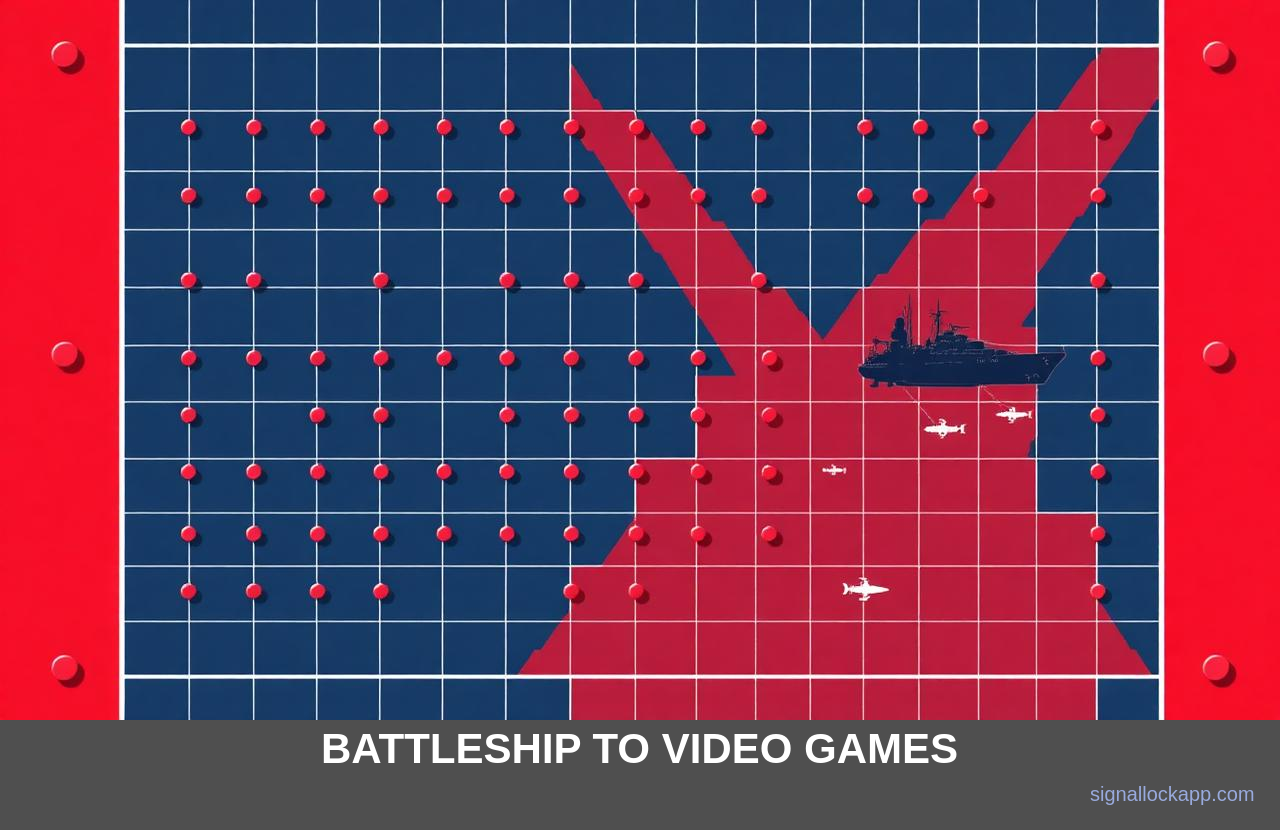
1931 — The original Battleship
Milton Bradley published it as a paper-and-pencil game; the plastic peg version arrived in 1967. Two coordinate grids, hidden ships, one shot per turn. Pure deduction with imperfect information — the same mental model a WW2 radar operator used a decade later.
1989 — Minesweeper
Microsoft bundled it with Windows 3.1 partly to teach users mouse control. The grid stayed, the hidden enemies stayed, and the deduction loop stayed — just with arithmetic instead of opponent guessing.
2007 — Picross / 2010s — Sudoku boom
Same DNA, different rules. The mobile era turned grid logic into a daily habit for hundreds of millions of players who'd never call themselves gamers.
2021 — Wordle and the daily ritual
Wordle stripped the grid down to one row of five cells but kept everything else: hidden answer, one guess per turn, deductive feedback. Its 300,000-to-2-million-players-overnight rise proved the format still has decades of life.
Where radar games fit
Replace the grid with a circular sweep and you get SignalLock: same hidden information, same one-guess-at-a-time pressure, with the added thrill of a target that might move while you decide.
1947 — Radar's Influence on Cathode Ray Games
While Milton Bradley refined the board game, the first electronic iterations emerged from World War II radar engineering. Thomas T. Goldsmith Jr. and Estle Ray Mann patented the 'Cathode Ray Tube Amusement Device' in 1947, inspired specifically by radar displays. This system used analog circuitry to manipulate a beam of light on a phosphor-coated screen, simulating projectiles fired at targets. It lacked computer memory, so targets were physical overlays placed on the glass. This moment represents the fundamental transition from the mental grid of the board game to the literal electronic scan lines of modern video systems.
The connection to radar wasn't just aesthetic; it was structural. Radar operators utilized a Plan Position Indicator (PPI) to translate electromagnetic pulses into visual dots on a grid-like polar coordinate system. Early game designers adopted this same logic, requiring players to interpret 2D space to locate hidden objects across a coordinate axis. Whether it was a blip on a screen or a peg on a plastic board, the gameplay loop remained rooted in the precision of the coordinate grid, bridging the gap between high-stakes military defense and consumer-grade entertainment.
The 1970s — Bitmapped Grids and Memory Storage
As integrated circuits replaced analog tubes, the 'grid' evolved into the concept of pixel-mapped video memory. Games like 1978's Space Invaders treated the screen as a rigid 224 by 256 matrix where state changes were tracked by specific bit addresses. This technical limitation mirrored the original Battleship mechanics: every entity on the screen had a precise coordinate at all times. Memory was too expensive for fluid motion, so designers used static grid steps for movement, effectively turning every action game into a high-speed variant of its paper ancestors.
This era also saw the rise of the 'sprite,' a graphical object that could move independently across the grid. However, even with improved hardware, collision detection—determining if a shot hit its mark—relied on the same Cartesian coordinate mathematics used in 1930s paper games. If the X and Y coordinates of a bullet overlapped with the bounding box of a target, a 'hit' was registered. This digital transition proved that whether you are using a pencil or a microprocessor, the fundamental logic of spatial deduction remains the most efficient way to process interactable information.
1940s — The Coordinate Geometry of Early Radar Displays
While Milton Bradley popularized the paper grid, the military application of coordinate geometry catalyzed its digital evolution. During World War II, Plan Position Indicator (PPI) radar displays transformed raw radio returns into a polar coordinate grid. Operators were tasked with mapping a physical three-dimensional space onto a two-dimensional phosphorescent screen, effectively playing a high-stakes version of Battleship where the 'pegs' were real-time blips of light. This transition from static paper to dynamic, electronic target tracking established the visual vernacular for every grid-based interface that followed in the computing age.
The shift from polar to Cartesian grids in computer memory occurred as researchers sought ways to store terrain and object data. By the time the SAGE (Semi-Automatic Ground Environment) system was developed in the 1950s, the concept of 'cells' representing specific geographical coordinates was firmly established. This technical requirement—breaking the world into discrete, addressable units—is the direct ancestor of the bitmap. When you click a cell in Minesweeper or enter a letter in Wordle, you are interacting with a simplified descendant of the same coordinate systems once used to track bomber formations over the Atlantic.
1977 — The Microprocessor and the Logic of Discrete States
The release of the Comp-IV by Milton Bradley in 1977 represented a pivotal moment where grid logic met the microprocessor. Unlike analog board games, this handheld device utilized binary logic to hide a random sequence within a grid-like numbered interface. Players had to deduce a hidden code through a series of iterative guesses, much like the process used in the game Mastermind. This was one of the first consumer-grade demonstrations of how a computer could manage 'hidden information' more efficiently than a human referee, setting a standard for the logic puzzles that would later dominate the early internet.
Technically, these games relied on the ability of early chips like the Texas Instruments TMS1000 to maintain state across a limited memory array. By representing the game board as an array of integers in RAM, developers could verify a player's move against the 'truth' of the hidden grid in milliseconds. This fundamental architecture—state verification against a reference array—remains the backbone of modern grid games. Whether it is a 10x10 Minesweeper field or the five-letter buffer of a Wordle clone, the underlying mechanical loop of comparing a user-defined coordinate to a pre-defined value has remained functionally unchanged for over forty years.