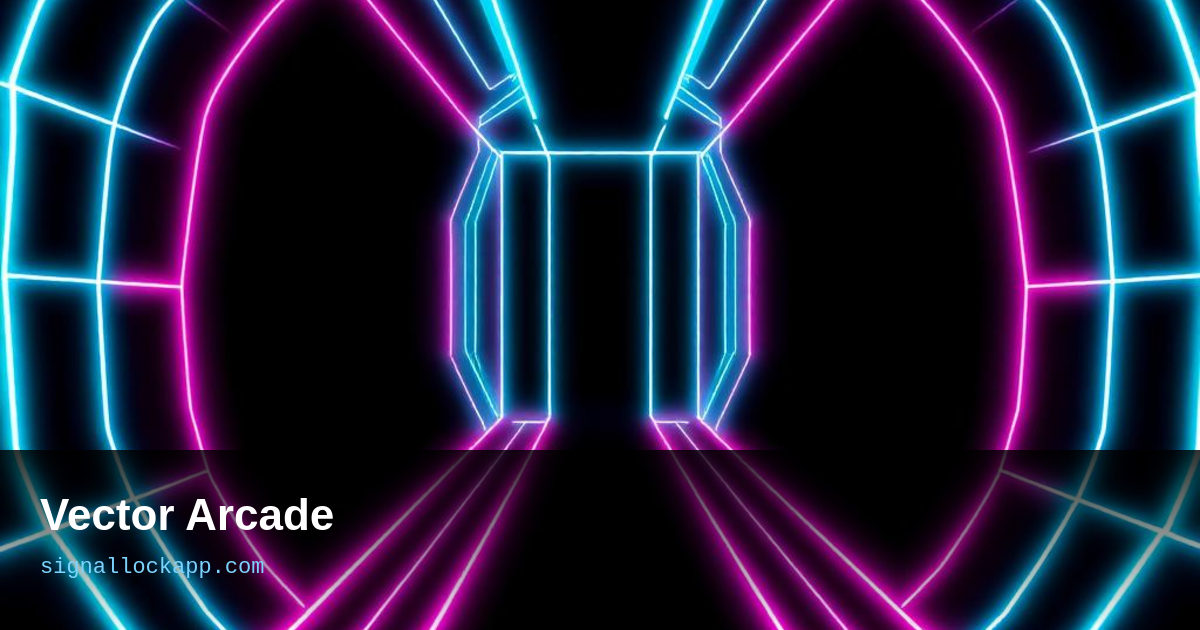
Vector, not raster
Raster displays draw every dot in a grid, 60 times a second. Vector displays draw only the lines they need — the electron beam traces the geometry directly. The result is razor-sharp at any scale, with a glowing, cinematic quality. Atari's Battlezone, Asteroids, Tempest and Star Wars all used vector hardware.
Tempest's radial tunnel
Designed by Dave Theurer, Tempest places the player at the edge of a web-like tunnel viewed from above. Enemies crawl up the lanes toward you. The entire screen is radial lines and angles — an aesthetic that would be impossible on raster hardware of the era and eerily similar to a Plan Position Indicator radar display. The colour overlay added psychedelic flavour to the monochrome vectors.
Star Castle's concentric rings
Cinematronics' 1980 classic encloses the player in rotating rings of shields that must be chipped away to reach the core cannon. The rings glow with phosphor persistence, breaking apart in geometric shards. The whole game is a radar screen turned into fortress.
The legacy in modern UI
Every neon wireframe, every HUD reticle, every sci-fi radar display in games from Elite Dangerous to Homeworld owes something to the vector arcade era. The aesthetic of glowing lines on black is synonymous with 'radar' and 'space' because Tempest and Star Castle burned it into popular culture.
The persistence of phosphor
A critical technical element shared by early vector games and mid-century radar displays was the use of long-persistence phosphors. In a standard television of 1980, pixels faded almost instantly, but vector monitors used chemical coatings that continued to glow after the electron beam passed. This lag created the 'smearing' effect visible when a ship moved in Asteroids or Star Castle, mimicking the way a radar sweep leaves a decaying trail behind a moving target. This wasn't merely decorative; it provided visual continuity, allowing the human eye to perceive fluid motion despite the fluctuating refresh rates of the vector generator hardware.
Engineers faced a significant thermal challenge with this technology. Because a vector beam focuses its entire energy on specific lines rather than spreading it across a grid, it can effectively 'burn' the phosphor coating if it remains stationary. Much like a radar operator had to calibrate brightness to avoid damaging the CRT, arcade technicians often had to replace tubes that had the Tempest web or the Star Castle rings permanently etched into the glass. This physical degradation is a hallmark of the era, proving that these displays were high-energy instruments rather than passive television screens.
Deflection yoke precision
The hardware driving these games, specifically the XY monitors manufactured by Wells-Gardner and Electrohome, operated on principles of magnetic deflection identical to military oscillators. While a raster display uses a fixed saw-tooth wave to scan the screen, a vector monitor uses an analog X and Y input to position the beam with infinite precision within its resolution limits. This permitted a 'stepless' diagonal line that could not be replicated by pixels until the advent of high-definition displays decades later. In 1980, the 1024x1024 addressable space of a vector monitor surpassed the visual fidelity of any home computer or competing raster arcade cabinet.
This precision allowed for the unique 'zoom' effects found in games like Star Wars (1983). Because the lines are represented as mathematical vectors rather than bitmaps, the hardware could scale objects by simply increasing the voltage across the deflection coils. There was no loss of detail or 'pixelation' as an object grew larger. This mathematical purity is what links the aesthetics of Tempest directly to the flight controllers and ballistic tracking systems of the Cold Air Force, where identifying a shape's trajectory was more vital than its surface texture or color depth.
The XY monitor engineering barrier
While raster monitors rely on a fixed scanning path, vector (or XY) monitors require high-speed deflection amplifiers to push the electron beam to any coordinate instantly. This created a significant heat and reliability bottleneck. In games like Tempest, the deflection yolks had to move the beam at speeds exceeding 1,000 inches per second to maintain flicker-free imagery. This high-voltage environment made the hardware prone to 'burn-out' if the beam remained stationary for even a fraction of a second, leading to the development of spot-killer circuits. These safety mechanisms were direct descendants of those found in military oscilloscope and radar displays, designed to protect the expensive phosphor coating from permanent damage.
The power consumption of a vector display was fundamentally different from its raster counterparts. In a raster system, power is consistent regardless of what is on screen. For a vector monitor, power draw scales with the total length of the lines drawn. If a game like Star Castle attempted to draw too many complex shapes simultaneously, the refresh rate would drop, resulting in visible flickering. This technical constraint forced designers like Dave Theurer to prioritize geometric efficiency. The sparse, high-contrast look was not just an artistic choice; it was a pragmatic response to the physical limits of electromagnetic deflection and the cooling capacity of the cabinet's internal components.
The transition to Vector Generators
To manage the complex geometry of Tempest, Atari developed the Vector Generator (VG), a dedicated state machine that functioned as a primitive GPU. Unlike the CPU-driven rendering in early raster games, the VG processed a dedicated display list of coordinates and instructions independently. This allowed for the fluid, 60Hz movement of the 'tunnel' without taxing the 6502 microprocessor's limited bandwidth. The precision of this digital-to-analog conversion allowed for sub-pixel accuracy that raster displays wouldn't achieve for another decade. Each line was rendered as a continuous voltage ramp, creating the signature 'glow' where the beam slowed down at the vertices, a phenomenon known as 'dwell' that mimics genuine radar blips.
By 1983, the cost and fragility of vector monitors led to their obsolescence in the arcade market. The industry moved toward 'vector-on-raster' emulation, where high-resolution bitmapped displays attempted to simulate the look of XY hardware. However, these simulations initially lacked the infinite contrast and instantaneous response times of the original cathode ray tubes. Early radar systems faced a similar transition, moving from analog PPI scopes to digital raster-scan displays to incorporate complex data overlays. The specific aesthetic of Tempest—sharp, glowing lines against a true black background—remains a unique artifact of a brief window where consumer entertainment was physically identical to high-end aerospace instrumentation.