The catalogued population
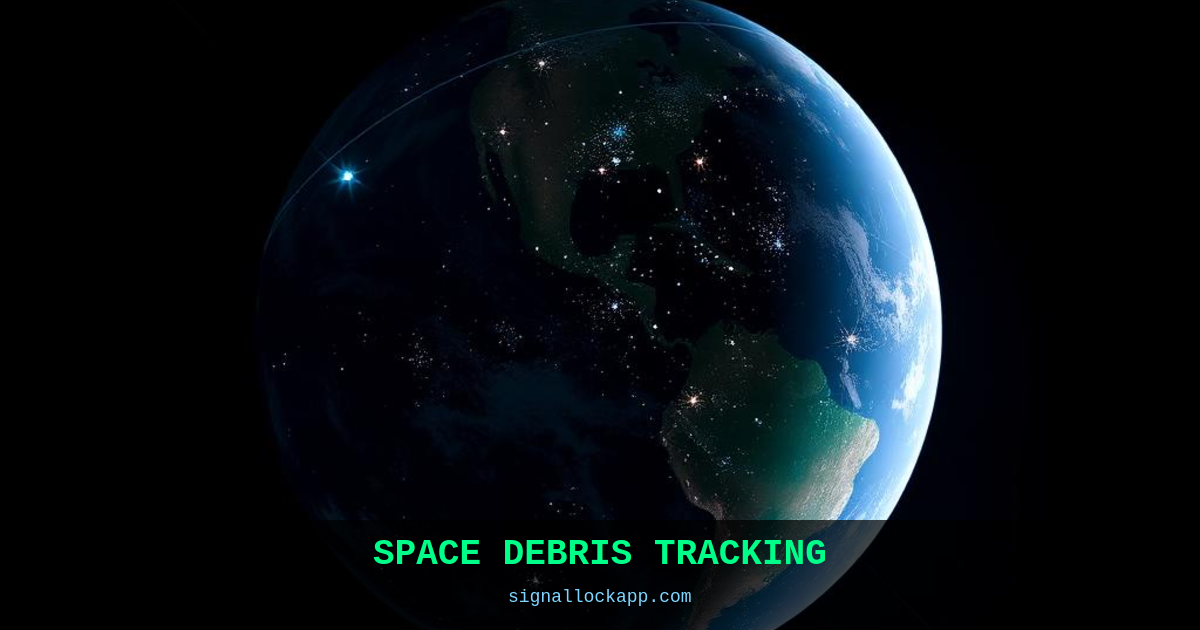
As of 2024, the US Space Surveillance Network tracks roughly 35,000 objects larger than 10 cm. Estimates suggest 1 million objects between 1–10 cm, and 130 million smaller than 1 cm. Only the large ones are tracked. The rest are statistical threats — and they can still destroy a satellite.
Space Fence (AN/FPS-85 follow-on)
The US Space Fence, operational since 2020, is a massive S-band phased array in the Marshall Islands. It can detect objects as small as a marble in low Earth orbit, updating the catalogue automatically. Previous systems relied on mechanical dishes; the new fence is all solid-state, tracking thousands of objects simultaneously.
TIRA and European assets
Germany's TIRA (Tracking and Imaging Radar) is a 34 m dish operating at 1.3 GHz. It can image objects in orbit at metre resolution, distinguishing a tumbling rocket body from an intact satellite. France's GRAVES is a bistatic radar system that fills gaps in southern coverage. Together with optical telescopes, these systems form a global debris surveillance network.
Collision avoidance
When a tracked object is predicted to pass within a few kilometres of an active satellite, operators are warned. The satellite can fire thrusters to dodge. This happens dozens of times per year for the ISS alone. Without radar tracking, every satellite would be flying blind through a shooting gallery.
Small-Object Detection and Rayleigh Scattering
The primary challenge in tracking orbital debris lies in the relationship between wavelength and object size. When a piece of debris is significantly smaller than the radar's wavelength, it enters the Rayleigh scattering regime, where the Radar Cross Section (RCS) drops precipitously as the fourth power of the object's diameter. To combat this, modern installations have shifted toward shorter wavelengths, such as the X-band (8–12 GHz) and Ku-band (12–18 GHz). These frequencies allow for the detection of sub-centimeter particles that S-band systems might overlook, providing the high-resolution data necessary to calculate precise orbital mechanics for objects moving at 7.8 kilometers per second.
Precision in these measurements is further complicated by the aspect angle and material composition of the debris. A metallic fragment reflects radar energy far more efficiently than carbon-fiber composites or solar cell shards. Modern signal processing utilizes polarimetric signatures to estimate the shape and orientation of these non-cooperative targets. By analyzing the change in polarization between the transmitted and received pulses, analysts can determine if an object is a flat plate, a sphere, or a jagged fragment. This data is critical for atmospheric drag modeling, as the object's orientation determines how quickly its orbit will decay over time.
The Kessler Syndrome and Statistical Maneuvering
In 1978, NASA scientist Donald J. Kessler proposed a scenario where the density of objects in Low Earth Orbit (LEO) becomes high enough that collisions trigger a self-sustaining cascade of further wreckage. Today, radar data is the primary defense against this 'Kessler Syndrome.' When two tracked objects are predicted to pass within a specific risk threshold—often a few hundred meters—satellite operators receive a Conjunction Data Message (CDM). However, because tracking accuracy is limited by atmospheric density fluctuations and sensor noise, these alerts often describe a 'probability of collision' rather than a certainty, forcing operators to burn precious fuel for maneuvers that may not have been strictly necessary.
Beyond active avoidance, radar serves as the 'ground truth' for the unmodeled population. Statistical sampling campaigns, such as those conducted by the Haystack Ultra-Wideband Satellite Imaging Radar (HUSIR) in Massachusetts, focus on a fixed volume of space to count smaller particles. By observing the 'beam-park' transit of untracked objects, scientists can estimate the total density of the lethal non-trackable population. This statistical data informs the design of shielding, such as Whipple bumpers, which protect the International Space Station from impacts that radar systems are physically incapable of localized tracking due to the power-aperture limits of current technology.
Bistatic Radar and the Detection of Micro-debris
While monostatic radars use the same antenna for transmission and reception, bistatic systems utilize geographically separated sites to capture scattered signals. In debris tracking, this configuration is critical for detecting fragments smaller than 5 cm. By placing the receiver hundreds of kilometers from the transmitter, the system can measure forward-scattered energy, which is often significantly stronger than the direct backscatter used by traditional radar. This technique allows for the detection of high-velocity fragments that would otherwise fall below the signal-to-noise threshold of a single-site installation, providing a more detailed look at the 'lethal non-trackable' population in LEO.
The effectiveness of bistatic radar depends on precise clock synchronization between sites, often achieved via GPS or atomic clocks. When a piece of debris passes through the transmitter's narrow beam, the receiver captures the reflected pulse at a specific time-of-flight, allowing operators to calculate the object's position and velocity vector through multilateration. This method is particularly useful for characterizing the aftermath of anti-satellite (ASAT) tests or accidental collisions, where thousands of small, irregularly shaped fragments are generated simultaneously. Without the sensitivity of bistatic configurations, these clouds of debris would remain invisible until they impacted another operational asset.
Phase-Coded Pulse Compression in Orbital Surveillance
To distinguish between closely spaced objects in orbit, modern radar systems utilize pulse compression techniques such as phase-coded modulation. By modulating the phase of the transmitted signal—often using Barker codes or polyphase sequences—the radar can transmit a long pulse with high energy while maintaining the range resolution of a much shorter pulse. This is essential for debris tracking because high energy is required to detect small cross-sections at distances of 1,000 km or more, but high resolution is necessary to separate a fragment from a nearby satellite. Without pulse compression, the energy required for small-object detection would necessitate peak power levels that exceed the physical limits of current transmitter hardware.
Upon reception, the signal is processed through a matched filter that 'compresses' the pulse into a narrow spike. This increases the signal-to-noise ratio and allows the radar to resolve objects that are separated by only a few meters in altitude. This capability is vital for conjunction assessment, where operators must determine the probability of a collision within a very small margin of error. In the 2009 collision between Iridium 33 and Kosmos-2251, the lack of high-resolution tracking data contributed to the inability to predict the specific impact point. Modern phase-coded systems now provide the precision needed to execute proactive avoidance maneuvers, saving satellites from catastrophic structural failure.