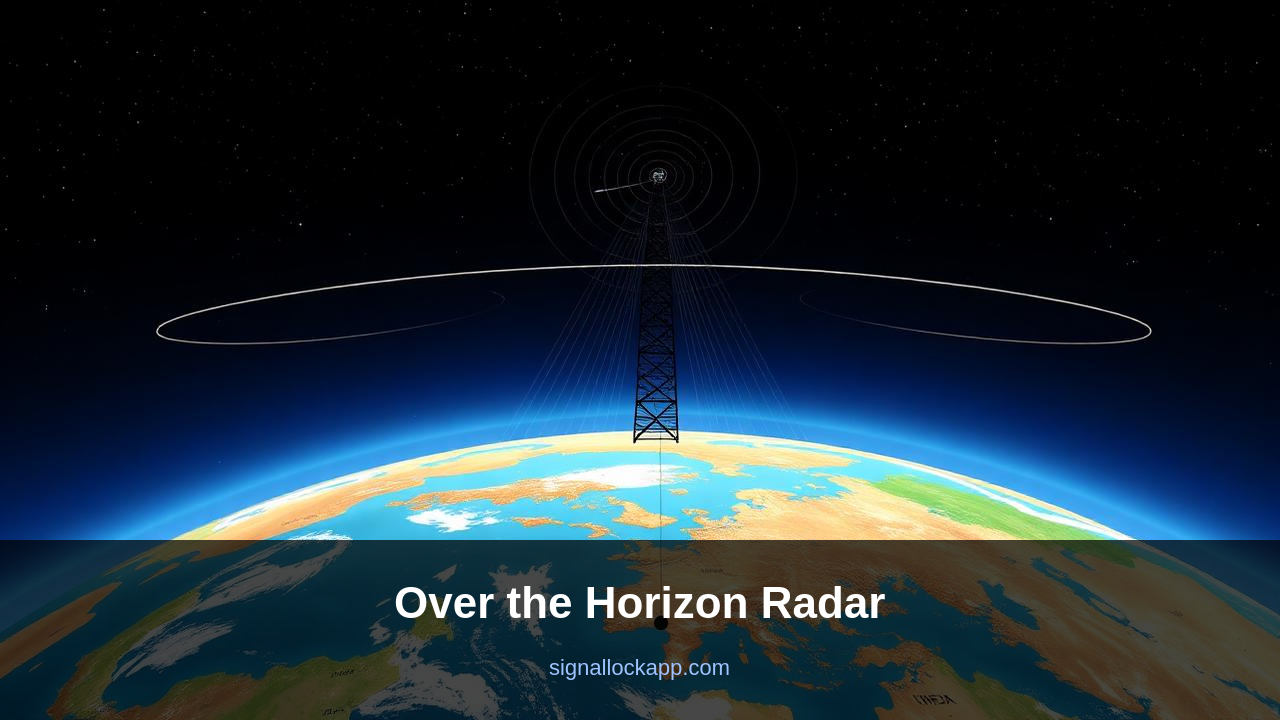
Ionospheric reflection
The ionosphere — a layer of charged particles 80 to 600 km above the Earth — reflects radio waves below about 30 MHz back to the surface. OTH radar transmits a high-frequency (HF) signal upward at a shallow angle, bounces it off the ionosphere, and illuminates a target area thousands of kilometres away. The echo bounces back the same way.
Why HF, why huge antennas
HF means long wavelengths — 10 to 100 metres. Antennas have to be matched to the wavelength, so OTH radar arrays are kilometres long. Australia's JORN system uses a 3-kilometre transmit array and a separate 3-kilometre receive array. The Soviet Duga 'Russian Woodpecker' was 700 metres tall and 150 metres wide.
What it can and can't see
OTH can detect aircraft, missile launches and large ships at 1,000-3,000 km range. Resolution is poor — kilometre-scale, not metre-scale. It cannot guide weapons; it can only cue other sensors. Stealth shaping doesn't help because the wavelength is too long, but OTH cannot tell an airliner from a fighter at that resolution.
Modern operators
Active OTH systems include Australia's JORN, Russia's Container, the US Relocatable Over-The-Horizon Radar (ROTHR) used for drug interdiction, and several Chinese systems aimed at the Western Pacific. The capability matters strategically: an OTH site can detect a B-21 launch from 3,000 km away even if the B-21 itself is invisible to X-band radar.
The Woodpecker problem
In 1976, shortwave radio listeners worldwide began hearing a massive, 10 Hz rhythmic interference pulse that disrupted legitimate communications and broadcasting. This signal originated from the Soviet Duga radar installation near Chernobyl. Known as the Russian Woodpecker, the system used staggering power levels—estimated up to 10 megawatts—to project signals deep into Western airspace. The interference was so severe that electronics manufacturers began building Woodpecker Blankers into high-end radio equipment to filter out the repetitive tapping sound, highlighting the massive electromagnetic footprint these systems require to overcome atmospheric noise.
The Duga system demonstrated the immense scale required for early OTH operations. Unlike modern digital systems, Duga relied on brute force and massive antenna arrays, some stretching 150 meters high and 500 meters wide. While it served as a Cold War early warning tool for ballistic missile launches, its lack of frequency agility often rendered it a diplomatic liability. Modern digital signal processing now allows systems like JORN to achieve better results with a fraction of the power and much more sophisticated frequency management, avoiding the blatant interference that marked the 1970s and 80s.
Surface wave vs. Sky wave
While most OTH radars use sky-wave propagation to reach thousands of kilometers, a specific subset utilizes High-Frequency Surface Wave Radar (HFSWR). These systems don't bounce signals off the ionosphere. Instead, they exploit the conducting properties of the ocean surface to 'hug' the curvature of the earth. This allows for continuous tracking of maritime targets and low-flying aircraft out to roughly 300 or 400 kilometers. Because they do not rely on ionospheric conditions, surface-wave radars avoid the 'skip distance' dead zones where sky-wave signals pass over a target without seeing it, making them ideal for coastal surveillance.
The technical trade-off involves severe signal attenuation. The salt water acts as a waveguide, but the further the signal travels along the curve, the more energy it loses to the sea itself. Designers compensate for this by using vertically polarized antennas and longer integration times for signal processing. This permits the detection of small vessels and drug-running craft that remain below the line-of-sight of conventional microwave radars. When combined with sky-wave systems, HFSWR fills the critical gap between close-range harbor defense radars and long-range continental early warning networks.
The Doppler Processing Challenge
Isolating a moving target from the background clutter of the earth's surface requires extreme computational power. Because the ionosphere is constantly shifting, the returned signal is distorted by phase noise and multi-path interference. To find a plane or ship, the system must perform a Coherent Integration Time analysis, often lasting several seconds, to separate the tiny Doppler shift of the target from the massive, low-frequency returns of the ocean waves or terrain. This necessitates high-dynamic-range receivers capable of distinguishing signals 100 decibels below the background noise level.
Early systems like the Soviet 'Duga' struggled with this signal-to-noise ratio, often producing the infamous tapping sound that interfered with global shortwave broadcasts. Modern digital signal processing has largely solved this by using adaptive beamforming and real-time ionospheric sounding. Computers now calculate the 'Maximum Usable Frequency' in milliseconds, allowing the radar to hop between channels to maintain a stable track. This processing evolution transformed OTH from a crude early-warning tripwire into a sophisticated tool capable of tracking individual maritime vessels across thousands of square miles.
Project Madre and the Birth of OTH
The conceptual foundation of sky-wave OTH radar was cemented in the 1950s by Dr. William J. Thaler at the US Naval Research Laboratory. Under 'Project Madre,' Thaler utilized a high-power transmitter at Chesapeake Bay to prove that backscatter from the ionosphere could detect missile launches and aircraft at transcontinental distances. Before this, radar was strictly line-of-sight, limited by the curvature of the Earth to roughly 40 kilometers for surface targets. Thaler’s success proved that the HF band was not just for radio communication, but a viable medium for planetary-scale surveillance.
The transition from experimental to operational status occurred during the Cold War, primarily to counter the threat of Low-Earth Orbit satellites and ICBMs. While the UK and US initially collaborated on projects like 'Cobra Mist' in Suffolk, technical hurdles regarding ground-clutter suppression led to several early cancellations. It wasn't until the 1980's that the maturation of solid-state electronics and FMICW (Frequency Modulated Interrupted Continuous Wave) waveforms allowed systems like the Australian JORN to provide the high-reliability data streams required for modern border defense and oceanic monitoring.