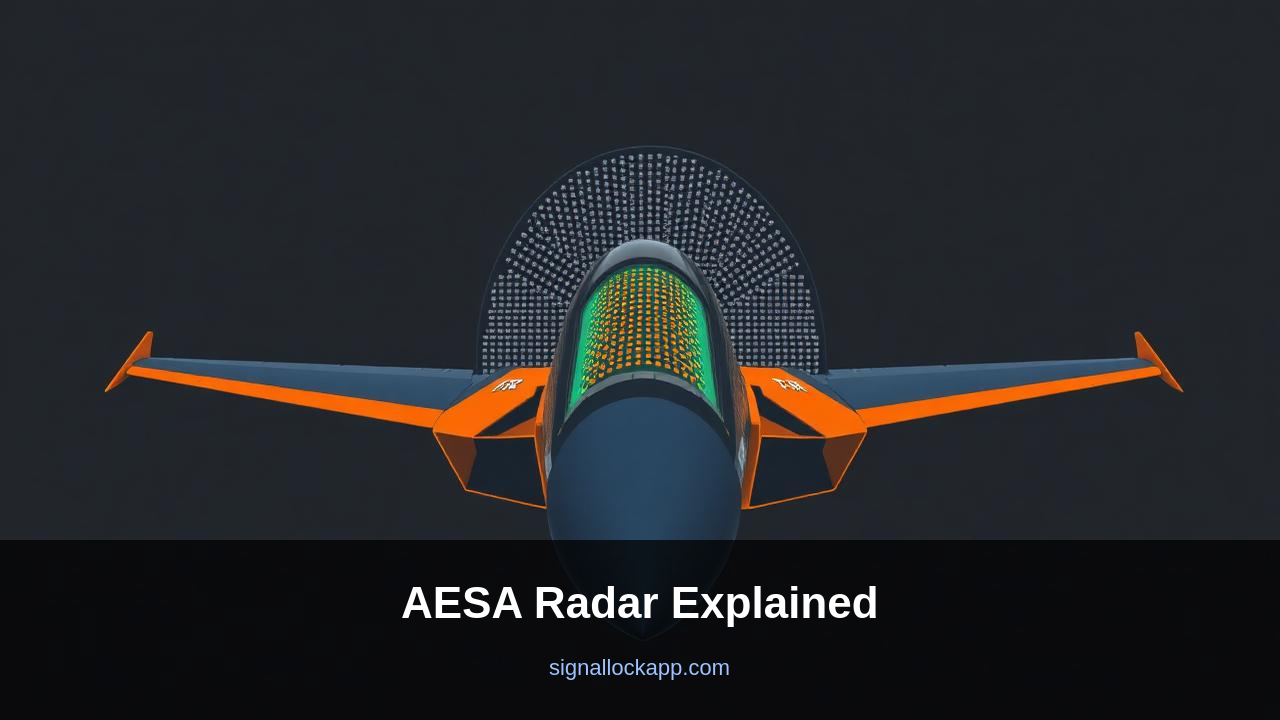
From dish to array
A mechanical radar has one transmitter, one receiver, one antenna, one beam. The antenna rotates to scan. Each rotation takes seconds. An AESA radar has thousands of independent transmit-receive modules — the F-35's APG-81 has about 1,600. Each one is a tiny radar. By controlling the phase of each module, the combined beam can be steered electronically in microseconds, with no moving parts.
Why this changes everything
An AESA can search one part of the sky while tracking a target in another, while jamming a third, while painting a high-resolution synthetic aperture map of the ground. It can switch between modes faster than the enemy can react. Older mechanical radars had to choose one job at a time.
Reliability and stealth interaction
With 1,600 modules, losing 100 of them in combat only degrades performance by 6%. A mechanical radar with a damaged motor is dead. AESA beams can also be 'low probability of intercept' — frequency-hopping pseudorandom waveforms that look like background noise to enemy radar warning receivers. A stealth aircraft with AESA can light up its own radar without giving away its position.
Why everyone wants one
AESA is now standard on Western fighters (F-22, F-35, F-15EX, Eurofighter Tranche 3, Rafale, Gripen E), Russian Su-57 and Chinese J-20. Even the most modern naval and ground radars (Aegis SPY-6, Patriot LTAMDS) are AESA. The mechanical dish is becoming a museum piece.
The GaN transition and thermal management
The shift from Gallium Arsenide (GaAs) to Gallium Nitride (GaN) represents the most significant leap in AESA technology since its inception. While the APG-77 in the F-22 utilized GaAs, newer systems like the AN/APG-85 leverage GaN to handle five times the power density. This allows for significantly higher range and better sensitivity without increasing the physical size of the array. However, this power creates extreme heat, requiring advanced liquid cooling loops that integrate directly into the aircraft's environmental control system, as GaN modules operate at much higher temperatures than traditional silicon-based electronics.
Precision timing is the silent enabler of this performance. For an AESA to function, the phase shifter in each module must synchronize within picoseconds to form a coherent wavefront. At the speed of light, a timing error of one billionth of a second results in a beam pointing error of several degrees. Modern AESA arrays use high-stability master oscillators and FPGA-driven backends to ensure that thousands of individual signals sum constructively in space. This technical rigor is why AESA development remained restricted to a handful of nations for decades, as the manufacturing tolerances for these modules are among the tightest in aerospace engineering.
Beyond detection: Data links and warfare
A common misconception is that radar is only for finding targets. In reality, an AESA array is the world's most powerful directional antenna. Because it can steer beams with microsecond precision, it can function as a high-bandwidth data link. The F-35 uses its radar to beam massive amounts of sensor data to other aircraft at gigabit speeds, much faster than a standard Link 16 radio. This transforms the radar from a solitary sensor into a node in a massive wide-area network, allowing one jet to guide a missile fired by a completely different platform without that platform ever turning on its own radar.
This agility also fundamentally changes electronic warfare. In legacy systems, a dedicated jammer was needed to drown out enemy signals. An AESA can dedicate a small fraction of its modules to emit high-gain 'noise' or deceptive pulses toward an enemy radar while using the rest of the array to continue scanning for threats. This 'digital radio frequency memory' (DRFM) capability allows the radar to capture an incoming enemy pulse and retransmit it with a slight delay, creating 'ghost' targets that confuse enemy operators. It effectively blurs the line between a sensor and a weapon, making the radar a proactive tool for dominance.
The transition from PESA to AESA
While the transition from mechanical to electronic scanning was a leap forward, the distinction between Passive Electronically Scanned Arrays (PESA) and AESA is critical. In a PESA system, such as the Soviet Zaslon used on the MiG-31 in 1981, a single large central transmitter provides power to all phase shifters. This creates a single point of failure; if the central vacuum tube or traveling wave tube fails, the entire radar is blind. Furthermore, because all elements share the same signal source, a PESA is limited to one primary frequency and one main beam shape at any given instant.
AESA solves this by decentralizing the power source. Each of the 1,000 to 2,000 transmit-receive (TR) modules in a modern array possesses its own independent power amplifier and low-noise receiver. This allows for 'sub-gridding,' where different sections of the antenna simultaneously perform different tasks on different frequencies. By 2005, when the APG-77 achieved full operational capability on the F-22 Raptor, it demonstrated that this architecture was not just about reliability, but about achieving a bandwidth and agility that mechanical and PESA systems could never physically match.
The role of Solid State Power Amplifiers
The shift to AESA was made possible by the evolution of Solid State Power Amplifiers (SSPAs). Early mechanical radars relied on bulky, high-voltage vacuum tube technology like magnetrons or klystrons to generate the necessary microwave energy. These required massive cooling systems and liquid-cooled jackets. In contrast, AESA TR modules utilize Gallium Arsenide (GaAs) or the newer Gallium Nitride (GaN) semiconductors. These materials allow the radar to operate at much lower voltages while maintaining higher efficiency and power density, which is vital for the constrained internal volume of a fighter jet nose cone.
Technically, the performance of an AESA radar is determined by the cumulative aperture size and the total power output of these modules. Because GaN allows for higher thermal thresholds than GaAs, modern modules can be driven harder to increase detection ranges against stealthy targets with low radar cross-sections. This transition to solid-state electronics also means the radar's signature can be managed with extreme precision, allowing the system to use 'frequency agility' to spread its energy across a wide spectrum, effectively hiding its electronic emissions in plain sight of enemy sensors.