Two of Signal//Lock's stages — Vector Field (S19) and Vector Overflow (S20) — are pure vector arcade. Every lock leaves a glowing line on the dish, every line stays until you purge it, and a saturation meter at the top tracks how much of the radar you've filled. Lock too eagerly and you blind yourself.
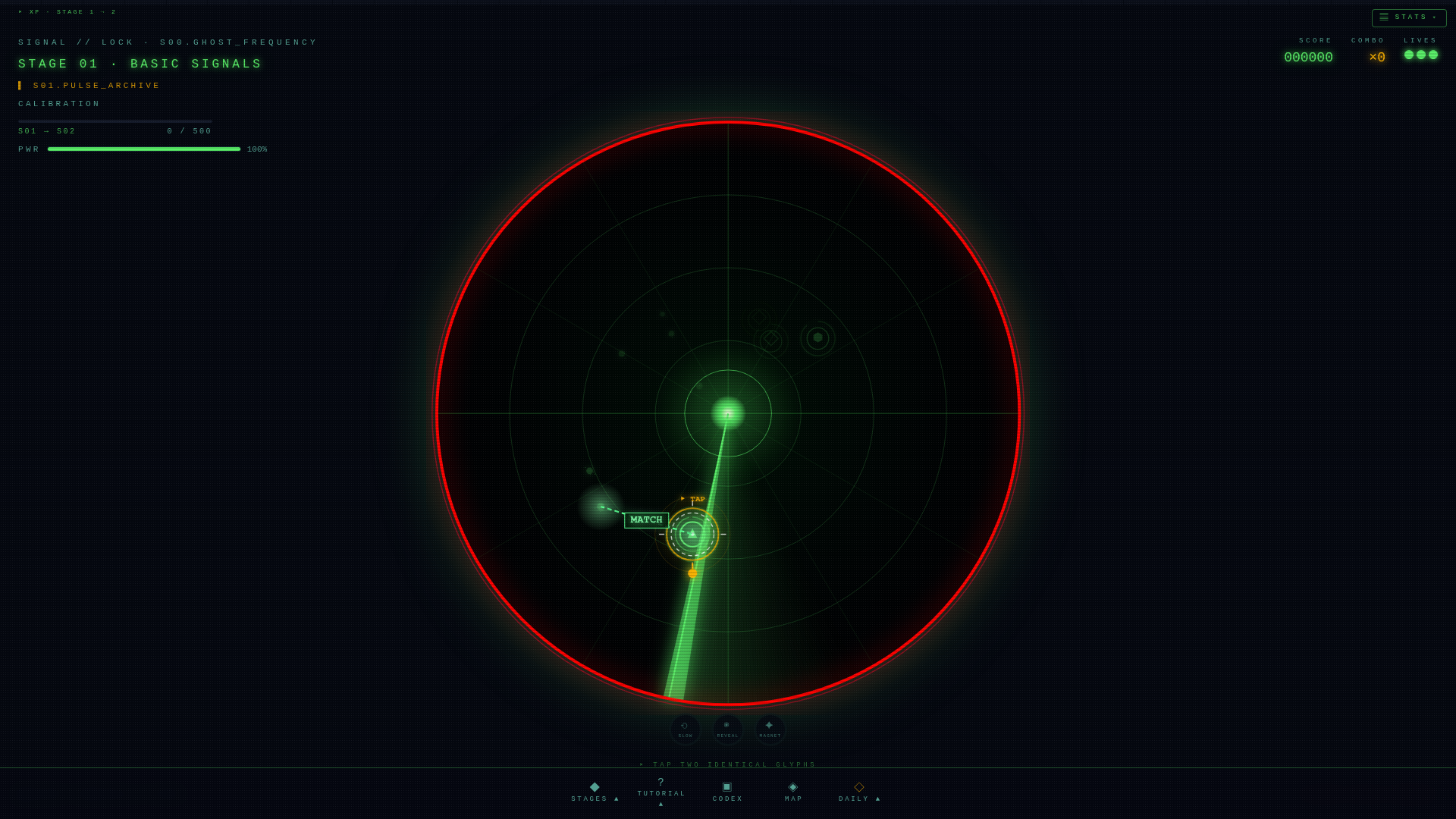
What feels like a vector cabinet
- Phosphor glow. Each beam draws a wide soft underlay plus a sharp core stroke — the same look as a CRT vector tube.
- Pure line geometry. No sprites, no textures. Every visual is a drawn line, including the targets and the sweep itself.
- Hard contrast. Black background, saturated color lines. Reads instantly even at high density.
What a 1980 cabinet didn't have
- A saturation meter. Old vector games drew lines that faded instantly. Signal//Lock makes them persist and gives you a meter that fills as the screen does.
- Color-streak purges. Lock three matched-color pairs in a row and the entire dish flashes clear. The relief flash is the core mechanic of vector overflow.
- Mobile-native input. Touch and mouse both target lines cleanly. No trackball required.
Free, no install, opens in a browser
Nothing to download. Open the tab and the dish boots immediately. A run is two to five minutes — short enough to fit a break, long enough to feel a real arc. Stages rotate so you don't replay the same rule set twice in a row.
Start a run
Open the radar — go straight into a stage. Read the vector overflow strategy guide before you tackle Stage 20.
Related pages
- Vector field strategy (Stage 19)
- Vector overflow strategy (Stage 20)
- Why it's a radar game
- All nine stages
What "vector arcade" meant in 1979
Vector arcade games — Asteroids, Tempest, Battlezone, Star Wars — used a different display technology from the raster CRTs of the era. Instead of scanning a fixed grid of pixels line-by-line, vector monitors drew lines directly from coordinate to coordinate using a steerable electron beam. The result was infinitely thin, infinitely sharp lines that glowed with a characteristic green or amber phosphor — and a strict budget: the beam could only draw a finite number of vectors per frame before flicker became unbearable. Game design adapted: fewer objects, sharper shapes, more reliance on motion and rotation than on detail.
Signal//Lock's Vector Overflow stage is a deliberate tribute. The stage drops the radar sweep entirely and renders contacts as vector-style line segments that persist on the screen with a long phosphor decay. Every miss leaves a faint line that stays visible for several seconds — exactly the way an overworked vector monitor would have looked when a developer pushed too many lines into one frame.
The phosphor decay loop
Vector Overflow's central mechanic is that the screen never fully clears. Persistent lines accumulate, the playfield literally fills up with the history of your decisions, and reading new contacts through the clutter becomes the difficulty curve. There is no explicit clutter penalty in the saturation meter — the clutter is its own punishment, because it makes the next decision harder. Players who play conservatively (taking only the cleanest locks) find the stage easier than players who try to clear everything, which inverts the lesson of every other stage in the game.
Modern browser rendering of vector aesthetics
Real vector monitors used analog deflection circuits; modern browsers render to a raster canvas, so "vector graphics" on the web are simulated. Signal//Lock fakes the look with three tricks: lines are drawn 1px wide with a 2-3px outer glow (the bloom that vector phosphor produced naturally), brightness decays exponentially over 2-3 seconds (matching long-persistence phosphor), and a subtle per-frame jitter on endpoint positions emulates the analog deflection's natural instability. None of these are graphically expensive — Vector Overflow runs at the same frame budget as the cleaner radar stages.
Frequently asked
- Is this a vector-graphics game?
- It uses a Canvas 2D raster surface but renders in a vector-graphics aesthetic — thin glowing lines, long phosphor decay, no fills. The Vector Overflow stage is the clearest example.
- How does this relate to Asteroids?
- Asteroids was a vector cabinet from 1979. Signal//Lock's Vector Overflow stage shares the visual language and the screen-filling persistence problem, but the gameplay is radar-style, not ship-based.
- Why does the screen fill up with old lines?
- That's the long-persistence phosphor effect from vector monitors. It's also a gameplay element — clutter makes the next decision harder, so playing conservatively pays off.
- Can I turn off the persistence effect?
- Reduced-motion mode shortens the phosphor decay significantly. The mechanical effect (clutter as difficulty) stays, but the visual intensity drops.
The XY monitor and its industrial origins
Vector arcade cabinets used XY monitors — also called vector monitors or random-scan displays — based on the same CRT technology that drove oscilloscopes and radar displays. The electron beam was steered directly to coordinates by analog deflection amplifiers rather than scanning a raster grid. The industrial heritage is obvious in the look: the green P39 phosphor on early Asteroids cabinets is the same phosphor used on Tektronix oscilloscopes of the era. Atari sourced its XY monitors from companies that primarily served the test-equipment market.
The technology had a hard physical limit: roughly 4,000-8,000 line segments per frame at 30-60 Hz before flicker became intolerable. Game design adapted. Asteroids capped active fragments precisely. Tempest redrew its rim once per frame and animated enemies as outline shapes. Battlezone shipped with a custom Math Box coprocessor specifically to compute 3D-to-2D vector projections fast enough to stay inside the line budget.
Why vector arcades died
XY monitors were expensive, fragile, and required custom calibration. By the mid-1980s raster monitors with high-quality colour and sprite hardware (the Williams hardware that drove Defender, the Atari System 1 board) had caught up visually for most game types, and the cost differential made vector cabinets untenable. Star Wars (1983) was the last major Atari vector cabinet; by 1985 the format was commercially dead. The aesthetic, however, never died — it rotated through synthwave revival, retro-indie titles (Geometry Wars, Resogun), and now into Signal//Lock's Vector Overflow stage.