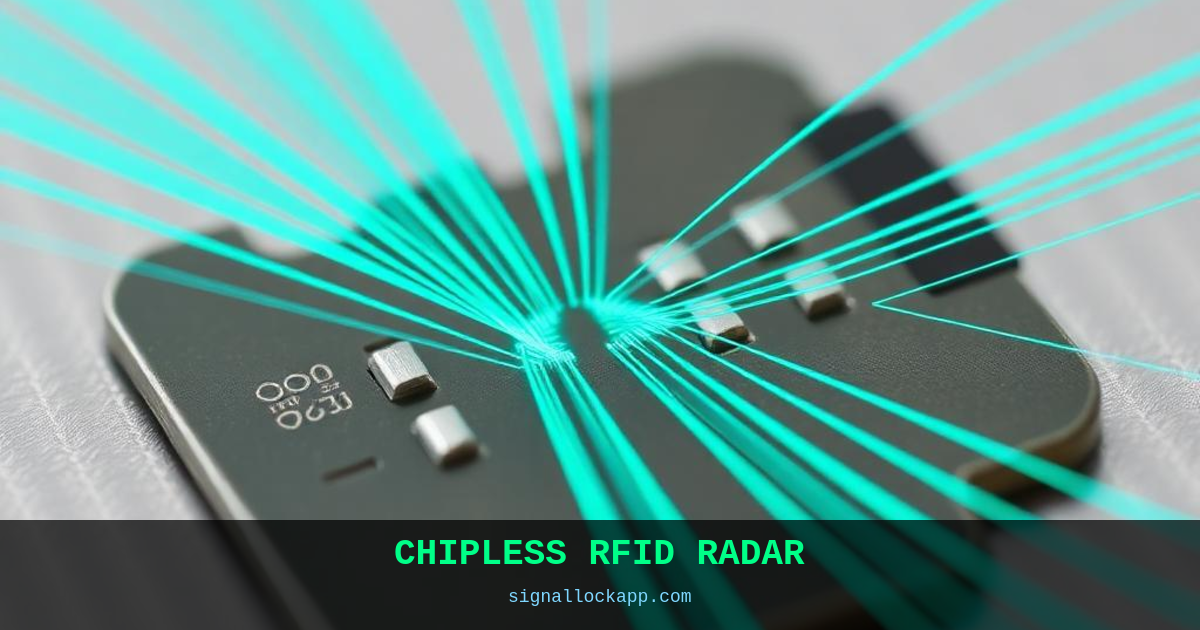
Frequency-domain signatures
A chipless tag is a set of resonant structures — dipoles, slots, or reflectors — each tuned to scatter strongly at a specific frequency. When illuminated by a broadband radar pulse, the reflected spectrum has peaks and nulls at those frequencies. The pattern is the ID. A tag with 10 resonators gives 2^10 = 1,024 unique codes. 20 resonators give a million.
Materials and fabrication
Because there is no chip, chipless tags can be printed with conductive ink on paper or plastic. They survive temperatures, flexing and moisture that would destroy electronics. A tag printed on a cardboard box costs fractions of a cent. The reader is a swept-frequency or impulse radar that interrogates the tag and decodes the spectral response.
Applications beyond supply chain
Chipless tags are being tested for anti-counterfeiting (luxury goods, pharmaceuticals), structural health monitoring (cracks change the tag's signature), and even as disposable environmental sensors (humidity swells the substrate, shifting resonance). Every application treats the tag as a radar target with a designed RCS spectrum.
Limits
Range is short — metres, not tens of metres — because the tag doesn't amplify. Multiple tags in the same beam create spectral overlap. And the reader must be calibrated against environmental clutter. But for item-level tracking where cost is everything, chipless RFID is a compelling alternative to barcodes.
Time-domain reflectometry and SAW
While frequency-domain tags dominate cost-sensitive markets, time-domain chipless RFID employs Surface Acoustic Wave (SAW) technology for higher precision. In these devices, an interdigital transducer converts the incoming radar signal into an acoustic wave that travels across a piezoelectric substrate. As it passes, metal reflectors placed at precise intervals bounce the energy back. Because acoustic waves travel 100,000 times slower than light, the delays are measurable in the nanosecond range, allowing for distinct time-coded pulses that represent data without requiring any CMOS logic or semiconductor gates.
The primary advantage of SAW tags is their inherent ability to function as high-resolution sensors in extreme environments. Since the velocity of the acoustic wave is highly sensitive to the physical state of the substrate, shifts in the return timing can map directly to temperature or pressure changes. This makes them ideal for monitoring rotating components in industrial turbines or high-voltage switchgear where battery-powered sensors fail. Unlike standard RFID, the signal processing for time-domain tags relies heavily on cross-correlation algorithms to distinguish the tag's signature from the surrounding clutter and multipath reflections.
The challenge of bit density and range
A common technical hurdle in chipless RFID is the trade-off between data capacity and the allocated bandwidth. To store 64 or 128 bits—standard for global logistics—the tag requires a large number of resonators across a wide frequency window, often exceeding the Ultra-Wideband (UWB) regulations defined by agencies like the FCC. Increasing the number of resonant elements also increases the physical size of the tag, which complicates integration into small labels. Current research focuses on multi-state coding, where the amplitude and phase of the reflected signal are manipulated to pack more information into a narrower frequency band.
Operational range remains the most significant differentiator between chipless and chipped systems. Because chipless tags lack an active amplifier or a chip to manage backscatter modulation, the signal strength follows the radar range equation's fourth-power law, decaying rapidly over distance. Most commercial implementations are limited to a range of one to two meters. Overcoming this requires sophisticated background subtraction techniques in the reader's DSP, which must isolate the tag's small Radar Cross Section (RCS) from much larger static reflectors like walls or metal racking in a warehouse environment.
UWB and Multi-Resonator Encoding
To achieve higher bit densities without increasing physical tag size, modern chipless systems utilize Ultra-Wideband (UWB) signals. While early implementations relied on simple amplitude-shift keying, where the presence or absence of a resonance peak represented a bit, sophisticated readers now employ phase-based encoding. By measuring the phase shift of the backscattered signal relative to the interrogating wave, engineers can encode multiple bits within a single resonant structure. This approach leverages the complex Radar Cross Section (RCS) of the tag, treating each conductive element as a multi-state data carrier rather than a binary switch, effectively quadrupling the data capacity of standard printed geometries.
The signal processing required for this is computationally intensive. The reader must perform a Fast Fourier Transform (FFT) on the returned time-domain signal to isolate the spectral signature from background clutter and multipath interference. Unlike silicon-based RFID, which uses a discrete protocol like EPC Gen2, chipless tags rely on electromagnetic signature analysis. A common technical hurdle involves 'clutter removal,' where the reader subtracts the environmental reflection—the wall or floor behind the tag—to see the faint signature of the printed ink. This requires precise calibration and often limits the practical reading range to under one meter in high-noise industrial environments.
Historical Evolution: From Chaff to Data
The conceptual ancestors of chipless RFID trace back to World War II radar countermeasure technology known as 'window' or 'chaff.' Allied and Axis forces dropped strips of aluminum foil cut to specific lengths—half-wavelengths of the enemy's radar frequency—to create massive false-positive reflections. While chaff was intended to obscure data through saturation, chipless RFID uses the same principle of resonant scattering to transmit specific data through precision. In the early 2000s, researchers like Jalal Miah and Stevan Preradovic formalized the transition from chaotic scattering to organized data encoding, moving the technology from the battlefield into the realm of inventory management and item-level tracking.
A critical distinction emerged during this period between 'spatial domain' and 'frequency domain' tags. Spatial domain tags, similar to a 1D barcode read by radar, utilize the time-of-flight of pulses reflecting off discrete conductive lines. Frequency-domain tags, which have become the industry standard for chipless research, use spirals and 'C' shaped resonators to maximize bandwidth efficiency. By 2010, the introduction of conductive polymer inks allowed these resonators to be printed directly onto flexible substrates, finally fulfilling the promise of a zero-silicon identifier that could compete with the cost-per-unit of a traditional optical barcode while maintaining the non-line-of-sight advantages of radio waves.