Venus through the clouds
Venus is wrapped in sulphuric acid clouds opaque to every visible-light telescope. In the 1960s and 70s, Arecibo and Goldstone pinged it with S-band radar and mapped its surface for the first time. Magellan finished the job from orbit in 1990, but radar got there first.
Asteroid radar imaging
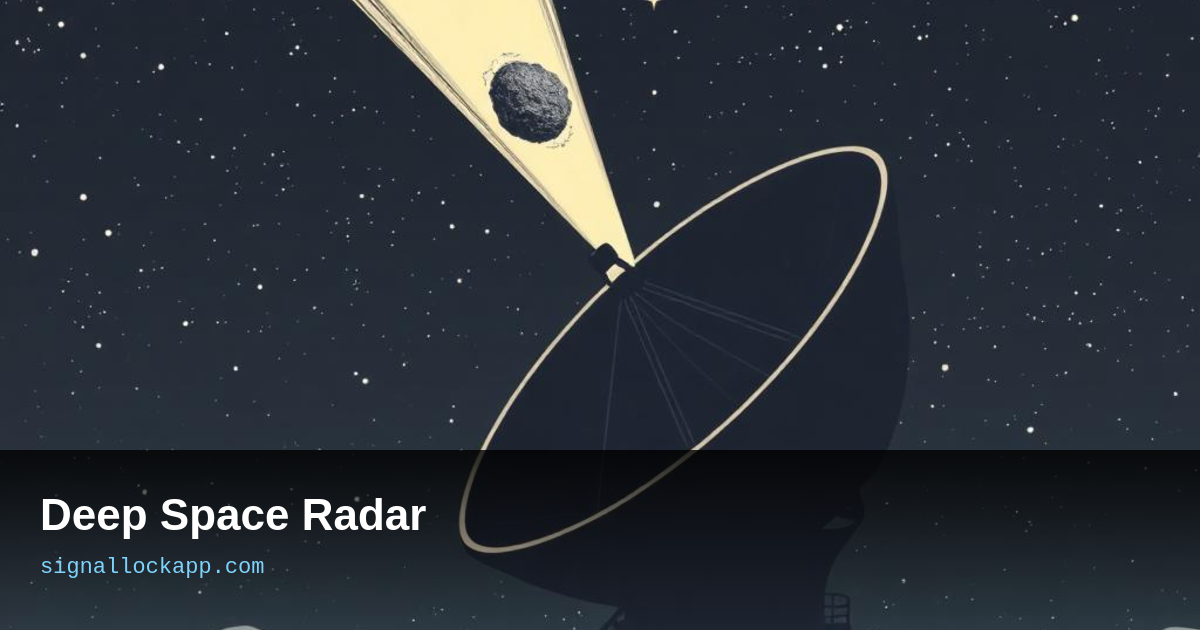
When a near-Earth asteroid passes within a few million km, Goldstone or (until 2020) Arecibo could resolve it down to metres. Shape, spin rate, surface roughness, moons — all recovered from delay-Doppler images. Hundreds of asteroids have been characterised this way.
Planetary defence
Radar imaging is how we know whether an incoming asteroid is solid rock, rubble pile, or contact binary. Defenders need that data to decide between a kinetic impactor (DART), a nuclear option, or a gravity tractor. Radar provides it years in advance.
After Arecibo
Arecibo's collapse in December 2020 cut radar astronomy roughly in half. The Goldstone Solar System Radar continues. Plans for a new dedicated radar at Green Bank (the ngRADAR concept) would partially replace Arecibo's capability.
Delay-Doppler: The mechanics of the echo
A radar telescope does not produce a visual image in the traditional sense; it constructs a two-dimensional map known as a delay-Doppler plot. The 'delay' component measures the time a pulse takes to travel to the target and back, providing precise distance measurements to different parts of the object's surface. Simultaneously, the 'Doppler' component measures the frequency shift caused by the object's rotation. Parts of the body moving toward the transmitter compress the signal (blueshift), while parts rotating away stretch it (redshift). By processing these shifts, astronomers can reconstruct the exact shape and spin axis of an irregular body even when it appears as a single pixel to optical telescopes.
Precision in these measurements is remarkable. For a near-Earth asteroid, the ranging accuracy can be within 10 meters, and the velocity can be determined to within a fraction of a millimeter per second. This diagnostic power allows scientists to distinguish between a solid monolithic rock and a loosely bound 'rubble pile' held together by gravity. These physical properties are crucial for calculating the Yarkovsky effect—a subtle force where uneven heating from the sun pushes an asteroid’s orbit over time—allowing for orbital predictions that are valid for centuries rather than just decades.
The bistatic breakthrough: Goldstone and DSS-13
In the wake of the Arecibo Observatory's collapse in 2020, the burden of deep-space radar shifted primarily to the Goldstone Solar System Radar (GSSR) in California. Modern operations often utilize a 'bistatic' configuration to maximize sensitivity. In this setup, the 70-meter DSS-14 antenna at Goldstone transmits the high-powered signal—often up to 450 kilowatts—while separate, quieter facilities like the Green Bank Telescope or the Very Large Array act as the receivers. This separation prevents the outgoing signal from saturating the sensitive receiving equipment, effectively increasing the signal-to-noise ratio for targets located further out in the main asteroid belt.
Historically, this method provided the first evidence of water ice at the poles of Mercury in 1991. Despite Mercury's proximity to the sun, radar reflections showed highly reflective, depolarized regions within permanently shadowed craters. These 'radar-bright' patches exhibited characteristics identical to the icy moons of Jupiter. This discovery proved that radar could identify chemical compositions and physical states that optical observations could only infer. Today, bistatic radar remains the primary tool for scouting the landing sites of future robotic missions, ensuring that the terrain is neither too steep nor too soft for a successful touchdown.
The Lunar Distance and Distance Scale
In 1946, Project Diana demonstrated the first successful radar reflection from the Moon. This was more than a technical feat; it established the radar range as the primary tool for calibrating the Astronomical Unit (AU). Before radar, the distance from Earth to the Sun was estimated via the transit of Venus, a method prone to significant observational error. By timing the round-trip of a radar pulse to Venus or the Moon with microsecond precision, astronomers like Irwin Shapiro and his colleagues at MIT Lincoln Laboratory refined the scale of the solar system by orders of magnitude.
This precision allowed for the validation of General Relativity through the 'Shapiro Delay' effect. As radar pulses passed near the massive gravity well of the Sun, researchers observed a slight delay in the return signal, as predicted by Einstein’s theory. This integration of radar echo timing into fundamental physics transformed the technology from a mapping tool into a premier instrument for testing the fabric of spacetime. The ability to measure the velocity of planets to within millimeters per second remains a cornerstone of modern celestial mechanics and orbital trajectory planning.
The Icy Moons and the Thermal Anomaly
Radar astronomy has revealed unexpected surface characteristics on the Galilean moons of Jupiter, specifically Europa, Ganymede, and Callisto. Unlike terrestrial planets which show high specular reflection, these icy bodies exhibit extremely high radar backscatter and unusual circular polarization ratios. This phenomenon, often called the 'coherent backscatter opposition effect', suggests that radar waves penetrate several meters into the clean, porous ice before scattering back. This subsurface probing provides data on the purity and structural integrity of the ice shells that visible light sensors cannot penetrate.
Similarly, radar observations of Mercury’s poles in the 1990s revealed highly reflective regions inside permanently shadowed craters. Despite the planet's proximity to the Sun, the radar signature was consistent with water ice rather than silicate rock. This discovery, later confirmed by the MESSENGER spacecraft, illustrates radar's unique capacity to detect volatiles in environments where thermal equilibrium would otherwise suggest their absence. By analyzing the 'glint' of the return signal, scientists can differentiate between solid bedrock and deposits of frozen water hidden in the shadows of the inner solar system.