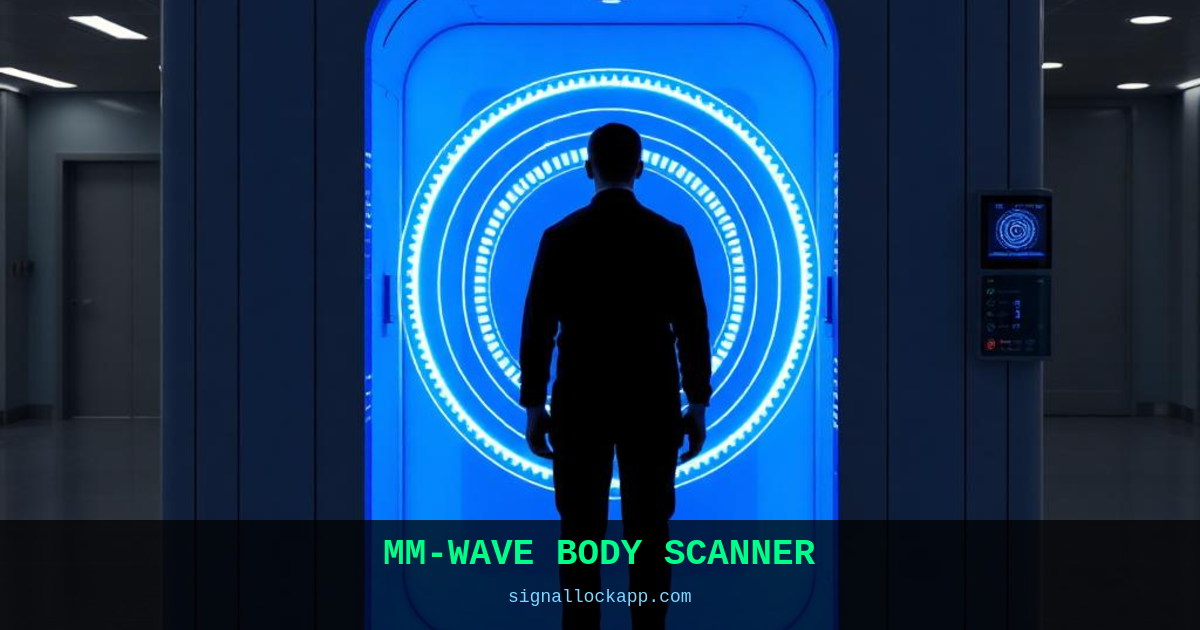
Active vs. passive imaging
Passive scanners detect the natural millimetre-wave radiation your body emits — like thermal imaging, but at shorter wavelengths. Active scanners transmit their own signal and measure the reflection, giving much higher resolution and the ability to see into cavities. All modern airport portals are active.
How it resolves objects
At 30 GHz the wavelength is 10 mm. A pistol or knife under clothing creates a shadow and reflection pattern different from skin. The scanner uses holographic reconstruction or synthetic aperture techniques to build a depth image. Materials matter: metals reflect strongly, plastics and ceramics weakly, but all are detectable against the skin background.
Privacy and algorithmic masking
Early scanners produced recognisable human images, sparking outrage. Modern systems use automated threat detection (ATD) software that analyses the raw data and displays only a generic stick figure with a yellow box over the anomaly. No human sees the body image unless the machine flags something. The EU mandates this; the US TSA adopted it after trials.
Beyond airports
Millimetre-wave scanners are being tested for border checkpoints, stadium entry, and even walk-through fever screening. The same radar physics, repackaged for different threats. The technology will become as invisible as metal detectors are today — and just as ubiquitous.
Frequency bands and penetration limits
Airport body scanners typically operate within the E-band, specifically in the 24 GHz to 30 GHz range, though some advanced systems push into the 70-90 GHz spectrum. These frequencies are selected because they sit in an atmospheric window where millimetre waves suffer minimal attenuation while maintaining high spatial resolution. However, the physical penetration is limited to non-conductive materials. While the waves pass easily through cotton, wool, and synthetics, they cannot penetrate water, wet clothing, or human tissue. This creates a high-contrast boundary at the skin surface where the dielectric constant changes abruptly.
The depth of penetration inversely correlates with the frequency. At 30 GHz, a signal can distinguish between a thin layer of plastic explosive and the torso, whereas higher frequencies provide better surface texture details but less material differentiation. It is a common misconception that these scanners use X-rays; they are entirely non-ionizing. The energy output of a single scan is approximately 10,000 times weaker than a mobile phone call. This explains why the signals reflect almost entirely off the skin rather than entering the body, making them safe for repeated use by frequent flyers and airport staff.
The rise of circular polarimetry
To improve detection of non-metallic threats like 3D-printed firearms or liquid explosives, modern scanners have transitioned from simple linear polarization to circular polarimetry. When a millimetre wave reflects off a flat surface like a human chest, its polarization state changes in a predictable way. However, complex geometries—such as the edges of a concealed ceramic blade—depolarize the signal or shift its phase differently. By analyzing these polarimetric signatures, the system can distinguish between harmless items like heavy denim seams and legitimate security threats that might otherwise blend into the body's natural contours.
The hardware implementation of this technique involve rotating antenna arrays or stationary multi-static panels. In the late 2000s, L3 Technologies (now Leidos) and Rohde & Schwarz dominated this engineering shift, moving away from the slow, rotating 'booth' designs toward the fixed, quick-scan panels seen today. These newer arrays use thousands of small transmitters to capture data in milliseconds. This rapid acquisition reduces motion blur—a significant problem in early models where a passenger breathing or shifting weight could create ghost artifacts that the automated threat detection software would erroneously flag as a concealed object.
Phase-coherent signal processing and reconstruction
The effectiveness of millimetre-wave scanners relies on the phase-coherent nature of the transmitted signals. Unlike conventional X-rays, which rely on photon absorption, these radar systems measure both the amplitude and the phase shift of reflected waves. By capturing the time-of-flight information for each microwave pulse, the system can perform holographic reconstruction. This allows the processor to mathematically 'focus' the image at different depths, effectively peeling away layers of fabric to isolate objects located directly against the epidermis. This phase sensitivity is what differentiates a simple proximity sensor from a high-resolution imaging radar.
To achieve the necessary resolution without a massive physical antenna, scanners employ Synthetic Aperture Radar (SAR) techniques. As the transceiver arrays rotate or move vertically around the passenger, they collect thousands of data points from multiple angles. High-speed Digital Signal Processors (DSPs) then combine these points to create a three-dimensional point cloud. While the raw data is technically an image, it functions more like a dense topographical map of the body's surface. This mathematical approach ensures that even non-metallic items, such as liquid explosives or 3D-printed ceramics, produce a detectable phase disruption compared to the predictable reflection coefficient of human skin.
Comparative safety and non-ionizing radiation
A common misconception is that millimetre-wave scanners use harmful ionizing radiation similar to medical X-rays. In reality, these systems operate in the extremely high frequency (EHF) band, typically between 24 GHz and 100 GHz. Because the individual photons at these frequencies lack the energy to break molecular bonds or remove electrons from atoms, they cannot cause DNA damage or cancer. The energy emitted by a single scan is approximately 10,000 times lower than the power transmitted by a standard mobile phone during a brief call. This safety profile is why the technology replaced the 'backscatter' X-ray machines previously used in the early 2010s.
The transition away from backscatter X-ray technology was driven by both public health concerns and operating efficiency. Backscatter systems utilized low-dose ionizing radiation which, while generally considered safe by regulators, required significant shielding and sparked long-term health debates. Millimetre-wave portals, being fundamentally a type of non-ionizing radar, bypass these regulatory hurdles entirely. They facilitate a faster throughput in high-security environments because they do not require the same lead-lined enclosures. Current research is focusing on even higher frequencies, near 300 GHz, to improve resolution while maintaining this inherent safety margin for frequent travelers and security staff.