Spatial multiplexing
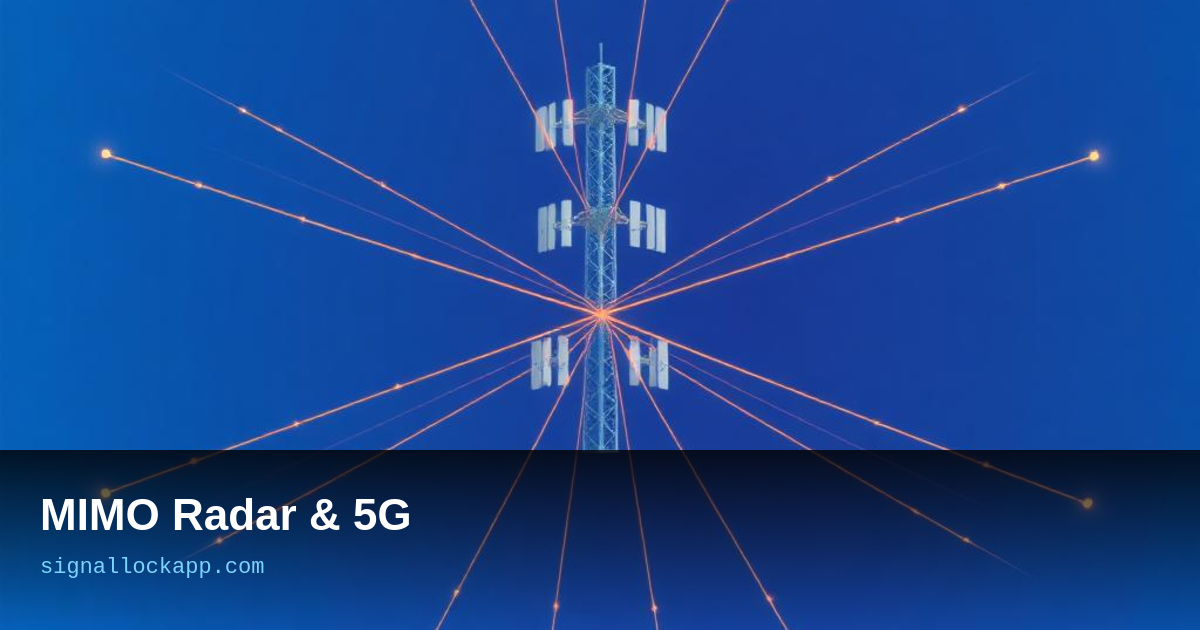
In communications, MIMO means sending different data from each antenna so the receiver, knowing the channel, can separate them. In radar, MIMO means transmitting orthogonal waveforms from each antenna. The returns contain angle, Doppler and range information from every transmit-receive pair. One array does the work of many.
5G as radar
A 5G base station is already a massive MIMO array with 64+ antennas. It must track users to steer beams. Researchers are showing that the same signals, processed correctly, can detect pedestrians around street corners, map building occupancy, and even sense breathing and heart rate through walls. No extra hardware — just smarter signal processing.
Waveform orthogonality
The key is making each transmit channel distinct. Methods include frequency division (each antenna gets a slice), time division (rapid switching), or code division (unique phase codes per antenna). Up-and-coming: index modulation, where the active antenna itself carries information. The better the orthogonality, the cleaner the radar image.
From lab to deployment
Automotive MIMO radar prototypes resolve multiple targets in dense urban clutter. Military systems use MIMO to track swarms of drones. The IEEE 802.11bf standard, expected around 2025, will formalise Wi-Fi sensing. Your router will not just stream video — it will know when you walk into the room.
Virtual Array Extension
The primary mathematical advantage of MIMO radar is the creation of a 'virtual array.' In a standard phased-array system with N elements, the angular resolution is limited by the physical aperture size. However, by using MIMO with T transmitters and R receivers, the system can synthesize a virtual array equivalent to T times R elements. For example, a configuration with 4 transmitters and 8 receivers behaves like a 32-element linear array. This drastically increases the degrees of freedom without increasing the physical footprint or manufacturing cost of the hardware, allowing for higher angular resolution in compact consumer electronics.
This extension is particularly critical for the automotive sector. Modern 77 GHz radar sensors leverage the virtual array to distinguish between closely spaced objects, such as a cyclist riding parallel to a stationary vehicle. By exploiting the spatial diversity of the virtual elements, engineers can suppress side lobes and improve the signal-to-noise ratio. The transition from physical to virtual apertures has effectively moved radar development from a hardware-constrained discipline into a digital signal processing domain, where throughput and algorithm efficiency dictate performance rather than the raw number of physical antenna patches.
The Integrated Waveform Challenge
Merging communication and sensing requires a delicate balance of waveform design. Traditionally, communication signals like Orthogonal Frequency Division Multiplexing (OFDM) are optimized for data rate, while radar signals like Frequency Modulated Continuous Wave (FMCW) are optimized for range and velocity resolution. Current JCAS research focuses on adapting the cyclic prefix of OFDM symbols to serve as a radar pulse. This allows the base station to estimate the delay and Doppler shift of reflections while simultaneously delivering high-speed data. However, the high peak-to-average power ratio (PAPR) of OFDM remains a significant hurdle for high-efficiency radar transmitters.
A historical precursor to this integration dates back to the early 2000s, when researchers first experimented with passive radar using FM radio and DVB-T signals. Unlike those early 'illuminators of opportunity,' modern 5G MIMO systems provide a deterministic and controllable signal source. The move toward 6G will likely introduce 'Full-Duplex' sensing, where the array transmits and receives on the same frequency at the same time. This requires advanced self-interference cancellation techniques originally developed for military electronic warfare, now being miniaturized for urban infrastructure to enable real-time traffic monitoring and autonomous drone navigation.
The Ambiguity Function Conflict
The primary tension in JCAS arises from the fundamental difference between communication and radar performance metrics. Communications focus on high throughput and low Bit Error Rate (BER), which favors signals with high spectral efficiency and a flat frequency response. Radar, conversely, relies on the ambiguity function to measure resolution in range and Doppler domains. A waveform optimized for data transfer often yields high range sidelobes, creating 'ghost' targets or masking smaller objects near strong reflectors. Finding a hybrid waveform that maintains a thumbtack-shaped ambiguity function without sacrificing Shannon capacity is the current frontier of signal design.
Historically, this conflict was handled via time-sharing, where specific slots in a frame were dedicated to pulses while others carried data. However, the shift toward 5G-enabled vehicular networks (V2X) requires simultaneous operation. Engineers are now employing Orthogonal Frequency Division Multiplexing (OFDM) as a dual-use baseline. By embedding sensing parameters into the pilot subcarriers—originally meant for channel estimation—researchers can perform radar tasks without subtracting from the data payload. This creates a parasitic sensing mode where the communication signal serves as the illumination source, effectively turning every smartphone into a bistatic radar receiver.
Bistatic Geometry and Synchronization
Unlike traditional monostatic radars where the transmitter and receiver share a clock, 5G-based sensing often operates in a bistatic or multistatic configuration. This introduces the critical challenge of phase synchronization. For coherent processing, the receiving node must know the exact timing and carrier phase of the transmitted signal. In a 5G macrocell environment, this is achieved through GPS-disciplined oscillators or Precise Time Protocol (PTP) over fiber backhaul. Without sub-nanosecond synchronization, the calculated range of a detected object can drift by meters, rendering the spatial map useless for autonomous navigation or localized security applications.
The geometry of these distributed systems also alters the radar cross-section (RCS) of targets. An object that appears 'stealthy' or small to a forward-facing monostatic radar may have a massive signature in a bistatic setup due to forward scattering. This geometric diversity provides 5G sensing with a significant advantage over standalone radar modules. By combining perspectives from multiple base stations, the system overcomes the 'corner case' problem where a single sensor is blinded by occlusion. The result is a networked sensing fabric that treats the entire urban landscape as a single, coherent aperture.