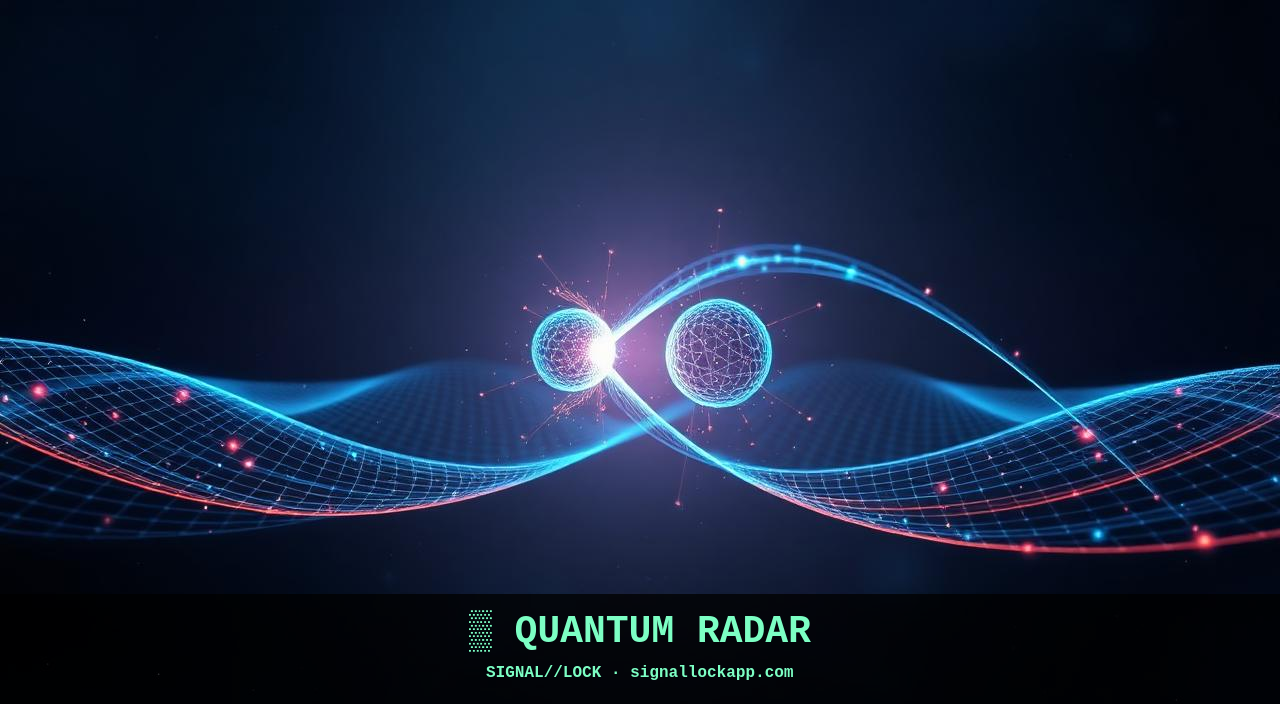
Quantum illumination
Generate two entangled photons. Send one ('signal') toward a target, keep the other ('idler') at the receiver. When the signal returns, perform a joint measurement against the idler. Theoretically, this gives a 6 dB SNR advantage over classical radar when the background is bright and the signal is weak.
The decoherence problem
Entanglement is fragile. By the time the signal photon has reflected off a target tens of kilometres away, the entanglement is almost certainly destroyed by interactions with atmospheric molecules. The 6 dB advantage collapses. Lab demonstrations work at sub-metre ranges in cryogenic environments — not exactly fighter-vs-radar conditions.
Microwave generation
Generating entangled microwave photons (not optical) requires Josephson parametric amplifiers cooled to 20 mK. The 'transmitter' is a dilution refrigerator the size of a wardrobe. You cannot put this on a destroyer, let alone a fighter.
What's actually plausible
Quantum-enhanced radar for short-range, low-power applications (medical imaging, single-photon LIDAR) is real. Long-range quantum radar against stealth aircraft is — for now — a press release, not a system. The advantage is real but small, the engineering is fierce, and classical AESA + ML keeps closing the same SNR gap by a different route.
The Gaussian State Limitation
A common technical misconception is that quantum radar relies on simple particle entanglement like a Bell pair. In microwave applications, the signal is actually a 'squeezed' Gaussian state. To gain any advantage over classical thermal noise, the receiver must distinguish between the correlated signal-plus-noise and pure noise. This requires the phase of the idler photon to be preserved with extreme precision. However, as the range increases, the atmospheric thermal background introduces 'lossy' noise that effectively masks the quantum correlation. In numeric terms, while a classical radar scales linearly with power, a quantum radar's advantage is logarithmic, meaning you hit a wall of diminishing returns almost immediately as power increases.
Furthermore, the 6 dB theoretical limit assumes a perfect joint measurement. In practical engineering, the conversion of microwave photons to optical signals for processing (or vice versa) introduces more insertion loss than the quantum advantage provides. Lloyd's 2008 paper, which formalized 'quantum illumination,' explicitly noted that the benefit exists only in the presence of high-intensity thermal noise where signal power is incredibly low. If you have enough power to overcome the noise classically, the quantum method offers no benefit. This renders the technology useless for long-range surveillance where high-power pulsed transmitters are already standardized and far more efficient.
The CETC 2016 Announcement
In 2016, the China Electronics Technology Group Corporation (CETC) made international headlines by claiming to have developed a working quantum radar with a 100-kilometer detection range. This claim was met with immediate skepticism from the global physics community. While CETC showed images of a hardware assembly, most experts believe the result was either a misunderstanding of 'quantum-enhanced' classical methods or a deliberate misdirection. A 100 km range would require preserving entanglement through a warm, turbulent atmosphere—a feat that contradicts the known decoherence rates of microwave photons. The energy required to maintain the necessary cryogenics for such a range exceeds current mobile platform capabilities.
Technical analysis suggests that any Chinese success likely involved 'ghost imaging' or noise-subtraction techniques rather than true entanglement-based quantum illumination. Ghost imaging uses spatial correlations between two beams of light but does not strictly require entanglement to function. While useful for seeing through smoke or clouds, it does not provide the 'stealth-killing' capabilities promised by hyped media reports. The distinction is critical: one is an incremental improvement in signal processing, while the other is a paradigm-shifting weapon that, as of the 2020s, remains physically localized to laboratory benches and liquid-helium cooling systems.
The Spontaneous Parametric Down-Conversion Barrier
The fundamental process for creating entangled photon pairs, known as Spontaneous Parametric Down-Conversion (SPDC), is significantly less efficient at microwave frequencies than it is in the optical spectrum. In a typical laboratory setup, researchers must utilize non-linear crystals or superconducting circuits to split a pump photon into two lower-energy photons. However, the probability of successful entanglement generation is extremely low, often requiring millions of pump cycles to produce a single correlated pair. While optical SPDC has been a staple of quantum optics since the 1980s, scaling this to the gigahertz range used by radar systems introduces massive thermal noise that masks the subtle quantum correlations required for detection.
Even if the generation rate improved, the 'heralded' nature of these photons creates a data rate bottleneck. In classical radar, a high-power magnetron or solid-state amplifier can pulse megawatts of energy across a wide bandwidth. A quantum system relying on individual photon counts currently operates at bit rates orders of magnitude lower than what is required for real-time tracking of high-speed aerial targets. The engineering effort required to bridge this gap is not merely a matter of incremental improvement; it requires a paradigm shift in how we manage non-linear interactions at millikelvin temperatures without destroying the delicate state of the system.
The False Identification Paradox
A common misconception is that quantum radar 'bypasses' stealth by detecting the physical shape of the aircraft differently. In reality, the 6 dB advantage provided by quantum illumination only applies to the detection of a signal's presence, not the resolution of its features. Stealth aircraft utilize radar-absorbent materials (RAM) designed to dissipate electromagnetic energy as heat. A quantum signal is subject to the same absorption physics as a classical one. If the return signal is completely absorbed or scattered away from the receiver, the entangled idler photon at the base station has nothing to correlate with, rendering the quantum advantage moot in high-absorption scenarios.
Furthermore, modern electronic warfare (EW) tactics such as Digital Radio Frequency Memory (DRFM) jamming rely on re-broadcasting a captured signal to confuse the receiver. Proponents argue that quantum radar is immune to this because a jammer cannot replicate the specific entanglement of the original pulse. While true, the jammer does not need to replicate entanglement; it only needs to saturate the receiver with decoherent noise. By raising the environmental temperature—the 'noise floor'—the jammer forces the quantum radar into a regime where the fragile quantum correlations are statistically indistinguishable from background thermal fluctuations, effectively nullifying the system's theoretical gains.