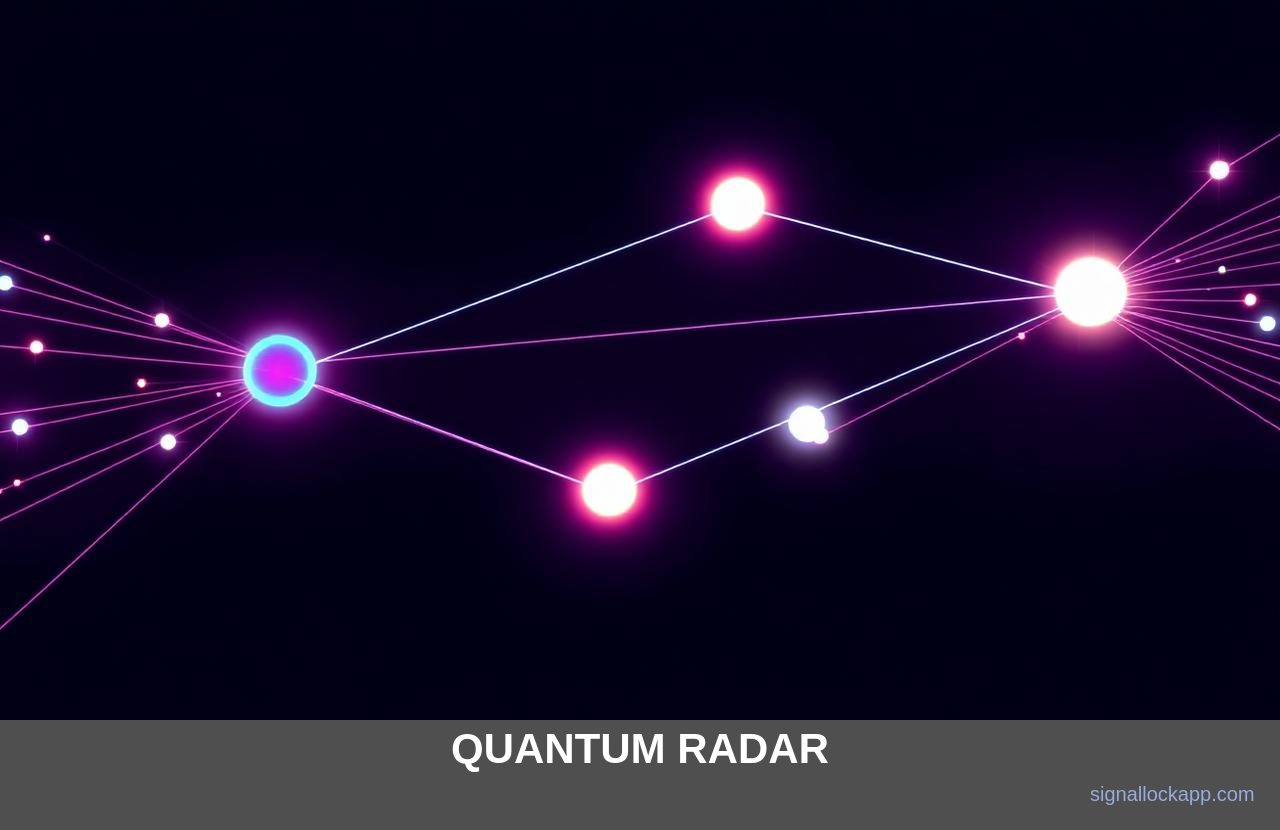
The entanglement trick
You generate pairs of entangled photons. Keep one (the 'idler') in your lab. Send the other (the 'signal') out at the target. When the signal returns, you compare it with its idler twin. Even buried in noise, entangled pairs correlate in a way classical noise cannot fake — so a stealth target with a tiny RCS becomes detectable.
Why it's hard
Entangled photons in the microwave band only exist at temperatures near absolute zero. You need a superconducting source, a cryogenic detector, and you have to store the idler for the entire round-trip time without losing coherence. At 30 km that's 200 µs — an eternity for a quantum state.
What's been demonstrated
Lab benchtop systems at ranges of metres, with modest sensitivity gains over classical microwave detection. The 2016 Chinese 100 km claim was never independently verified. The 2020 US AFRL Quantum 2-Way Ranging program demonstrated only short ranges in controlled conditions.
Verdict
Quantum radar is a real and active research field. It is not a deployable system today, and probably not for at least another decade. Classical radar engineering — better waveforms, AESA, MIMO — keeps closing the stealth gap faster.
The Quantum Illumination Advantage
To understand the performance ceiling, one must look at the Lloyd limit. In 2008, Seth Lloyd at MIT calculated that quantum illumination could provide a 6 dB improvement (a factor of four) in the effective signal-to-noise ratio compared to any classical sensor. This theoretical gain persists even when entanglement is destroyed by environmental decoherence on the path to the target. While a 6 dB boost is significant for detecting low-observable aircraft, it is not the 'magic bullet' often depicted in popular science media. It represents a refinement of detection probability at the margins of thermal noise rather than a total inversion of modern low-probability-of-intercept (LPI) strategy.
The advantage is strictly bounded by the intensity of the signal. Quantum illumination only outperforms classical radar when the transmitted pulse is extremely weak—averaging less than one photon per mode. As soon as you increase the power to practical levels for long-range tracking, the quantum advantage vanishes into the classical limit. This creates a paradox for engineers: the system is most effective when the signal is too weak to be useful for standard ranging, but as you scale the power to overcome atmospheric attenuation, the very entanglement that provided the 'stealth-busting' capability becomes irrelevant compared to high-power Gallium Nitride (GaN) transmitters.
The Microwave vs. Optical Divide
A critical technical hurdle lies in frequency conversion. Most quantum entanglement experiments occur at optical frequencies (hundreds of terahertz) using spontaneous parametric down-conversion in crystals like beta-barium borate. Radar, however, operates in the microwave X-band (8-12 GHz). Converting an optical idler to a microwave signal while preserving its quantum correlation requires an electro-opto-mechanical transducer. Researchers like Shabir Barzanjeh demonstrated this in 2015 using a nanomechanical resonator, but the efficiency of these bridges remains phenomenally low. Without a high-fidelity 'quantum link' between these two worlds, the system remains a laboratory curiosity restricted to cryogenic environments.
Furthermore, atmospheric turbulence behaves differently for quantum states than for classical wavefronts. While classical radar waves are relatively immune to fog or rain at lower frequencies, the delicate timing required for quantum correlation is susceptible to jitter. If a signal photon's phase or arrival time is shifted by mere picoseconds due to atmospheric density fluctuations, it will fail to correlate with the stored idler. This means that even if the hardware matures, a quantum radar might only function reliably in the vacuum of space for satellite-to-satellite tracking, where the intervening medium does not interfere with the fragile temporal synchronization required for the entanglement check.
The Environmental Decoherence Problem
The primary physical barrier to operational quantum radar is the immediate collapse of the wave function upon interaction with a thermal environment. While a classical radar pulse contains quadrillions of photons, a quantum illumination source operates at the single-photon level per temporal mode. As soon as the signal photon enters the atmosphere, it faces a gauntlet of solar radiation and thermal noise. At microwave frequencies, the background thermal noise is approximately 1,000 photons per mode at room temperature. For the 'entanglement trick' to work, the receiver must distinguish one specific signal photon from this massive wall of noise, a process that requires the idler photon to maintain phase stability with perfect precision.
Engineering this stability requires more than just cold hardware; it requires a solution to the 'quantum memory' problem. To correlate the returning signal with the idler, the idler must be stored in a superconducting cavity or a similar delay line that preserves its quantum state without any environmental interference. Current materials science cannot yet produce a storage medium with a high enough Q-factor to hold a microwave photon for the duration of a long-range flight—roughly 6.7 microseconds per kilometer of range—without the state degrading into useless random noise. Until this storage bottleneck is resolved, quantum radar remains restricted to short-range laboratory proximity sensors.
Asymmetric Noise Immunity
One often overlooked advantage of quantum illumination is its inherent resistance to active jamming and spoofing. In a classical electronic warfare scenario, an adversary can capture a radar pulse and retransmit a modified version to create a 'phantom' target. However, because a quantum radar relies on the specific quantum correlation between the signal and idler photons, an adversary cannot spoof the signal unless they also possess the entangled idler. Since the idler never leaves the transmitter's secure cryogenic housing, the adversary has no way to replicate the specific entanglement signature. Any artificial noise injected by a jammer will lack the necessary quantum correlation, allowing the receiver to mathematically filter it out as background clutter.
Numerical comparisons reveal the starkness of this advantage. In high-noise environments where the signal-to-noise ratio (SNR) is significantly below 1, classical radar theory dictates that detection becomes statistically impossible without increasing power. Quantum illumination, theoretically proposed by Seth Lloyd in 2008, offers a potential 6 dB (four-fold) improvement in the effective error probability compared to the best possible classical sensor of equal power. While 6 dB seems modest, in the context of stealth detection, it represents the difference between a clean lock and a blank screen. This advantage persists even if the entanglement is lost during the journey, provided the initial correlation was established, a phenomenon known as 'quantum-enhanced' classical sensing.