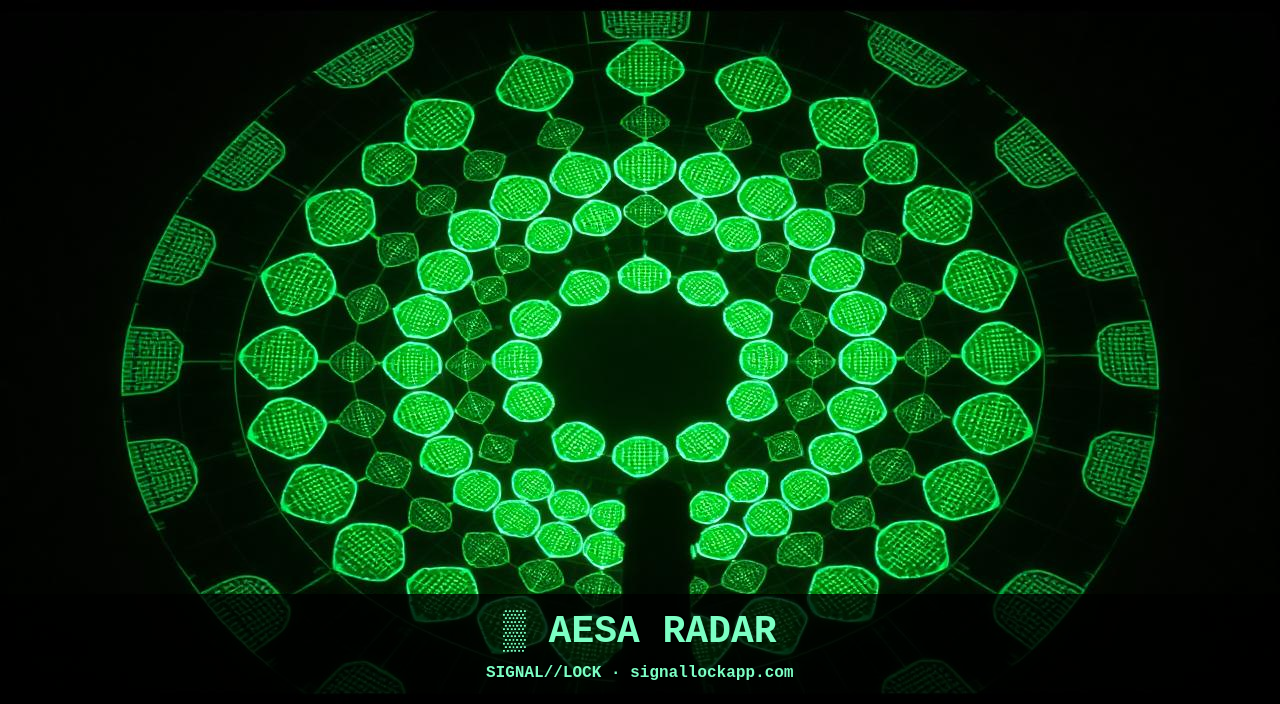
Transmit/Receive modules
An AESA face holds 1,000–2,000 T/R modules, each the size of a matchbox. Each contains a gallium-nitride (GaN) power amplifier, a low-noise receiver, a phase shifter and an attenuator. Failing modules degrade performance gracefully — losing 10% of modules costs only 1 dB of gain, where a mechanical radar with one failed transmitter is dead.
Beam agility
Because steering is electronic, the beam can jump anywhere in the field of view in microseconds. One pulse searches; the next tracks a missile; the next illuminates a target for a semi-active missile; the next is a data link to a wingman. The APG-81 on the F-35 interleaves all of these in real time.
Low probability of intercept
AESA can spread its energy across frequency and time so that an enemy radar warning receiver sees noise, not a radar. Frequency hops every pulse, pulse width and PRF jitter, and beam dwell times measured in microseconds make detection by classical RWRs very hard. This is why fifth-generation fighters can light up targets without warning the target it is being illuminated.
Cost and cooling
AESA is expensive — a fighter radar can cost several million dollars — and the T/R modules generate serious heat. Liquid cooling is standard. But the reliability gains (MTBF measured in thousands of hours vs hundreds for mechanical radars) and capability gains have made AESA the only acceptable choice for modern combat aircraft.
Synthetic aperture and high-resolution imaging
The electronic agility of AESA enables advanced Synthetic Aperture Radar (SAR) modes that are difficult for mechanical systems to sustain. By rapidly toggling between air-to-air tracking and ground-mapping modes, an AESA can build a high-resolution image of the battlefield while simultaneously maintaining situational awareness. This process relies on the precise control of phase and amplitude across the array, allowing the radar to simulate a much larger antenna aperture through the aircraft's motion. The resulting imagery can resolve objects as small as a few inches from distances of dozens of miles, even through cloud cover or smoke.
Modern systems like the AN/APG-77 utilize this resolution to perform Non-Cooperative Target Recognition (NCTR). By analyzing the radar return from a target's engine blades or specific airframe features, the software can identify the exact model of an enemy aircraft rather than just its position. This capability is a direct result of the wide-bandwidth waveforms that T/R modules can generate and receive. Because the array can split into multiple sub-apertures, it can perform these imaging tasks on one part of the face while another dedicated section continues to search the horizon for incoming threats.
Electronic warfare and cyber integration
An AESA is inherently a powerful electronic warfare (EW) tool due to its ability to steer high-gain energy with surgical precision. Traditional jammers radiate energy across a broad arc, which wastes power and alerts everyone to their presence. An AESA, however, can focus a narrow 'pencil beam' of high-power radiation directly at an enemy's receiver nodes, effectively blinding them with focused spectral density. This process, often called 'Electronic Attack,' allows a fighter to suppress enemy air defenses without carrying dedicated jamming pods, as the radar itself acts as the transmitter.
Beyond simple jamming, AESAs are increasingly used for high-bandwidth data injection and cyber effects. Because the beams can be modulated with extreme precision, they can theoretically be used to transmit data streams into enemy sensor networks that lack robust signal validation. This blurring of the lines between radar, communications, and electronic warfare is the foundation of Multi-Function Advanced Data Link (MADL) systems. The transition from gallium arsenide (GaAs) to gallium nitride (GaN) semiconductors has further enabled this by allowing modules to operate at higher voltages and temperatures, increasing the total radiated power available for these complex waveforms.
Gallium Nitride and Thermal Power Density
Modern AESA development is inextricably linked to the shift from Gallium Arsenide (GaAs) to Gallium Nitride (GaN) semiconductors. First appearing in field trials around 2010, GaN modules offer roughly five times the power density of their predecessors. This allows for significantly higher breakdown voltages and operating temperatures, enabling a radar to punch through heavy electronic jamming or extend its detection range by over 50%. However, this density creates a massive thermal management challenge. Because each T/R module generates heat in a concentrated area, systems now require liquid-cooling loops that snake through the antenna backplane to prevent the array from melting under its own pulse power.
The transition to GaN is not merely about power; it is about bandwidth. Older passive arrays were often limited to narrow frequency bands due to the physical properties of their waveguide components. A GaN-based AESA can operate across an ultra-wideband spectrum, shifting from X-band for precision tracking to lower frequencies for long-range volume search within the same mission. This versatility effectively combines the roles of multiple legacy radar sets into a single aperture. In naval applications like the SPY-6, this allows a ship to simultaneously defend against ballistic missiles in space and low-flying cruise missiles at the horizon without swapping hardware.
The Sidelobe Problem and Digital Beamforming
A common misconception is that AESA beams are perfect needles of energy. In reality, all phased arrays produce sidelobes—unintended energy leaks that radiate in directions other than the main beam. In legacy systems, these sidelobes were fixed by the physical geometry of the antenna. AESA solves this through adaptive digital beamforming. By precisely controlling the amplitude and phase of each individual module, the radar can 'null' its sidelobes in the direction of an enemy jammer. If a jamming signal is detected coming from a specific angle, the software calculates a phase pattern that creates a blind spot in the radar's sensitivity at that exact location while maintaining full gain elsewhere.
This digital control also enables 'multibeam' operation, a feat impossible for mechanical or passive systems. The processor can divide the 1,000+ modules into sub-arrays, effectively creating four or five independent radars operating simultaneously from the same face. One sub-array might scan the ground for moving targets (GMTI) while another maintains a high-update track on an aerial threat. This level of concurrency is why AESA is considered the foundational sensor for sixth-generation air dominance. It transforms the radar from a simple ranging tool into a multi-role sensor capable of offensive electronic attack and high-speed directional data transfer at the gigabit level.