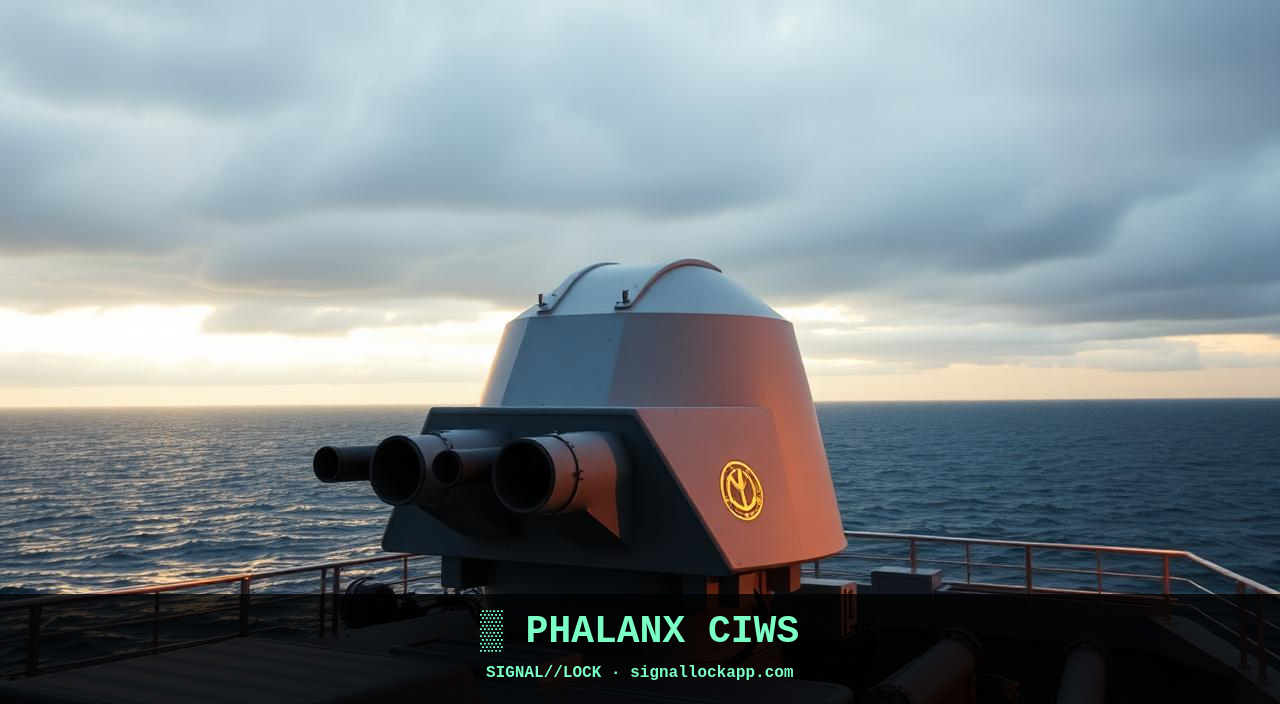
Radar and gun in one mount
The R2D2-shaped white dome contains a Ku-band search radar and a Ka-band tracking radar mounted directly on the gun. There's no human in the loop and no separate fire-control computer in the ship — the system is self-contained. It searches, detects, classifies, tracks, opens fire and walks the rounds onto the target by watching where the tracers go.
Closed-loop spotting
The tracking radar watches both the incoming missile and the M61 Vulcan's outgoing rounds. It measures the miss distance pulse-by-pulse and steers the gun until the round stream and the missile track converge. This 'closed-loop spotting' is why a 20 mm round can hit a missile travelling 600 m/s.
Ammunition
Originally depleted-uranium penetrators, later replaced with tungsten for political reasons. Each round weighs 100 g and the gun fires 4,500 per minute — 75 per second. A typical engagement burst is 200 rounds, gone in under three seconds. The magazine holds about 1,500 rounds, enough for several engagements before reloading.
Limitations
Phalanx struggles with manoeuvring sea-skimmers (the Russian P-800 Oniks pops up and dives at the last second), saturation attacks (multiple missiles within seconds), and high-supersonic threats where the engagement window collapses below one second. The replacement, SeaRAM, swaps the gun for 11 Rolling Airframe missiles with longer reach and higher kill probability.
The Block 1B upgrade and surface threats
In the mid-1990s, the US Navy identified a gap in defense against asymmetric threats like high-speed swarming boats and low-slow flyers. The resulting Block 1B upgrade added an Integrated Thermal Imager (ITI) to the white radome. This FLIR sensor allows the system to engage non-radar targets using manual override or automated electro-optical tracking. The upgrade also lengthened the gun barrels by 18 inches as the M61A1 transitioned to the OGWP (Optimized Gun Barrel Program), which reduced muzzle dispersion and maintained a tighter projectile grouping at the maximum effective range of 1.5 kilometers.
Crucially, the Block 1B increased the system's reliability against crossing targets—objects not flying directly at the ship. While the original radar-only Phalanx struggled with surface clutter and low-altitude multi-path interference near the water's surface, the thermal imaging system provides a clear thermal signature against the cold ocean background. This evolution turned a dedicated anti-missile system into a multi-role defensive weapon capable of neutralizing littoral threats, including terrorist-operated small craft and reconnaissance drones, extending the platform's utility well into the 21st century.
Reaction times and the 'Auto' mode controversy
The system operates in four modes: Standby, Manual, Semi-Automatic, and Automatic. In 'Automatic' mode, the internal computer makes the decision to fire based on pre-programmed parameters including target velocity, trajectory, and radar cross-section. This autonomy is necessary because the engagement window is often less than four seconds. If the system detects a target with a high closing velocity within the 5.5-nautical-mile search radius, it prioritizes the threat and engages immediately. This eliminates the latency inherent in human decision-making, which is too slow to counter supersonic anti-ship missiles like the P-270 Moskit.
However, this autonomy has faced historical scrutiny, most notably following the 1987 USS Stark incident. Although the Phalanx was in standby at the time and not 'Automatic' mode, the event sparked intense debate over the risks of automated fire-control systems. If the system is left in 'Auto' near friendly aircraft or in busy shipping lanes, the risk of fratricide increases. Modern electronic identification (IFF) integration and restrictive engagement zones have largely mitigated these risks, ensuring the system remains lethal against threats while minimizing the potential for tragic accidents in cluttered environments.
The Ku-band search and track transition
The system's search radar operates in the Ku-band, utilizing a digital MTI (Moving Target Indicator) to filter out sea clutter and birds while isolating high-velocity targets. Once a potential threat is detected, the Phalanx initiates a 'handshake' between the search radar and the pulse-Doppler tracking radar. This handover process must occur in milliseconds. Because the tracking radar utilizes a much narrower beamwidth than the search unit, any mechanical misalignment or lag in the mount's servos during this transition results in a failed acquisition. The system's ability to maintain a 'track-while-scan' capability ensures it can identify new threats even while engaged with a primary target.
The Ku-band frequency choice (12 to 18 GHz) is a calculated trade-off. While it provides high resolution necessary for detecting small-RCS (Radar Cross Section) missiles, it is susceptible to atmospheric attenuation in heavy rain or fog. To compensate, the Block 1B variant incorporates an integrated Forward-Looking Infrared (FLIR) sensor. This allows the system to remain effective in visually degraded environments where radar performance might be hampered by multipath interference—a common phenomenon where signals bounce off the water's surface, creating a 'ghost' image that can confuse less sophisticated point-defense systems.
The 1987 USS Stark incident
A critical case study in CIWS history is the May 17, 1987 attack on the USS Stark (FFG-31) by an Iraqi Falcon 50. Two Exocet missiles hit the ship, killing 37 sailors. During the engagement, the ship's Phalanx system was in 'Standby' mode rather than 'Auto-Special,' the high-readiness state required for immediate response. The crew did not expect an attack, and by the time the threat was identified, the missiles were within the radar's minimum range or obscured by the ship's own superstructure. This incident led to significant changes in operational doctrine regarding when and how CIWS systems are integrated into a ship's Combat Information Center (CIC) during transit in high-risk zones.
Post-incident analysis highlighted that even the most advanced autonomous system is a liability if inhibited by human-imposed safety constraints during active combat. Subsequently, US Navy doctrine was updated to emphasize the Phalanx's role as an automated failsafe. Modern crews are trained to manage 'engagement zones' where the CIWS is granted weapons-free authority over specific sectors. This prevents a repeat of the Stark tragedy, ensuring that if a missile enters the 1.5 km terminal zone, the system responds with its 4,500 rounds-per-minute cycle without waiting for a manual 'consent to fire' command from the bridge.