Hertz, Hülsmeyer and a thirty-year pause (1886–1934)
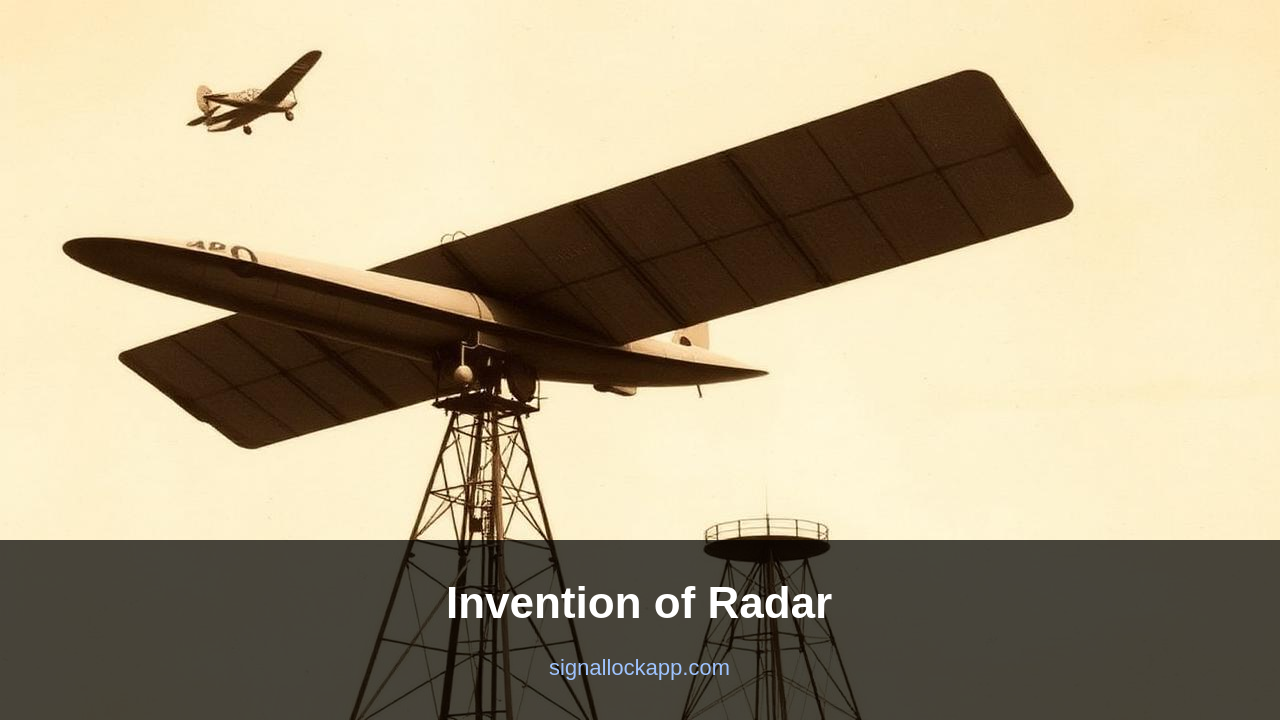
In 1886 Heinrich Hertz proved that radio waves reflect off solid surfaces just like light. In 1904 a German engineer named Christian Hülsmeyer patented the Telemobiloskop — a brass-and-glass machine that warned ships of nearby vessels in fog. It worked at 3 kilometres. Nobody bought it.
The idea sat almost untouched for three decades. Radio was busy becoming broadcasting. Reflecting waves off ships and aircraft seemed like a parlour trick until military planners in the 1930s realised that an aircraft moving at 300 km/h could not be heard, seen or stopped without some way to detect it beyond the horizon.
Eight countries, one idea (1934–1939)
Between 1934 and 1939, scientists in the United Kingdom, United States, Germany, France, Italy, the Soviet Union, the Netherlands and Japan independently built working radar prototypes. They did not collaborate. Most did not know the others existed.
Robert Watson-Watt's 1935 Daventry experiment in the UK is usually credited as the first practical air-defence radar, because it led directly to the Chain Home network that ringed Britain by 1939. Rudolf Kühnhold in Germany demonstrated ship detection in 1934. Robert Page at the US Naval Research Lab built the first pulsed radar the same year.
Why pulsed radar changed everything
Early systems sent a continuous wave and listened for Doppler shifts. They could tell you something was moving, but not where it was. Pulsed radar — invented independently in the US, UK and Germany around 1934 — sent short bursts, then measured the time delay of the echo. Time-of-flight gives you exact range. Range plus antenna direction gives you a point on a map. That single change is what turned radar from a curiosity into a weapon.
The cavity magnetron — the most important radar invention
In February 1940 two physicists at Birmingham University, John Randall and Harry Boot, built the first cavity magnetron. It produced microwave-frequency radio at kilowatt power levels from a device the size of a fist. Before the magnetron, radar antennas were the size of a tennis court. After it, radar fit in a fighter's nose cone.
Britain handed the magnetron design to the United States as part of the Tizard Mission in late 1940 — historians often call it 'the most valuable cargo ever brought to American shores.' Every microwave oven on Earth today is a direct descendant.
Why this still matters
The radar sweep you see in every air-traffic tower, every weather forecast, every arcade radar game including Signal//Lock, is the same Plan Position Indicator (PPI) display invented in 1944. The physics has not changed: send a pulse, wait for the echo, plot the dot. Everything else is engineering on top of that one idea.
The Tizard Mission and the dawn of technological sharing
In September 1940, the British government realized that while they had the cavity magnetron, they lacked the industrial capacity to mass-produce it during the Blitz. Sir Henry Tizard led a secret mission to the United States, carrying the device in a modest black metal box. This transfer of technology is often described by historians as the most valuable cargo ever brought to American shores. It bridged the gap between British theoretical innovation and American manufacturing might, leading to the creation of the MIT Radiation Laboratory, where nearly 4,000 personnel worked to refine the device and integrate it into aircraft and ships.
The impact was immediate and irreversible. Before the Tizard Mission, radar units were building-sized installations that required massive power supplies. The pulsed power of the cavity magnetron allowed for the miniaturization of sets to the size of a suitcase. This enabled the development of 'H2S' ground-mapping radar and airborne interception systems, which allowed night fighters to track bombers in total darkness. By the end of 1942, radar was no longer just a defensive perimeter on the English coastline; it had become an offensive tool capable of being carried into the heart of enemy territory.
The move to the microwave spectrum
Early systems like the British Chain Home operated in the High Frequency (HF) band, specifically between 20 and 30 MHz. These wavelengths were several meters long, which meant the antennas had to be gargantuan—standing hundreds of feet tall—to be effective. Because these waves were so long, they lacked 'angular resolution,' meaning they could detect a group of aircraft but struggled to distinguish individual planes within a formation. Engineers knew that to see finer details, they needed to move to what we now call microwaves—frequencies above 3000 MHz with wavelengths measured in centimeters.
The shift to S-band and X-band frequencies changed the physics of detection. Shorter wavelengths allow for smaller parabolic dishes that can focus the radio energy into a narrow beam, much like a searchlight. This increased precision enabled the development of naval fire-control radar, which allowed ships to target enemies in fog or smoke with greater accuracy than optical rangefinders. Modern systems in the 21st century, from air traffic control to the millimeter-wave sensors in self-driving cars, are the direct descendants of this wartime push for higher frequencies and narrower beams.
The Chain Home system and the filter room
While the hardware of the Chain Home stations was impressive, the true innovation was the integrated reporting system established by the RAF. By 1940, the British had constructed massive masts reaching 360 feet in height along the coast. These stations operated at relatively low frequencies between 20 and 30 MHz, which produced significant ground interference. To solve this, operators used a manual direction-finding technique involving a goniometer to compare the phase of received signals. This raw data was not sent directly to pilots; instead, it was transmitted to a centralized Filter Room. Here, analysts cross-referenced radar plots with observer corps reports to remove ghosts and evaluate the size of incoming raids.
The Filter Room's Dowding System was effectively the world's first integrated data-processing network. It allowed the Royal Air Force to focus its limited number of Hurricane and Spitfire fighters exactly where the German Luftwaffe was approaching, rather than maintaining exhausting standing patrols. This efficiency turned radar from a mere detection sensor into a force multiplier. Without this logistical architecture, the physical radar towers would have been overwhelmed by the speed of modern aerial warfare. The British realized early that a signal is only as useful as the speed of its interpretation, setting the precedent for all modern Command and Control (C2) environments.
Plan Position Indicators: Bringing the map to the screen
The original radar displays were A-scopes, which depicted signals as vertical spikes along a horizontal timeline. This required skilled operators to translate a 'blip' on an oscilloscope into a geographical coordinate mentally. The transformation to the circular, rotating display known as the Plan Position Indicator (PPI) changed the interface forever. Introduced widely around 1940, the PPI synchronized the rotation of the radar antenna with a scanning beam on a cathode-ray tube. This created a top-down, bird's-eye view of the surrounding area, allowing commanders to see the relative positions of multiple targets in real-time as physical dots on a glowing map.
This visual leap facilitated the move of radar from stationary coastal sites into the cockpits of night fighters and onto the bridges of naval destroyers. The PPI made it possible for a navigator to recognize coastlines and navigate through total darkness or thick fog without external landmarks. By 1943, the H2S radar system allowed Allied bombers to 'see' German cities through cloud cover using this circular mapping technique. It remains the standard interface for air traffic control and maritime navigation today, proving that how information is displayed to a human is just as critical as how the pulse is generated.