Maxwell's prediction
In 1865 James Clerk Maxwell published four equations that unified electricity and magnetism. A consequence: changing electric fields should radiate energy at the speed of light. Nobody had ever seen such waves. Maxwell died in 1879 without proof.
The spark-gap transmitter
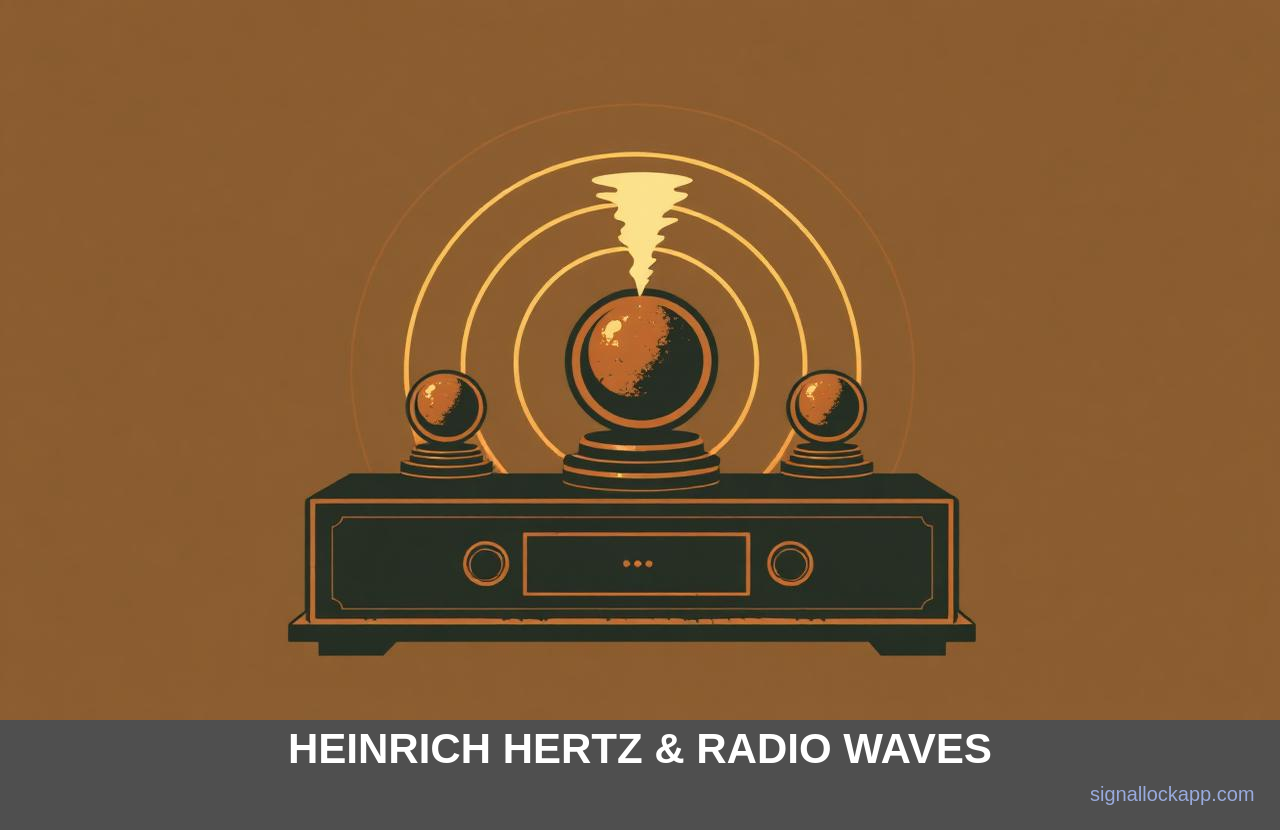
Hertz built a high-voltage induction coil that arced across two brass spheres. Each spark pumped a burst of electromagnetic energy into the air. Across the room a thin wire loop with its own tiny gap caught a faint spark in sync. Invisible waves had crossed the room.
Measuring the wavelength
Hertz bounced the waves off a zinc sheet and mapped the standing-wave pattern with his detector loop. Distance between nulls gave him the wavelength — about 66 cm. Multiplied by frequency, he got the speed of light. Maxwell was vindicated.
'Of no use whatsoever'
Asked about applications, Hertz replied that his waves were 'of no use whatsoever — this is just an experiment that proves Maestro Maxwell was right.' He died of vasculitis in 1894 at age 36, never seeing Marconi's wireless telegraph or the radar that would carry his name as a unit of frequency.
The Polarization Controversy
To confirm the waves were truly electromagnetic and not some unknown form of acoustic vibration, Hertz shifted the orientation of his detector loop. In 1888, he noticed that rotating the receiving ring relative to the transmitter caused the spark to vanish or intensify. This proved that radio waves have a specific polarization, oscillating in a single plane—a direct characteristic of transverse waves predicted by Maxwell’s theory. By placing a series of parallel wires between the transmitter and receiver, he observed that the wires could block the signal depending on their alignment, much like how a modern polarized lens filters light.
This experiment provided the first concrete link between electricity and optics. Until this moment, light was considered a distinct phenomenon from electrical energy. Hertz’s proof of polarization allowed him to treat radio waves as 'invisible light,' demonstrating that they could be refracted through large prisms made of pitch and reflected using metallic mirrors. This established the foundational physics for the directional antennas used in modern radar systems and satellite communication. He effectively merged the fields of optics and electromagnetism, proving that the spectrum extended far beyond what the human eye could perceive.
The Accidental Photoelectric Effect
While refining his spark-gap apparatus in 1887, Hertz observed a puzzling anomaly that would later trigger the quantum revolution. He noticed that the tiny spark in the secondary receiver loop became stronger and more bright when it was illuminated by the ultraviolet light emitted from the primary transmitter spark. To test this, he placed a glass shield between the two; the spark dimmed because glass blocks ultraviolet radiation. While Hertz documented this phenomenon meticulously, he did not pursue its theoretical implications, focusing instead on the wave nature of the energy rather than the particle-like behavior of light.
This observation was the first recorded instance of the photoelectric effect. While Hertz died in 1894 at the age of 36, his findings provided the data that Albert Einstein would use in 1905 to explain how light delivers energy in discrete packets, or photons. Therefore, Hertz's basement laboratory did more than just confirm the existence of radio waves; it inadvertently laid the groundwork for modern electronics. Every digital camera sensor, solar panel, and night-vision device used today operates on the photoelectric principles first cataloged by Hertz during his search for Maxwell's invisible waves.
The skin effect and the wire resonator
While proving wave propagation, Hertz also identified what would become known as the skin effect. He observed that high-frequency currents do not penetrate deep into a conductor but remain concentrated on the surface. During his 1887 experiments at the University of Karlsruhe, he discovered that a copper tube hindered the signal no more than a solid copper rod of the same diameter. This technical nuance was critical for the later development of waveguides and coaxial cables, ensuring that engineers understood how to manage signal loss in the radio spectrum.
To resonate at the desired frequency, Hertz tuned his apparatus using length-to-thickness ratios that predated modern antenna theory. His primary transmitter utilized two side-by-side metal plates connected by a straight wire interrupted by the spark gap. By adjusting the physical dimensions of these plates, he could shift the frequency, effectively creating the first tunable radio oscillator. This early mastery of resonance allowed him to confirm that electromagnetic waves behave like light, reflecting off insulators and refracting through prisms made of pitch.
The quantitative validation of 1888
In early 1888, Hertz performed his most rigorous calculations to resolve the discrepancy between the velocity of waves in wires versus their velocity through air. His findings initially showed a disturbing difference, which he feared suggested a flaw in Maxwell’s theory. However, through subsequent trials, he identified interference from the walls of his lecture hall as the variable causing the error. Once corrected, his results yielded a velocity near 300,000 kilometers per second, providing the first experimental confirmation that light and electromagnetic radiation are identical in nature.
Beyond the velocity, Hertz meticulously quantified the interference patterns created by his waves. By moving his receiving loop along the path of the radiation, he mapped nodes and antinodes with precision, calculating a frequency of approximately 50 megahertz. This leap from qualitative observation to quantitative proof transformed Maxwell's theoretical abstractions into a practical branch of physics. It moved the study of electricity from the realm of slow-moving currents into the high-speed world of oscillating fields, laying the cornerstone for all future telecommunications.