The 1940 breakthrough
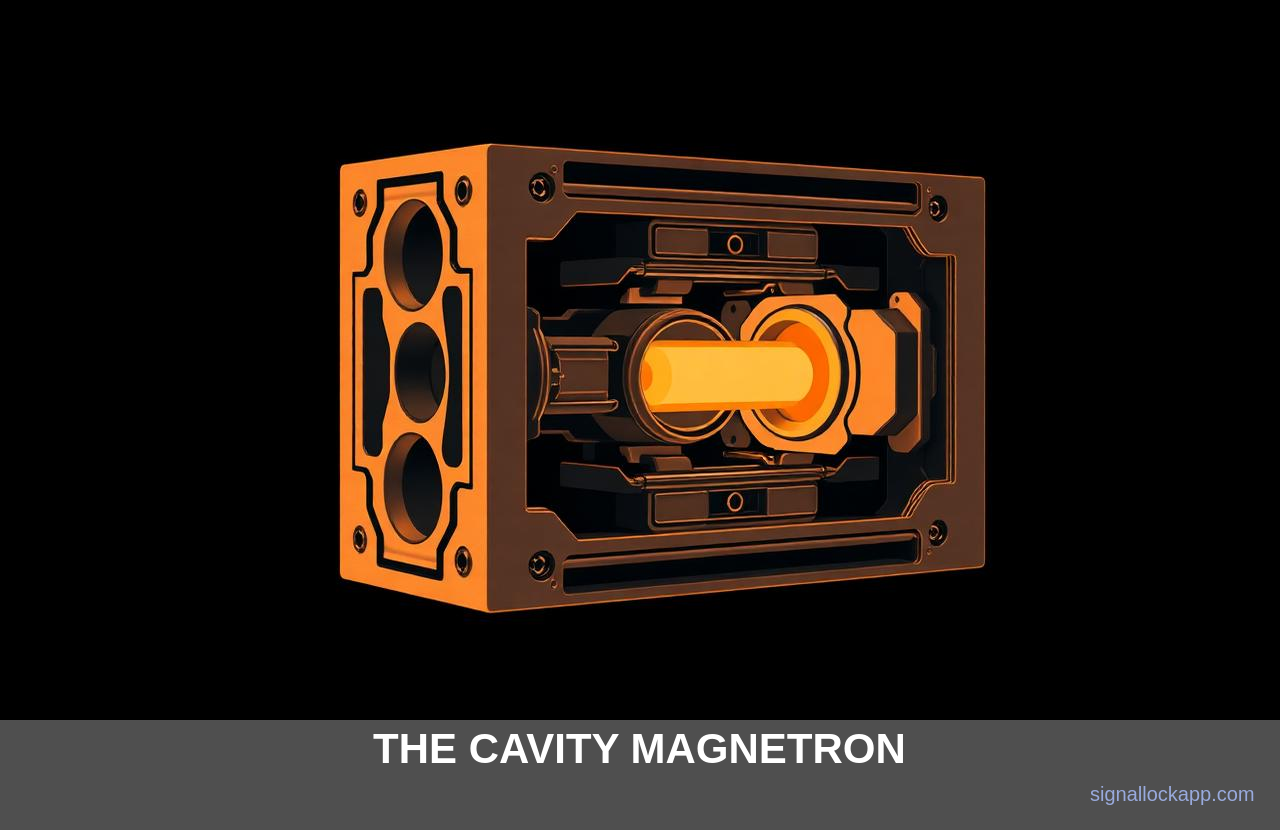
John Randall and Harry Boot at Birmingham University drilled six resonant cavities into a copper block, added a heated cathode in the middle, and applied a magnetic field. The result: 10 kW of pulsed 10 cm microwaves from a device you could hold in your hand. Existing klystrons produced milliwatts.
The Tizard Mission
In September 1940 Britain sent a working magnetron to the United States in a black metal trunk. Historian James Phinney Baxter called it 'the most valuable cargo ever brought to our shores.' MIT's Radiation Lab reverse-engineered it into the H2S airborne radar, the SCR-584 fire-control radar, and dozens of other systems.
Why microwaves mattered
Long-wave radars needed enormous antennas. A 10 cm microwave radar could use a 1 m dish — small enough for aircraft, ships and trucks. Suddenly, fighters could find U-boats at night, bombers could see cities through cloud, and fleets could spot incoming kamikazes.
Same physics in your microwave oven
Every kitchen microwave still uses a cavity magnetron, almost unchanged from Randall and Boot's design. The same 2.45 GHz that boils your soup once guided a Lancaster bomber to its target.
The Critical Role of the Resonant Cavity
While previous vacuum tubes relied on linear electron flow, the cavity magnetron utilizes a circular geometry that creates a self-sustaining oscillation. As electrons travel from the central cathode toward the outer anode, a powerful magnetic field bends their path into a circular orbit. This 'cloud' of spinning electrons passes the openings of the six resonant cavities. Each cavity acts as a high-frequency LC circuit, where the physical dimensions of the hole determine the frequency. The moving electrons induce an alternating charge on the cavity walls, which in turn creates an electromagnetic field that bunches the electrons further, establishing a feedback loop that converts direct current into high-power microwave pulses.
The heat management of this process was the primary engineering hurdle for Randall and Boot. Because the device operated at such high power densities, the copper block itself served as a massive heat sink. Early laboratory models required water cooling to prevent the copper from melting under the intense bombardment of electrons that failed to reach the cavities. By 1941, mass-produced versions moved to finned air-cooling systems, allowing the magnetron to be mounted securely in the confined, unpressurized nose cones of night fighters. This transition from laboratory curiosity to ruggedized military hardware was completed in less than twelve months, a pace necessitated by the escalating Battle of the Atlantic.
The Proximity Fuze and the SCR-584
The impact of the magnetron extended far beyond mere detection; it revolutionized ballistics through the development of the SCR-584 radar and the proximity fuze. Before 1943, anti-aircraft gunners relied on visual lead-computation and timed fuses that rarely detonated near the target. The SCR-584, powered by the magnetron's precision, could automatically track an enemy aircraft with an accuracy of 0.06 degrees. When coupled with the Bell Labs M9 predictor, this system could calculate the exact intercept point and aim heavy artillery without human intervention. This technical synergy turned the V-1 'Buzz Bomb' threat from a terror weapon into a target-practice exercise for Allied batteries defending London and Antwerp.
Perhaps most remarkably, the miniaturization enabled by the magnetron influenced the design of vacuum tubes small enough to fit inside a 5-inch artillery shell. These 'proximity fuzes' used the same principles of reflected radio energy to detect when a shell was within lethal range of an aircraft or the ground. This meant a direct hit was no longer required for a kill. General George S. Patton credited this development with winning the Battle of the Bulge, noting that the 'funny fuze' made Allied artillery devastatingly effective against German infantry in open terrain. It remains a prime example of how microwave technology shifted the tactical balance of the 20th century.
The Electron Dance: Understanding Cross-Field Interaction
To understand the magnetron’s efficiency, one must look at the interaction between the electric and magnetic fields, a configuration known as a 'cross-field' device. In a standard vacuum tube, electrons travel in a straight line from cathode to anode. In the cavity magnetron, a strong axial magnetic field forces these electrons into a circular, spiraling path. As they sweep past the openings of the resonant cavities, they induce high-frequency oscillations. This process is self-sustaining: the oscillating fields in the cavities bunch the electrons into a 'spoke' pattern, which then rotates in synchronization with the microwave frequency, effectively converting high-voltage direct current into pulsed radio-frequency energy with up to 80% efficiency.
This mechanism solved the 'transit time' problem that handicapped earlier radio valves. In conventional tubes, the time it took for an electron to travel across the gap limited the maximum frequency. By using the magnetic field to keep electrons in the interaction space longer and forcing them to work against the oscillating field, Randall and Boot bypassed these limits. The resulting power density was unprecedented; while previous high-frequency generators produced mere watts, the Birmingham prototype reached 400 watts almost immediately, eventually scaling to kilowatts. This leap was the technical foundation for the centimeter-wave revolution, allowing radar to move from static coast-watch stations to mobile airborne platforms.
The Post-War Legacy: From Radar to the Kitchen
The transition from military secret to domestic appliance began with Percy Spencer, an engineer at Raytheon. In 1945, while standing near an active magnetron, Spencer noticed a candy bar in his pocket had melted. He realized that the same 2.4 GHz waves used to detect Nazi aircraft could agitate water molecules in food, generating heat. This led to the 'Radarange,' the first commercial microwave oven. Early units were massive, standing nearly six feet tall and requiring water cooling, but they utilized the exact same cavity magnetron principle developed by Randall and Boot. By the 1970s, mass production of magnetrons in Japan drove costs down, transforming a weapon of war into a standard kitchen tool.
Beyond the kitchen, the magnetron remains a critical component in various modern industrial applications. It is used in semiconductor manufacturing for plasma etching, in medical radiotherapy for powering linear accelerators that treat cancer, and in industrial drying processes. While solid-state power amplifiers are beginning to replace magnetrons in some low-power radar applications due to their precision and reliability, the magnetron remains the most cost-effective way to generate high-power microwaves. Its fundamental design has remained largely unchanged for over eighty years, proving that the solution reached in 1940 was not just a wartime fluke, but a masterstroke of vacuum-tube engineering.