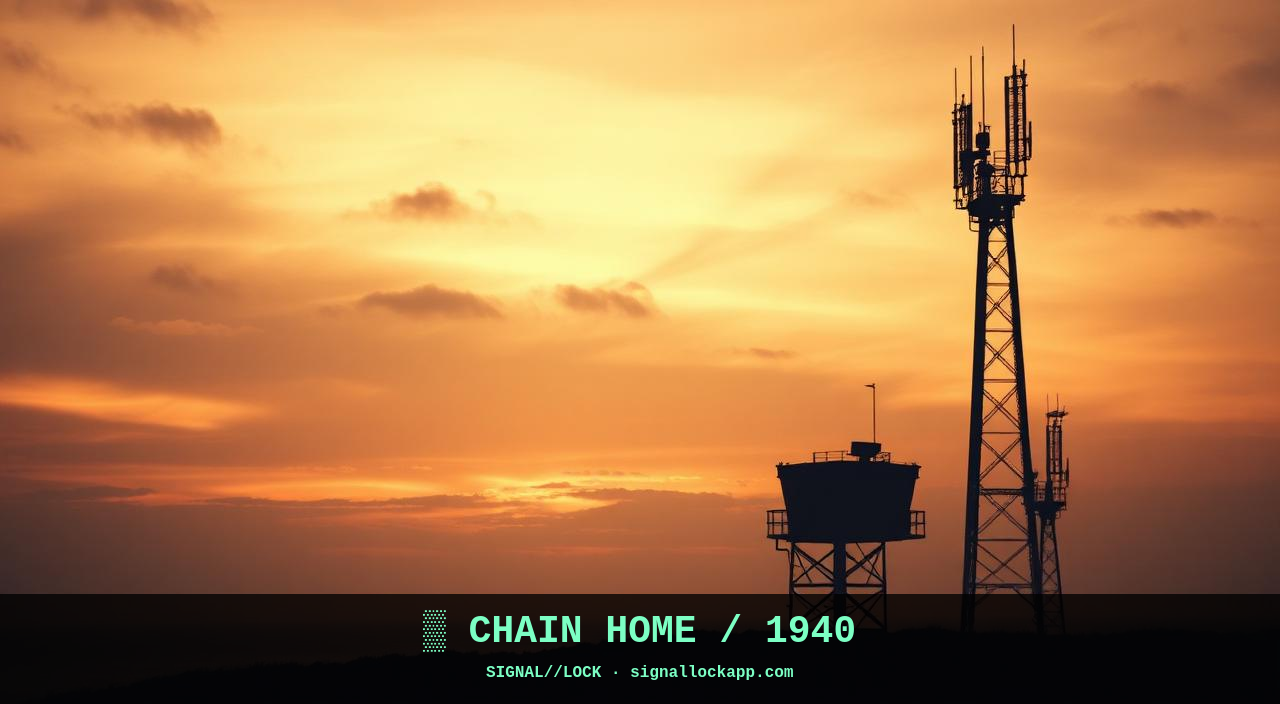
The towers
360-foot steel towers held the transmitter antennas, with 240-foot wooden towers for receivers. The wavelength was so long that a single antenna couldn't focus a beam — instead, the system illuminated huge volumes and used multiple antennas with phase comparison to estimate direction. Accuracy was poor by modern standards (±5°) but adequate to vector fighters.
Filter rooms
Raw radar plots went to a Filter Room where WAAF plotters fused multiple radar reports with Observer Corps visual sightings, resolved duplicates and produced a single track. The filtered tracks went to Fighter Command HQ and then to sector stations, where controllers vectored squadrons. Total decision latency: about four minutes from plot to airborne intercept order.
Why the Germans missed it
The Luftwaffe knew the towers existed but underestimated their importance. Early raids targeted airfields, not radar stations. When the stations were finally attacked in August 1940, the wooden huts and steel towers were surprisingly hard to destroy and were repaired within hours. The Germans never broke the system.
Legacy
Chain Home was obsolete by 1942, replaced by centimetric-wavelength systems. But the operational concept — fused multi-sensor surveillance, central control and vectored intercept — became the template for every air defence network since, from NORAD to today's IADS.
The Pulse Recurrence Frequency Limitation
Chain Home operated with a Pulse Recurrence Frequency (PRF) of 25 or 50 pulses per second, synchronized to the 50 Hz National Grid to prevent drifting interference on cathode ray tube screens. This low frequency allowed the system to detect targets at exceptionally long ranges, up to 200 miles, because the 'silent' interval between pulses was long enough for a signal to travel to a distant bomber and return before the next pulse was transmitted. However, this also meant the refresh rate was remarkably slow compared to modern radar, requiring plotters to manually interpolate the movements of fast-moving aircraft between updates.
To manage the lack of precision in 'floodlight' transmissions, operators used a goniometer—a device that physically rotated a search coil within a field generated by the receiving antennas. By finding the 'null' point where the signal vanished, an operator could mathematically derive the bearing of an incoming raid. This process was as much an art as a science, relying on the spatial intuition of the WAAF operators. Despite the primitive hardware, this method provided the necessary early warning that allowed the RAF to conserve its limited fuel and pilot strength by avoiding continuous standing patrols.
The Identification Friend or Foe (IFF) Problem
In the early months of 1940, the Chain Home system faced a critical flaw: it could distinguish an object in the sky but not its intent or origin. This led to frequent 'friendly fire' risks and unnecessary scrambles. To solve this, the British developed the first active IFF systems, such as the R3002. These transponders detected the incoming Chain Home radar pulse and transmitted a synchronized, coded response back to the receiver. This appeared as a 'pip' on the operator’s screen that periodically grew in size, clearly marking the target as a friendly RAF fighter.
Without this secondary electronic handshake, the Dowding System would have collapsed under the weight of false alarms. The implementation of IFF allowed controllers to see exactly where their own squadrons were positioned relative to the Luftwaffe tracks being reported by the Filter Rooms. By September 1940, the integration of radar-based detection and transponder-based identification created a three-dimensional tactical map that no other military power in the world could replicate, effectively ending the era of surprise aerial bombardment.
The Crossed-Dipole Goniometer
Because the Chain Home antennas could not rotate, operators relied on a radiogoniometer to determine the azimuth of incoming raids. The receiver towers housed pairs of orthogonal dipoles that picked up the phase difference of the 25-meter signal. By manually adjusting a search coil within the goniometer to find the 'null' point of the signal, a skilled operator could triangulate the bearing. This method was fundamentally different from the sweeping beam of later microwave radars; it was more akin to radio direction finding. Accuracy relied heavily on the operator's hearing and the calibration of the phase-shifting circuitry, which required constant adjustment for atmospheric interference.
To determine altitude, Chain Home utilized a second set of antennas placed at different heights on the receiver towers. By comparing the strength of the signal received at the primary antenna versus the secondary antenna—a manual process known as height-finding—operators could estimate the flying elevation of the Luftwaffe formations. This was critical for the Dowding System, as it allowed RAF controllers to vector Spitfires and Hurricanes to the correct height, preventing the Germans from gaining the advantage of a 'bounce' from above. Without this rudimentary trigonometric calculation, the British fighters would have spent their limited fuel climbing blindly while the enemy held the high ground.
Ground Reflection and the 12-Megahertz Limit
Chain Home operated in the High Frequency (HF) band, specifically between 20 and 30 MHz. This specific frequency choice was dictated by the available vacuum tube technology of the late 1930s, which could not yet generate stable high-power pulses at centimetric wavelengths. A unique characteristic of the system was its reliance on ground reflection. The signal bounced off the sea or flat land in front of the towers to create interference patterns that extended the vertical coverage. This 'lobe' structure meant that aircraft flying at extremely low altitudes could occasionally slip through undetected, a vulnerability the Luftwaffe intermittently exploited during the later stages of the battle.
The massive 350-kilowatt pulse power of the transmitters meant that the towers were prone to mutual interference. To prevent stations from jamming each other, they were assigned specific frequencies within the 20 to 50 MHz spectrum, and their Pulse Recurrence Frequency was synchronized to the national power grid. This synchronization ensured that every station on the South Coast 'fired' its pulse at exactly the same time, allowing the receivers to filter out stray pulses from neighboring towers. It was a masterpiece of analog engineering that transformed a collection of individual radio masts into a coherent, singular defensive shield across the English Channel.