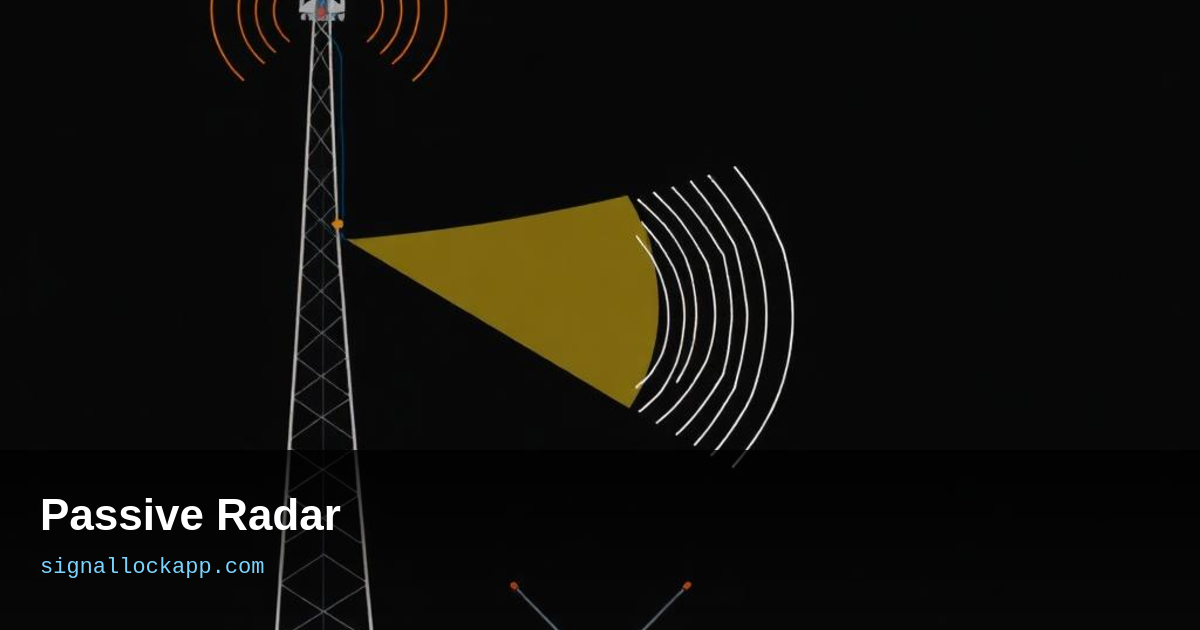
How it works
A reference antenna picks up the direct signal from an FM broadcast tower, DVB-T station, or 4G cell. A surveillance antenna picks up reflections from aircraft. Cross-correlate the two with enough computing power and time-difference-of-arrival gives you target range and direction.
Why it's hard
The reflected signal is millions of times weaker than the direct one. The transmitter is uncooperative — its waveform was designed for radio, not radar. You need clean reference geometry, beefy signal processing, and patience. But 2010s GPU computing finally made it practical.
Real systems
Lockheed Silent Sentry, Selex AULOS, BAE Aurora, Czech VERA-NG. NATO members operate passive radar quietly in the Baltic and Black Sea. China and Russia have publicly fielded their own systems.
Why it matters
Anti-radiation missiles home on a radar's emissions. A passive radar emits nothing — there's no signal to home on. For a defender, this is a survivable backup when conventional radars are jammed or destroyed.
The bistatic geometry challenge
In traditional monostatic radar, the transmitter and receiver are co-located, making the calculation of a target's position a simple matter of measuring the time-of-flight. Passive radar, however, operates in a bistatic or multistatic configuration where the source (like a distant FM tower) and the receiver are separated by miles. This creates a specific geometric problem: the target's position is not found on a circle, but rather on an ellipsoid where the transmitter and receiver act as the two foci. To resolve exactly where the aircraft is located, a passive system must often track reflections from multiple different sources simultaneously—such as three different TV towers—to find the intersection point of these ellipsoids in real-time.
This spatial complexity is further complicated by the 'Doppler stretch' effect. Because the transmitter and the target are moving relative to one another at different angles than the target and the receiver, the shift in frequency is not as straightforward as in pulse-doppler systems. Engineers must use complex cross-ambiguity functions (CAF) to compare the reference signal with the reflected signal across thousands of potential snapshots per second. Modern systems often use FPGA-based hardware to handle these billions of operations per second, ensuring that the latency between the physical reflection and the digital blip on the operator's console remains low enough for tactical engagement or air traffic control.
Historical roots: The Klein-Heidelberg
While often viewed as a 21st-century breakthrough, the first operational passive radar system was deployed by Germany in 1943 during World War II. Known as the 'Klein-Heidelberg,' this system did not have its own transmitter. Instead, it used the high-powered pulses from the British Chain Home radar stations against them. By capturing the British signals as they crossed the English Channel and then capturing the reflections of those same signals off Allied bombers, German operators could determine the range and bearing of incoming raids. It was an ingenious solution to the British jamming efforts, as the British could not jam their own radar transmissions without blinding themselves.
The Klein-Heidelberg system remained a secret for much of the war because it emitted no electronic signature for British signals intelligence to find. It provided a range of approximately 450 kilometers with a distance accuracy within 10 kilometers—remarkable for the vacuum-tube era. This historical precedent highlights the primary strategic value of passive detection: it is fundamentally 'covert.' Because the receiver never reveals its location through a high-energy pulse, it cannot be targeted by anti-radiation missiles like the AGM-88 HARM, making it an essential component of modern resilient integrated air defense systems (IADS) that must survive in contested environments.
The Processing Lag and Coherence Time
In traditional active radar, the pulse repetition frequency is precisely known. In passive radar, the 'pulse' is a continuous stream of broadcast data, meaning the receiver must digitally reconstruct a synchronized replica of the transmitted signal. This process relies on integration gain; by correlating the surveillance signal with the reference signal over a period of 100 to 500 milliseconds, the system can pull a weak reflection out of the noise floor. However, this creates a fundamental trade-off: longer integration times increase sensitivity but limit the maximum detectable velocity of a target due to phase decorrelation. If an aircraft maneuvers rapidly, the Doppler shift changes mid-integration, causing the signal to smear.
Modern systems solve this by utilizing multi-static configurations. Since passive radar typically leverages commercial signals like FM radio (88-108 MHz) or Digital Video Broadcasting (DVB-T), the wavelengths are relatively long—between 1 and 3 meters. These long wavelengths are particularly effective against low-observable or 'stealth' aircraft, which are shaped to redirect X-band and S-band frequencies used by active fire-control radars. A passive system doesn't need the aircraft to reflect energy back to its source; it only needs the aircraft to scatter energy toward the surveillance antenna, making the physical geometry of stealth coatings less effective at these lower, uncooperative frequencies.
The Daventry Experiment
The practical proof for passive radar precedes the invention of active radar by several months. In February 1935, Robert Watson-Watt and Arnold Wilkins conducted the Daventry Experiment in the UK. Rather than building a transmitter, they used the existing 10 kW short-wave signals from the BBC Empire station. As a Handley Page Heyford bomber flew between the transmitter and their makeshift receiver, they successfully detected the interference patterns caused by the aircraft’s reflection. This test proved that radio waves could detect metal objects at a distance, leading directly to the development of the Chain Home network, though that system eventually utilized its own dedicated transmitters.
Today, the legacy of Daventry lives on in 'illuminators of opportunity.' Modern researchers use Starlink satellites and GPS constellations as passive sources. While satellite signals are significantly weaker than terrestrial FM towers, the high-altitude geometry provides a top-down view that eliminates terrain masking. This space-based passive radar approach allows for the monitoring of remote maritime regions without deploying a single active transmitter into the area. It transforms the global telecommunications infrastructure into a secondary, unintentional sensor web that is virtually impossible for an adversary to jam or destroy without taking down their own communications.