1. Faceted shaping
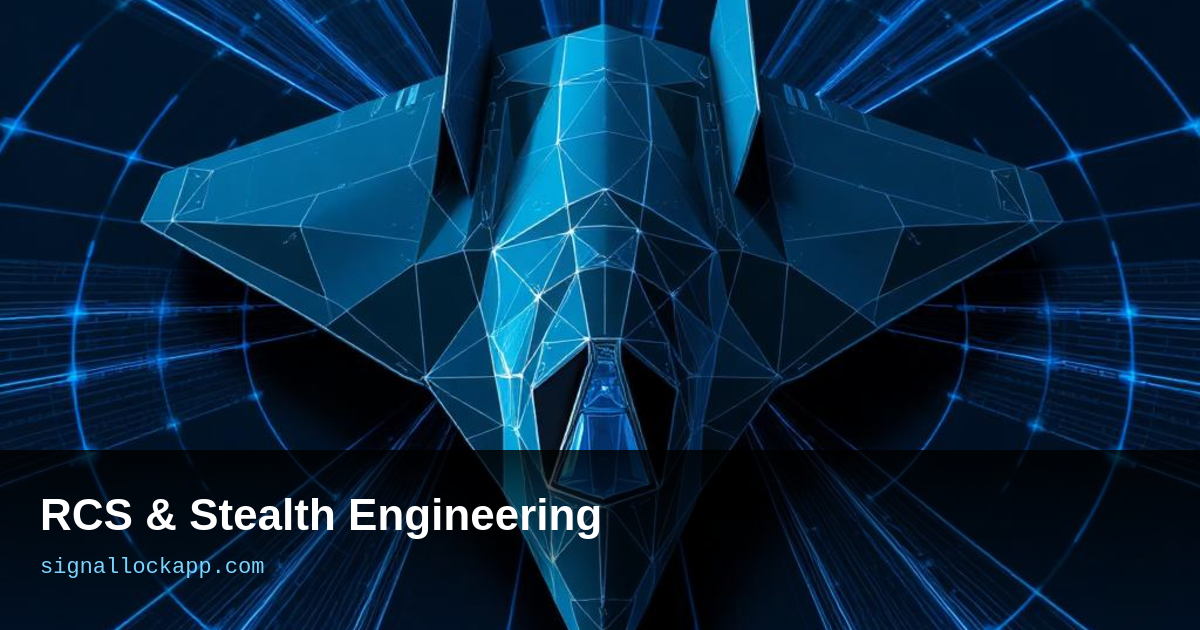
The F-117 approach: flat panels at angles that bounce radar energy away from any plausible threat direction. Crude looking but mathematically clean — only required 1970s computing power.
2. Continuous curvature
B-2, F-22, F-35: smooth curves designed to scatter energy in non-threat directions. Required modern Method-of-Moments and FDTD simulation. Aerodynamically much better than facets.
3. Edge alignment
Wings, intakes, control surfaces, weapons-bay doors — all aligned to a small number of azimuth angles. Look at a top-down photo of an F-22 and count the parallel lines: that's RCS engineering, not styling.
4. Radar-absorbent materials (RAM)
Iron-ball paint, carbon-loaded ferrite tiles, structural composites tuned to absorb specific frequencies. Maintenance-heavy — RAM degrades with weather, exhaust and physical contact.
5. Cavity management
Engine intakes and exhausts are giant radar reflectors. Stealth aircraft hide them with S-shaped ducts, screened inlets, and serrated trailing edges. Every cavity is engineered as carefully as the airframe.
6. Active cancellation (the future)
Detect the incoming radar pulse and emit an out-of-phase response that cancels the reflection. Hard to do across a band, hard to do at multiple angles — but lab demonstrations exist and operational systems are rumoured.
Frequency-Selective Surfaces (FSS)
Metamaterial structures known as Frequency-Selective Surfaces act as high-pass or band-pass filters for electromagnetic energy. Integrated into radomes and canopy glass, these periodic arrays of metallic elements appear transparent to an aircraft's own radar and communication frequencies but remain opaque and reflective to enemy X-band or S-band waves. This prevents internal equipment—like the high-RCS flat plate of an antenna—from scattering energy back to the threat. By carefully tuning the geometry of these printed circuits or etched patterns, designers can ensure the airframe maintains a consistent dielectric profile across the mission spectrum.
The technical complexity involves managing the transition between the metallic skin and the FSS-treated apertures. Historically, this was a primary vulnerability of 4th-generation fighters, where the cockpit and radar dish acted as corner reflectors. In modern LO design, Indium Tin Oxide (ITO) coatings on canopies and multi-layer FSS radomes are standard. These materials must be environmentally rugged enough to withstand supersonic heating and erosion while maintaining precise electromagnetic properties. A poorly tuned FSS will not only increase the RCS but can also introduce parasitic interference for the aircraft’s own sensors, requiring a delicate balance of material engineering.
The 'Creeping Wave' and Surface Current Suppression
RCS is not merely about specular reflection; it also involves surface waves, specifically 'creeping waves' that travel along the skin of the aircraft and re-radiate at trailing edges or discontinuities. When a radar pulse hits a curved surface, a portion of that energy follows the contour of the body into the 'shadow region.' If this wave encounters a sharp break, like a nozzle or a panel gap, it launches back toward the source. Engineering against this requires the use of magnetic RAM or graded-dielectric coatings that attenuate these traveling waves before they reach a scattering center.
Surface current management is why modern stealth aircraft feature 'sawtooth' edges on every operational door and access panel. These serrations are specifically angled to redirect the re-radiated energy of surface currents away from the enemy's monostatic radar receiver. In the 1990s, the development of high-fidelity Finite Difference Time Domain (FDTD) software allowed engineers to visualize these currents in real-time, leading to the refined tapering seen on the B-2 Spirit. Effective suppression can reduce a return by an additional 5 to 10 dBsm, proving that the treatment of the aircraft's 'joints' is as critical as the primary shaping of its wings.
7. S-duct and Serpentine Inlets
The engine compressor face is one of the most significant radar reflectors on a modern jet, acting as a massive metallic mirror that rotates and shifts frequencies. To mitigate this, engineers utilize S-duct or serpentine inlets. These curved air intake tunnels physically block a radar's line-of-sight to the engine blades. By forcing incoming electromagnetic waves to reflect several times against internal walls coated with radar-absorbent material before reaching the engine, the energy is almost entirely dissipated as heat rather than being reflected back to the source.
The application of this technique was famously seen on the Lockheed Martin F-22 Raptor and later refined for the F-35. Beyond simply hiding the intake blades, the geometry must be carefully calculated to ensure laminar airflow remains consistent even at high angles of attack. If the duct is too aggressive in its curvature, it risks engine stalls; if it is too shallow, the RCS spikes. This balance represents a peak engineering challenge where fluid dynamics and electromagnetics must achieve a compromise that satisfies both stealth and aerodynamic performance.
8. Planform Alignment and the 'Butterfly' Tail
While edge alignment focuses on the parallelism of surface boundaries, planform alignment dictates the overall silhouette of the aircraft to manage diffraction. Conventional vertical stabilizers act as corner reflectors, creating massive RCS spikes from side-on or quartering angles. Modern stealth design addresses this by replacing traditional t-tails or twin verticals with highly canted 'V' or 'butterfly' tails. These surfaces are angled away from the vertical plane, ensuring that radar energy hitting the tail is deflected into the upper or lower atmosphere rather than back to a ground-based or airborne receiver.
The YF-23 Black Widow II serves as a masterclass in this discipline, utilizing only two massive canted surfaces for both pitch and yaw control. This reduced the number of structural intersections and gaps where electromagnetic waves could 'pool' or diffract. By minimizing the total number of orientations that an aircraft's edges present to the world, engineers can funnel the majority of the radar return into a few very narrow, predictable 'spikes' that an adversary is unlikely to detect for more than a millisecond at a time.