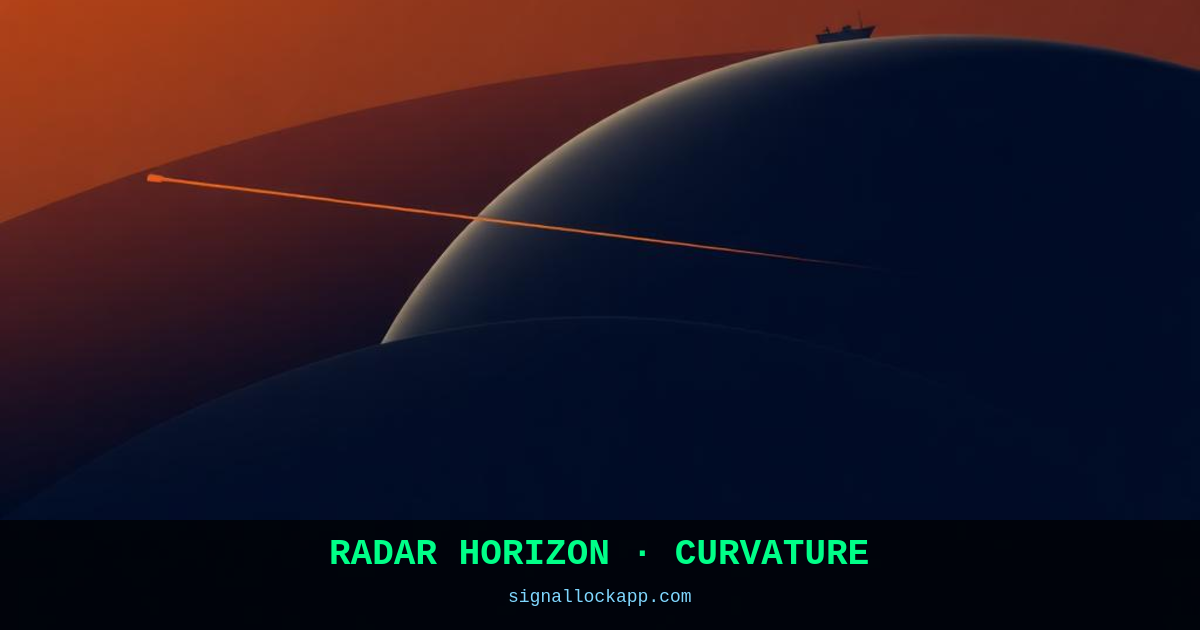
The standard radar horizon formula
For a radar at height h metres and a target at height t metres, the radar horizon in kilometres is approximately 4.12(√h + √t). A radar on a 30 m tower sees a fighter at 10,000 m out to about 440 km. A ship radar at 20 m sees a missile skimming the waves at 5 m out to only 28 km. Height is everything.
Atmospheric refraction
The atmosphere bends radio waves downward because density decreases with altitude. Under standard conditions this effectively increases radar range by about 15% — the '4/3 Earth' model used in planning. But conditions are rarely standard.
Ducting and super-refraction
Temperature inversions trap moisture and create a layer where refractive index decreases unusually fast. Radar signals bounce along this layer like a waveguide, extending detection from 50 km to 500 km or more. The effect is strongest at UHF and L-band. Mediterranean summers and Persian Gulf mornings are famous for it. So is the radar-operator confusion it causes.
Beating the horizon
Over-the-horizon radar uses ionospheric bounce. Airborne early warning puts the radar at 10,000 m. Satellite SAR looks down from orbit. Every solution is expensive. The physics of the horizon is why the world's most powerful nations invest billions in platforms whose only purpose is to lift the sensor higher.
Diffraction and the Lloyd's Mirror effect
While the geometric horizon defines the primary cutoff, physics allows for marginal detection slightly beyond this line through diffraction. As radio waves graze the curved surface of the Earth, they interact with the boundary layer, scattering into the shadowed region. This Huygens-Fresnel principle application allows high-power systems to detect massive targets a few kilometers into the 'blind' zone, though signal strength drops exponentially. At these low grazing angles, the radar must also contend with the Lloyd's Mirror effect, where signals reflecting off the sea surface interfere with the direct path signal. This phenomenon creates a series of vertical interference lobes, meaning a target may vanish and reappear as its altitude or range changes relative to these nulls.
Historically, understanding these interference patterns was critical during the 1982 Falklands War. Low-flying Argentine Super Étendard aircraft exploited the horizon and the interference nulls to approach the British task force undetected. By flying below the radar's lowest interference lobe, the aircraft effectively stayed within a 'blind' area where the combination of Earth's curvature and surface reflection cancelled out the incoming pulses. This vulnerability demonstrated that even with the 4/3 Earth refraction correction, the lowest few hundred feet of the atmosphere remain a complex tactical dead zone that simple geometric formulas fail to fully map.
Radar cross section at the horizon limit
The radar horizon is not a hard wall for all objects equally; it interacts specifically with a target's Radar Cross Section (RCS). As a target dips toward the horizon, its effective reflection area is often compromised by multipath propagation and clutter. For seawater, the sea state or 'roughness' dictates whether the reflection is specular or diffuse. A calm sea acts as a mirror, creating strong multipath interference that can either amplify the return signal or mask it entirely. Modern digital signal processing attempts to compensate for this by using complex tracking algorithms that model the expected phase shifts, but the fundamental physics of the horizon remains a limiting factor for signal-to-noise ratios.
Furthermore, the horizon limit creates a specific tactical requirement for Airborne Early Warning (AEW) platforms like the E-3 Sentry. By elevating the radar antenna to 30,000 feet, the geometric horizon against a sea-skimming cruise missile expands from roughly 30 kilometers to over 400 kilometers. This shift is not merely an incremental improvement; it changes the reaction time for defense systems from less than two minutes to over twenty minutes. Without this altitude-induced horizon expansion, modern carrier strike groups would be unable to defend against supersonic low-altitude threats, regardless of how much power the radar transmitter emits.
The Radio Horizon vs. The Optical Horizon
While they are often conflated, the radio horizon and the optical horizon are not identical. Because radio waves possess longer wavelengths than visible light, they interact differently with atmospheric density gradients. Standard terrestrial refraction causes the Earth to appear flatter to a radar system than it does to the human eye. This is why engineers use the 8,493 km 'effective earth radius' for calculations rather than the physical mean radius of 6,371 km. This difference allows a radar to 'see' approximately 15 percent further than a visual observer at the same elevation, a critical margin for early warning systems during the Cold War.
The divergence becomes even more pronounced in the presence of anomalous propagation. While a lookout on a ship's bridge is limited by the geometric curve of the water, a naval radar operating in the X-band (8-12 GHz) may detect surface targets far beyond the visual horizon due to evaporation ducts just above the sea surface. These ducts, typically only 10 to 20 meters thick, act as a leaky waveguide. Understanding the deltas between these two horizons is vital for electronic warfare officers who must calculate 'burn-through' ranges where their own sensors can overcome an enemy's jamming despite the curvature constraints.
The Multi-Path Null and Low-E Detractions
As a target approaches the radar horizon, the phenomenon of multipath interference becomes the primary obstacle to accurate tracking. This occurs because the radar receives two versions of the return signal: one traveling directly from the target and another reflected off the Earth's surface. When these two signals arrive out of phase, they can destructively interfere, creating 'nulls' in the radar coverage. For a sea-skimming anti-ship missile, these nulls can make the target periodically vanish from the display even before it physically drops behind the horizon, creating a 'flicker' effect that complicates fire-control solutions.
To mitigate this, modern phased-array radars utilize complex waveform scheduling and frequency agility. By shifting the operating frequency, the interference pattern of the nulls changes, hopefully placing a 'peak' where a 'null' previously existed. Historically, this was a manual struggle for operators using early sets like the British Type 271 during WWII, who had to distinguish between genuine fading and atmospheric attenuation. Today, digital signal processing attempts to fill these gaps, but the physics of reflecting off a curved, conductive sea remains a fundamental barrier that no amount of processing power can entirely eliminate.