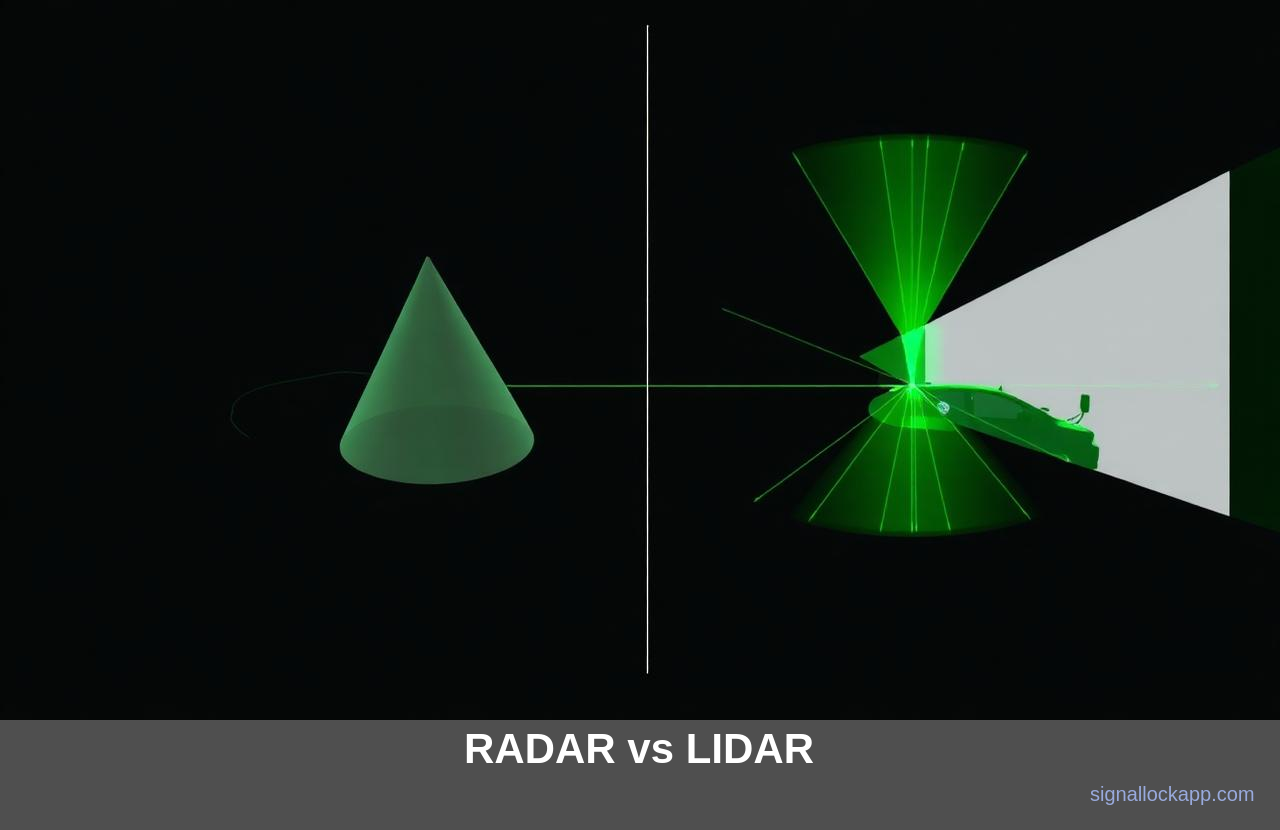
Wavelength: 1,000,000× difference
A typical radar uses 3 cm waves. A typical LiDAR uses 905 nm (0.000905 mm). LiDAR's tiny wavelength gives centimetre resolution at hundreds of metres; radar's longer wavelength gives metre resolution but punches through rain, fog and dust.
Weather
LiDAR struggles in heavy rain, snow and fog — the laser scatters off droplets and you lose your signal. Radar barely notices. This is why no serious self-driving stack relies on LiDAR alone.
Resolution
A modern automotive LiDAR makes a 3D point cloud with millions of points per second. Radar gives you maybe a few hundred targets per scan, each just a position and velocity. LiDAR sees that the object is a pedestrian; radar sees that something is moving 50 km/h at 80 metres.
Speed measurement
Radar measures velocity directly via Doppler shift. LiDAR has to compare two consecutive frames to estimate velocity — slower and less accurate. This is why police use radar guns, not laser guns, for speed traps.
When you'd choose which
LiDAR: archaeology, forestry, autonomous vehicle perception layer, indoor mapping. Radar: weather, aviation, ships, all-weather automotive ADAS, missile defence.
Material Interaction and Absorption
The physics of how these sensors interact with surfaces depends entirely on the electromagnetic spectrum. LiDAR relies on optical reflection; it behaves much like a high-end flashlight. Materials that absorb or refract light, such as dark-painted plastics or mirrors, can cause 'holes' in a LiDAR point cloud. This makes detecting a black vehicle or a glass window at certain angles significantly harder for a laser-based system. Because the beam is so narrow, it requires a direct line-of-sight and a surface that reflects at least some of the specific wavelength (often 905nm or 1550nm) back to the receiver.
Radar interacts with the conductive properties of an object rather than its optical clarity. Metal surfaces provide massive radar cross-sections because they are highly conductive and reflect radio waves efficiently. Interestingly, radar can occasionally 'see' through certain non-metallic materials like thin plastic bumpers, allowing sensors to be hidden behind car bodywork. While radar can suffer from multipath interference—where signals bounce off the ground or walls and create 'ghost' images—it is generally immune to the color or transparency issues that plague LiDAR, making it more reliable for detecting structural obstacles regardless of their finish.
The Doppler Effect and Instantaneous Velocity
Radar has a distinct advantage when it comes to measuring how fast an object is moving. Because it uses coherent radio waves, it can leverage the Doppler effect to measure instantaneous radial velocity in a single pulse. As the wave hits a moving car, the frequency of the return signal shifts. By measuring this shift, the radar sensor knows immediately if a target is accelerating or braking before it even calculates a second position. This is why adaptive cruise control systems rely so heavily on radar; it provides the 'delta-v' (velocity change) with millisecond precision.
Standard LiDAR systems generally lack this native velocity data. To determine speed, a LiDAR must compare the object's position across multiple frames—calculating the distance traveled over the time elapsed between laser pulses. While newer Frequency Modulated Continuous Wave (FMCW) LiDAR is beginning to bridge this gap by using a technique similar to radar to capture Doppler data, the vast majority of units in the field today are 'Time of Flight' (ToF) sensors. These require more computational overhead to track moving objects reliably, as they must build a historical path rather than reading speed directly from the physics of the wave.
Signal Coherence and Beam Divergence
The fundamental efficiency of LiDAR and radar rests on how their energy spreads during travel. A radar signal follows the inverse square law aggressively; because radio waves have wide beamwidths, the energy disperses over a large area, requiring massive power or large antennas to maintain a link at long range. Even a sophisticated phased-array radar experiences beam divergence that covers several meters at a distance of 100 meters, making it difficult to isolate small adjacent objects like two cyclists riding side-by-side.
In contrast, LiDAR utilizes the spatial coherence of stimulated emission to produce a near-parallel beam. A typical 905 nm laser diode maintains a spot size of only a few centimeters even at a distance of 200 meters. This lack of divergence allows LiDAR to achieve incredibly high angular resolution, mapping the specific contours of a target rather than just its presence. While radar provides a broad 'floodlight' of situational awareness, LiDAR acts as a precision 'scalpel' that can identify the exact gap between a parked car and a sidewalk curb.
The Data Interface: Point Clouds vs. Target Lists
The two sensors communicate with vehicle computers in entirely different languages. LiDAR generates a 'point cloud'—a dense, unstructured geometric representation of the environment consisting of millions of individual XYZ coordinates. Processing this requires significant computational overhead, usually involving deep learning and voxelization to turn raw points into recognizable shapes. Because LiDAR effectively recreates the 3D world, it is the primary tool for simultaneous localization and mapping (SLAM), allowing a vehicle to compare its live surroundings against a pre-existing high-definition map.
Radar interfaces are traditionally much leaner, providing a 'target list' rather than a raw signal. The radar's internal digital signal processor (DSP) performs a Fast Fourier Transform (FFT) to filter out noise and static ground clutter, outputting only objects of interest. This makes radar much faster for emergency braking systems, as the latency between detection and action is minimal. While the industry is moving toward '4D imaging radar' to bridge this gap, the distinction remains: LiDAR builds a world, while radar tracks specific dynamics.