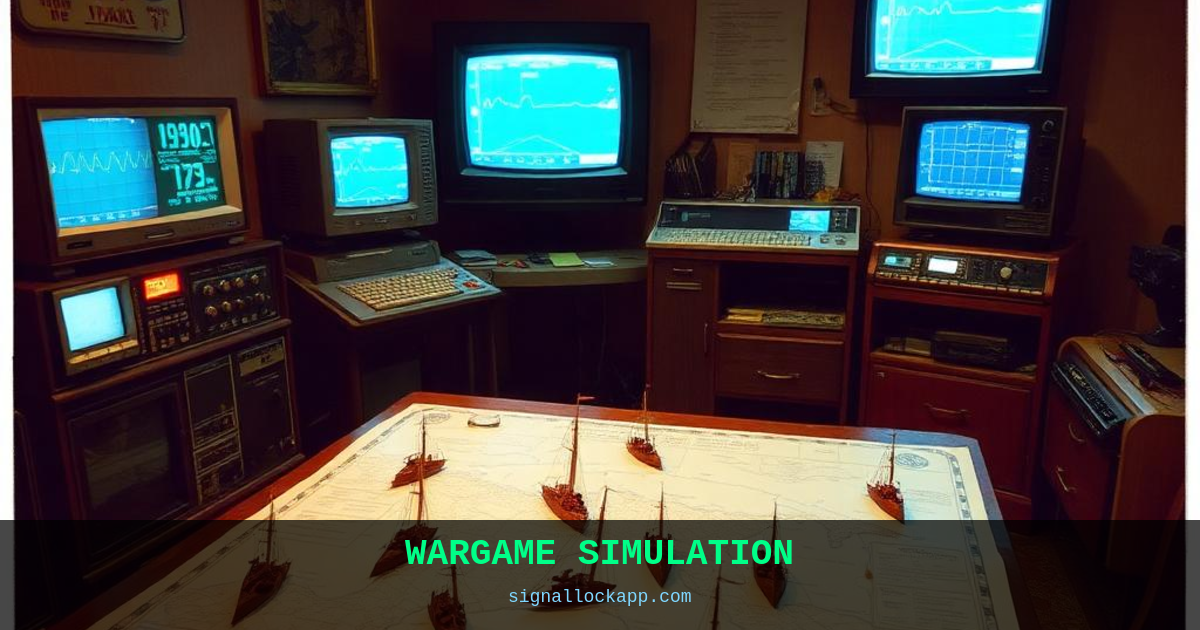
Detection probability tables
Traditional board wargames used lookup tables: if the radar unit is at altitude X and the target is at range Y with radar cross-section Z, roll a die. Hex-and-counter games like 'Air War' and 'Flight Leader' had detailed radar subroutines. These were crude but taught players the geometry of detection — altitude, aspect angle, jamming.
Computer simulation
When computers arrived, radar modelling got precise. The US Navy's SIMNET (1980s) linked simulators across bases with realistic radar propagation, clutter and countermeasures. Later, Command: Modern Operations and DCS World model real radar systems down to the frequency band, scan pattern and electronic attack. Players experience the same detection ambiguity that real operators face.
ECM and ECCM modelling
Jamming is modelled as signal-to-noise ratio degradation. Chaff is modelled as false targets. Stealth reduces detection range by a factor. The game equations are classified military models, sanitised for public release. When you deploy chaff in a flight sim, you are rehearsing a tactic derived from real electronic warfare doctrine.
Civilian descendants
RTS games like Command & Conquer used 'fog of war' directly inspired by radar and sensor concepts. FTL: Faster Than Light makes sensor range a core mechanic. Even puzzle games like Keep Talking and Nobody Explodes train communication protocols similar to those used in radar control teams. The military-to-game lineage is direct.
The Pulse-Doppler Transition
In the transition from early wargaming to high-fidelity simulation, the shift from basic pulse radar to Pulse-Doppler systems marked a critical evolutionary step. Early simulations treated radar as a simple line-of-sight sphere, where presence within a radius guaranteed detection. However, the introduction of the 'look-down/shoot-down' capability in systems like the AN/APG-63 required simulators to model the Doppler notch. This is the physical phenomenon where a target flying perpendicular to the radar beam matches the radial velocity of the ground clutter, effectively becoming invisible to the processor. Modern simulations now force players to 'beam' the enemy—maneuvering into this notch to exploit the signal processing limitations of the simulated hardware.
The mathematical complexity of these models increased during the 1990s as computational power allowed for real-time Fourier transforms. Instead of binary detection states, wargames began simulating the actual signal-to-noise ratio (SNR). This allowed for the representation of 'gate stealing' in electronic warfare, where a jammer creates a false range gate to pull the victim radar's tracking away from the actual airframe. By simulating the specific pulse repetition frequency (PRF) and duty cycles, commercial and military simulations moved beyond mere board game probabilities into the realm of digital signal processing (DSP) emulation, providing a more authentic representation of the technological cat-and-mouse game played in the electromagnetic spectrum.
Synthetic Aperture Radar and Terrain Mapping
While air-to-air radar simulation focused on detection loops, the inclusion of Synthetic Aperture Radar (SAR) in wargaming introduced the challenge of imaging. Unlike traditional real-aperture radar, SAR uses the motion of the platform to simulate a much larger antenna, providing high-resolution ground imagery regardless of weather or light. Early strategic simulations represented this with a simple 'fog of war' removal, but contemporary high-end wargames simulate the time-delay and phase-shift required to reconstruct a SAR strip. This transition changed how players utilize reconnaissance assets; instead of getting an instantaneous snapshot, they must maintain a stable flight path over a duration to allow the virtual processor to build a coherent image of the battlefield.
This level of fidelity has direct roots in cold-war era trainers designed for the F-15E Strike Eagle and the TSR-2 projects. In these systems, the simulation had to account for 'speckle'—the grainy interference characteristic of radar imaging—and shadow zones where terrain blocked the signal. Today, the same algorithms used to train military intelligence officers are found in commercial titles like Command: Modern Operations. These games simulate the trade-off between resolution and coverage area, forcing the player to choose between wide-area sea searches or narrow, high-resolution spot maps for target identification. This provides a bridge between pure game mechanics and the technical realities of all-weather battlefield surveillance.
The Lookhand Influence and Signal Analysis
In the late 1950s, the development of the 'Lookhand' system at the Tactical Air Command marked a shift from visual identification to complex signal analysis within wargaming. This era saw the introduction of the 'probability of kill' (Pk) and 'probability of detection' (Pd) based on actual signal-to-noise ratios rather than arbitrary dice rolls. Military planners required models that accounted for specific radar energy reflection properties of aluminum hulls versus wooden components, leading to the first digitised databases of radar cross-sections (RCS). These early simulations were instrumental in training weapon systems officers to differentiate between genuine atmospheric clutter and the deliberate interference of Soviet track-while-scan radar sets.
The mathematical rigor applied to these models forced a transition in how electronic intelligence (ELINT) was integrated into simulation. Designers realized that simulating a radar pulse required modeling the pulse repetition frequency (PRF) and pulse width (PW) to accurately reflect how a receiver might 'gate' a target. This technical granularity eventually crossed over into the civilian sector via serious games developed for defense contractors. Today, the legacy of Lookhand survives in high-fidelity simulators where players must manage their pulse recurrence to avoid detection by hostile Electronic Support Measures (ESM) equipment, illustrating the high stakes of signal management in modern peer-to-peer conflict.
The Integration of Over-the-Horizon (OTH) Modeling
A critical but often overlooked facet of radar simulation is the modeling of Over-the-Horizon (OTH) systems using ionospheric refraction. Unlike line-of-sight radar, OTH simulation requires calculating the 'skip distance' of high-frequency (HF) signals bouncing off the ionosphere. In tactical wargames like those used at the Naval War College in the 1970s, this was represented by simplified reach-back zones. However, modern computational power allows for real-time ray tracing of signal paths, accounting for solar cycles and time-of-day atmospheric density. This adds a layer of strategic complexity, as players can no longer rely on the curvature of the Earth to hide their movements if the simulated atmospheric conditions favor long-range propagation.
Simulating OTH radar also introduced the concept of the 'Clutter-Limited' environment to the wargaming community. Because OTH systems must filter massive amounts of sea and ground return to identify a moving aircraft or ship, the simulation must model the Doppler shift sensitivity required to extract a target from the noise. This necessitates a move away from binary 'detected or not' mechanics toward a probabilistic model based on velocity gates. These simulations teach operators and players alike that speed can be just as important as stealth; if a target's radial velocity matches the environmental clutter, it effectively disappears within the simulation's processing window, mirroring real-world physical limitations.