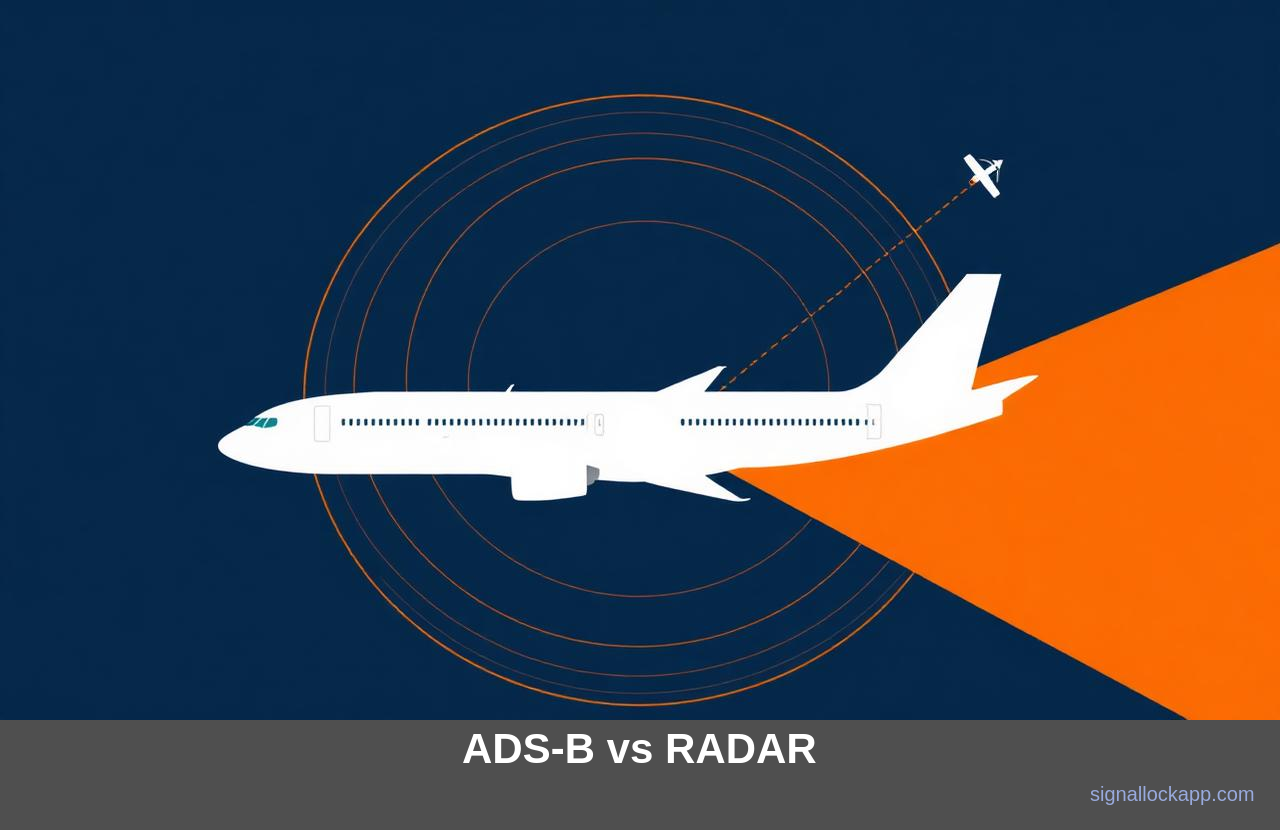
How ADS-B works
Each aircraft determines its own position via GPS and broadcasts it twice per second on 1090 MHz (or 978 MHz UAT for general aviation). Ground stations, satellites and other aircraft pick it up. Accuracy: a few metres. Cost per ground station: about $100k vs. tens of millions for radar.
Why radar still matters
ADS-B requires the aircraft to be cooperative, powered, GPS-locked and not spoofing. A primary surveillance radar sees anything that reflects — including a hijacked transponder-off airliner, a swarm of birds, a stray drone, or a balloon. After 9/11 the FAA quietly raised investment in primary radar.
Secondary surveillance radar (Mode S, Mode C)
The middle ground: ground radar interrogates the aircraft's transponder, which replies with altitude and ID. Faster than primary, more trustworthy than ADS-B, used everywhere as backup.
The future
Space-based ADS-B (Aireon's 66-satellite constellation) now covers oceans where ground radar can't reach. Most controllers run a fused display — ADS-B as the primary picture, radar as the truth check, space-based ADS-B for the bits in between.
The Geometry of Latency and Updates
Primary radar relies on the rotational speed of the antenna, typically completing a full scan every 5 to 12 seconds for en-route and terminal surveillance. This creates a staggered 'snapshot' of the sky where a high-speed jet may travel several kilometers between updates. In contrast, ADS-B Out systems transmit position data at a rate of 0.5 to 1.0 seconds. This near-continuous stream allows for a reduction in separation standards, moving from the traditional five-mile minimum to as little as three miles in certain high-density corridors. This increased update rate is not merely a matter of convenience; it significantly reduces the controller's workload by providing a fluid, real-time vector rather than a jumping target on the screen.
The technical superiority of ADS-B comes with a specific vulnerability: GPS constellation reliance. While a primary radar and its magnetron function independently of external networks, ADS-B is only as accurate as the Global Navigation Satellite System (GNSS) signal received by the airframe. During solar flares or intentional jamming events, the 'integrity' and 'accuracy' parameters (NIC and NACp values) within the ADS-B message drop, forcing controllers to revert immediately to radar-based separation. This dependency is why the FAA maintains the Minimum Operational Network (MON), a strategic backbone of VORs and primary radars designed to remain functional even if all satellite-based navigation becomes compromised across a wide geographical area.
Terrestrial vs. Space-Based ADS-B
A major limitation of traditional radar is the curvature of the earth and terrain masking; once an aircraft flies over the ocean or behind a mountain range, it disappears from the scope. Terrestrial ADS-B ground stations share this line-of-sight limitation. However, since 2019, the deployment of space-based ADS-B receivers on Low Earth Orbit (LEO) satellites has bridged this gap. Companies like Aireon now provide global coverage, including the North Atlantic and polar regions, where radar was previously impossible. This allows for 'radar-like' separation in oceanic tracks, significantly increasing fuel efficiency by letting aircraft fly at their optimal altitudes and speeds instead of fixed, wide-buffered oceanic tracks.
Despite the global reach of satellite ADS-B, primary radar remains the only tool for detecting 'non-cooperative' targets. In the context of national security, military sensors use primary radar to identify aircraft that have intentionally disabled their transponders or are utilizing stealth technologies to reduce their Radar Cross Section (RCS). ADS-B is a broadcast of identity, whereas radar is an interrogation of physical presence. In a dense urban environment or during peak traffic, the two systems work in a composite 'fused' display. If the ADS-B signal and the radar return do not overlap precisely, the system flags a 'split track' error, alerting the controller to a potential technical fault or a spoofed signal.
The Challenge of Frequency Congestion
As ADS-B adoption nears 100% in controlled airspace, a technical bottleneck emerges on the 1090 MHz frequency. Because aircraft broadcast their state twice per second regardless of ground interrogation, high-traffic corridors like the Los Angeles Basin or the London TMA face 'spectral saturation.' This creates a phenomenon known as garbling, where overlapping pulse trains from multiple aircraft prevent the ground station from decoding individual messages. To mitigate this, engineers are developing sophisticated multi-sector antennas and receiver side-lobe suppression, yet the physics of a shared frequency remains a limiting factor that radar avoids by using localized, directional beams.
While ADS-B is highly efficient for data throughput, it lacks the inherent isolation of Primary Surveillance Radar (PSR). Radar systems use a rotating beam that only focuses on a sliver of the sky at any given microsecond, naturally filtering out signals from other directions. In contrast, an ADS-B receiver is 'omni-directional,' listening to every transmitter within a 250-mile radius simultaneously. This distinction is why major hubs continue to rely on PSR for terminal approach control; during peak hours, the risk of a 'lost' ADS-B target due to signal interference is a statistical reality that traditional radar physics helps to resolve.
The Update Rate Disparity
A critical advantage of ADS-B over traditional radar is the refresh rate, which fundamentally changes how Air Traffic Control (ATC) manages separation. Conventional long-range en-route radars rotate once every 12 seconds, meaning a controller only sees a new position report five times per minute. ADS-B, however, broadcasts data at 0.5-second intervals. This near-continuous stream allows for a reduction in separation standards—from five miles down to three miles in many jurisdictions—effectively increasing the capacity of existing jetways without adding physical infrastructure or runways.
However, this high update rate introduces a new dependency on the aircraft's internal Navigation Integrity Category (NIC). If a GPS constellation experiences a momentary 'geometry gap' or if an onboard receiver loses lock, the ADS-B output becomes unreliable or drops out entirely. Radar does not suffer from this specific failure mode; as long as the kinetic object exists in space, the reflected photon returns to the dish. For this reason, the International Civil Aviation Organization (ICAO) mandates that all high-density 'Performance-Based Navigation' routes must still be underlaid by a primary radar net to catch 'non-reporting' targets instantly.