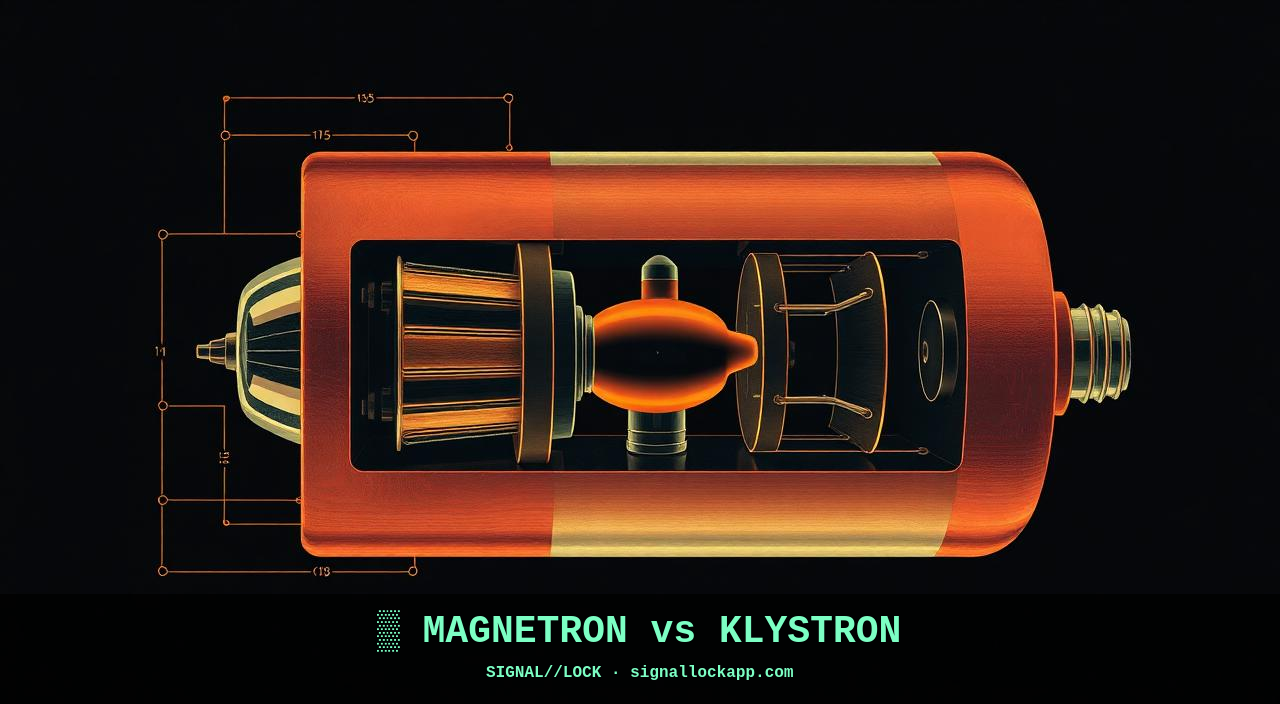
The cavity magnetron
Invented at Birmingham University in 1940 by Boot and Randall. A copper block with resonant cavities, with a hot cathode at the centre and a magnetic field perpendicular to the electric field. Electrons spiral and dump energy into the cavities, producing tens of kilowatts at 10 GHz from a device the size of a soup can. It made airborne radar practical overnight.
Why magnetrons are dirty
A magnetron oscillates freely — the frequency drifts with temperature and load. You can't make it coherent pulse-to-pulse, which kills Doppler processing. It's perfect for cheap weather radar and microwave ovens (same physics, lower power), useless for modern MTI or pulse compression.
The klystron's precision
A klystron is a velocity-modulated amplifier. An input signal modulates an electron beam, the beam drifts and bunches, and a resonant cavity extracts amplified output. The output is phase-coherent with the input — you can pulse-compress, Doppler-process and integrate coherently. Klystrons power most ground-based long-range radars and particle accelerators (SLAC ran on klystrons for decades).
Still alive
Solid-state has replaced both in many roles, but the power density of a tube at high frequencies is still unmatched. NEXRAD weather radars use klystrons. Marine radars use magnetrons because they're cheap and don't need coherence. The microwave oven in your kitchen is still a 1940s magnetron.
The Varian brothers and velocity modulation
While the cavity magnetron was a British breakthrough for power density, the klystron emerged from Stanford University in 1937. Russell and Sigurd Varian, working with physicist William Hansen, realized that high-frequency signals could not rely on standard vacuum tubes because electron transit time between electrodes became a limiting factor at microwave wavelengths. Their solution was velocity modulation: instead of trying to switch a current on and off, they speeded up and slowed down electrons in a continuous beam. This caused the electrons to 'bunch' as they traveled through a drift space, creating high-power pulses of energy when they reached the output cavity.
The Varian brothers' innovation turned the electron beam into a tool for amplification rather than just oscillation. By 1939, the klystron was already proving its worth in blind-landing systems for aircraft, but its true military potential wasn't realized until later in the war. Unlike the magnetron, which is essentially a power plant, the klystron functions as a precision gain stage. This distinction allowed engineers to use low-power oscillators to define a stable frequency, which the klystron then boosted to megawatts. This stability is the foundation of the Master Oscillator Power Amplifier (MOPA) architecture used in nearly all sophisticated radar systems today.
Cooling and the thermal barrier
A critical difference between these two tubes lies in how they handle waste heat. In a magnetron, the anode block itself is the resonant structure. As it generates power, it absorbs intense thermal energy, causing the metal to expand and the resonant frequency to shift—a phenomenon known as thermal drift. This fundamental physics limit means a magnetron must be allowed to 'breathe' in frequency, making it ill-suited for the narrow-band filters required to extract weak signals from heavy ground clutter. High-power magnetrons are typically liquid-cooled, but even with advanced plumbing, they cannot match the spectral purity of an equivalent klystron.
Klystrons manage heat differently because the electron beam is dumped into a dedicated component called the collector after it passes the output cavity. The collector can be massive and heavily cooled without affecting the frequency-determining cavities earlier in the tube. This physical separation allows klystrons to operate at much higher duty cycles and average powers. For example, the planetary radar at Arecibo utilized a klystron capable of 2.5 megawatts of continuous wave (CW) power. While magnetrons remain the king of peak power for their size, the klystron's ability to maintain a rock-solid phase while dissipating hundreds of kilowatts remains unmatched for long-range surveillance.
The Cross-Field Limit
The fundamental efficiency of the magnetron stems from cross-field interaction, where orthogonal electric and magnetic fields force electrons into cycloidal orbits. This allows for excellent energy conversion, often exceeding 70% efficiency, but it creates a chaotic thermal environment. Because the anode block must dissipate the heat of impacting electrons while simultaneously serving as the resonant structure, there is a hard physical limit on average power. For early air-intercept radars like the SCR-720, this meant balancing peak power for range against the risk of the copper cavities melting during heavy duty cycles.
Conversely, klystrons separate the heating from the RF generation. The electron beam does not terminate on the resonant cavities; it passes through 'drift tubes' and is eventually absorbed by a dedicated collector at the end of the tube. This technical separation allows klystrons to scale to massive sizes. A modern klystron, such as those used in the Aegis Combat System or the Stanford Linear Accelerator, can be several meters tall and produce megawatts of average power. By isolating the thermal load of the beam from the frequency-defining structures, the klystron achieves high-power stability that a self-oscillating magnetron simply cannot match.
Pulse Compression and Coherence
The shift from magnetrons to klystrons in the 1950s and 60s was driven by the requirement for Pulse Compression (CHIRP). A magnetron is an oscillator that 'starts up' with a random phase for every pulse, making it an incoherent source. While engineers developed 'coherent-on-receive' techniques using stable local oscillators to track these phase shifts, the results were always limited by noise. This made it difficult to extract moving targets from heavy ground clutter, as the phase jitter of the magnetron obscured the subtle Doppler shifts of an incoming aircraft or missile.
Klystrons rectified this by functioning as amplifiers rather than oscillators. A low-power, highly stable Exciter generates the waveform—including complex frequency modulation—and the klystron merely boosts it. This ensures that every pulse is a perfect, phase-coherent copy of the last. This breakthrough enabled the development of Modern Moving Target Indication (MTI) and Synthetic Aperture Radar (SAR). Without the klystron's ability to maintain phase relationships over many pulses, the high-resolution imaging and long-distance tracking capabilities of modern air traffic control and military defense systems would remain theoretically impossible.