Doppler in one line
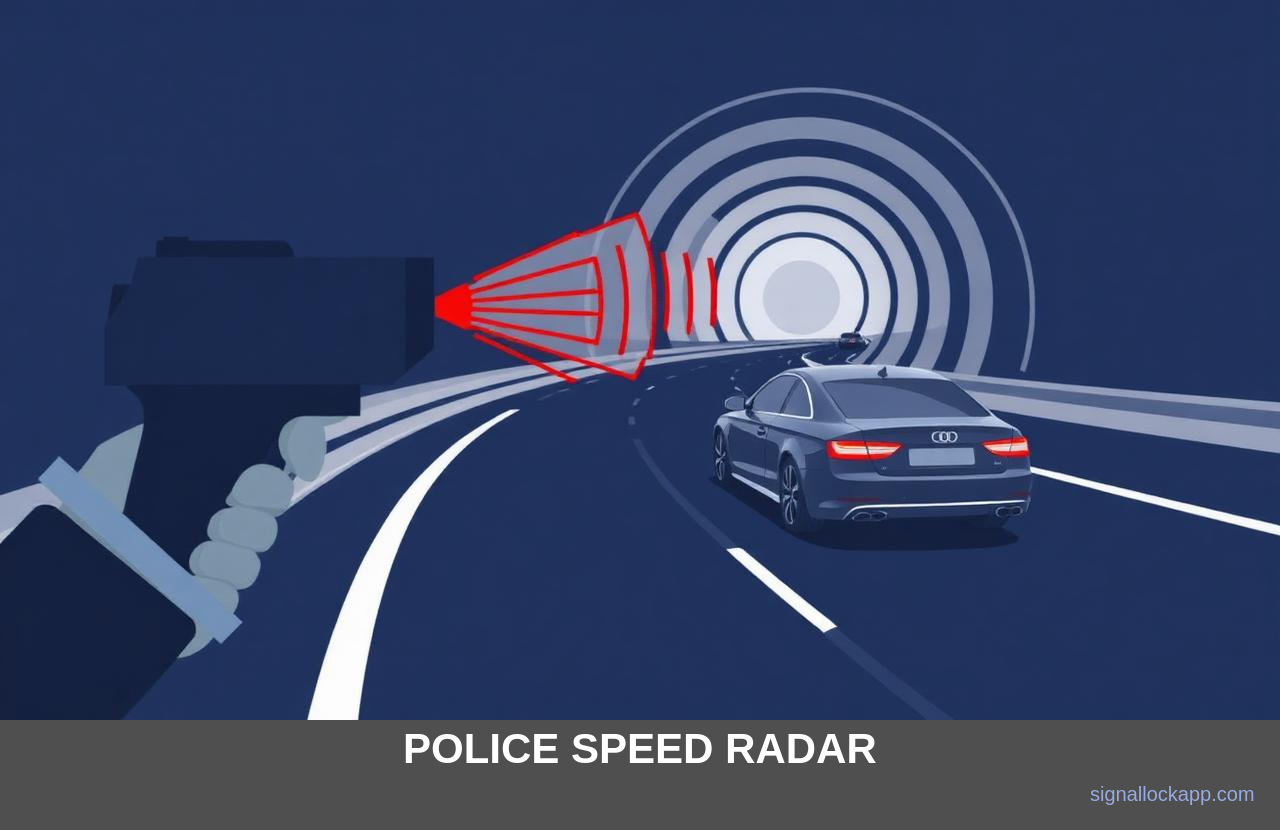
A signal at frequency f bouncing off a target moving at velocity v returns at f × (1 + 2v/c). At 24 GHz (K-band) and 100 km/h, the shift is about 4,400 Hz — tiny, but easy to measure with a mixer.
K-band, Ka-band, Ku-band
Older guns use X-band (10 GHz) — long range but easily detected. K-band (24 GHz) is a sweet spot. Ka-band (33–36 GHz) gives a narrower beam and is harder to detect with consumer detectors. Photo-radar vans usually run Ka.
LIDAR (laser speed guns)
A 905 nm pulsed laser ranges the target several hundred times per second. Distance vs. time gives speed without Doppler. Pencil-thin beam — almost impossible to detect with a radar detector because the wavelength is in the infrared, not microwave.
What detectors actually detect
Consumer detectors hear the gun's emission, not the return. Against modern instant-on Ka or pulsed LIDAR, you get warned after the cop already has your speed locked. Jammers are a different (illegal in most jurisdictions) story.
The Cosine Effect Myth
A common misconception in traffic court is that radar guns overestimate speed when the officer is parked at an angle to the road. Mathematically, the opposite is true. The radar device measures the relative velocity along the line of sight between the antenna and the vehicle. This is calculated as the true velocity multiplied by the cosine of the angle between the target's path and the radar beam. As the angle increases, the measured speed decreases. If an officer tracks a car at a 20-degree angle, a vehicle traveling at 100 km/h will only register as approximately 94 km/h on the display.
Law enforcement training manuals refer to this as the 'Cosine Effect.' While it always favors the motorist in stationary mode, the situation changes in moving radar mode. If the radar unit inaccurately calculates the patrol car's own speed due to reflections from large nearby objects—a phenomenon known as 'shadowing'—it can result in an artificially high reading for the target vehicle. This mechanical nuance is why modern DSP (Digital Signal Processing) chips in units like the Stalker DSR are designed to distinguish between ground clutter and legitimate patrol speed signals simultaneously.
The Evolution of Mixing: From Analog to DSP
In the 1950s, early units like the Stephenson Model S-1 used a simple analog frequency counter to display speed. These devices relied on a vacuum tube oscillator and a basic crystal mixer to extract the difference frequency, or beat frequency, between the transmitted and reflected waves. Because the analog circuits were sensitive to heat and voltage fluctuations, the accuracy of the reading could drift significantly during a single shift. Officers carried tuning forks calibrated to specific frequencies; striking the fork and holding it before the antenna provided a physical reference to verify the electronic calibration.
Modern systems moved from analog discrimination to Fast Fourier Transform (FFT) analysis. Instead of simply averaging a returning wave, a Digital Signal Processor breaks the signal into thousands of frequency bins. This allows the radar to track multiple targets simultaneously, identifying the strongest signal versus the fastest signal. This shift solved the 'large vehicle' problem where a distant semi-truck would mask the speed of a closer, faster passenger car. By isolating specific peaks in the frequency spectrum, contemporary Ka-band units provide a level of target discrimination that was physically impossible with 20th-century analog hardware.
The Heterodyne Receiver and Signal Mixing
Modern police radar relies on a heterodyne architecture to extract the Doppler shift from the carrier wave. When the reflected signal returns to the antenna, it is extremely weak compared to the transmitted signal. A local oscillator generates a reference signal, and these two signals are fed into a nonlinear device called a mixer. This process creates new frequencies based on the sum and difference of the inputs. Because the difference between the transmitted frequency and the shifted reflection typically falls within the audio range (a few kilohertz), the hardware can filter out the high-frequency microwave carrier and process only the low-frequency beat note.
The precision of this measurement depends heavily on the stability of the Gunn diode or dielectric resonator oscillator (DRO) used in the gun. If the source frequency drifts due to temperature fluctuations, the resulting speed calculation could theoretically be skewed. However, modern Digital Signal Processing (DSP) units perform Fast Fourier Transforms (FFT) on the incoming data, allowing the device to distinguish between legitimate vehicle returns and environmental noise, such as moving fans or vibrating signs. This digital filtering ensures that the 'clutter' of a busy intersection doesn't result in a false reading for an individual vehicle.
Moving Mode: The VSS-Independent Solve
Measuring speed from a stationary position is straightforward, but measuring from a moving patrol car requires solving for two separate velocities simultaneously. In 'Moving Mode,' the radar unit emits a beam that reflects off the road surface (the ground return) to determine the patrol car's own speed, while simultaneously tracking the reflection from the target vehicle. The unit then performs a basic arithmetic subtraction: Target Speed = Closing Speed minus Patrol Speed. This allows an officer to monitor oncoming traffic while cruising at highway speeds without needing a direct connection to the vehicle's speedometer or VSS.
A common technical failure in this mode is 'shadowing,' where the radar accidentally locks onto a large, slow-moving truck in front of the patrol car instead of the stationary ground. If the radar thinks the patrol car is moving slower than it actually is, the calculated speed for the target vehicle will be erroneously high. To combat this, high-end units like the Stalker DSR use dual antennas and directional sensing to isolate the ground return from the target return. This prevents the 'stationary' background from being confused with 'moving' traffic, a refinement that transformed the reliability of highway enforcement in the 1990s.