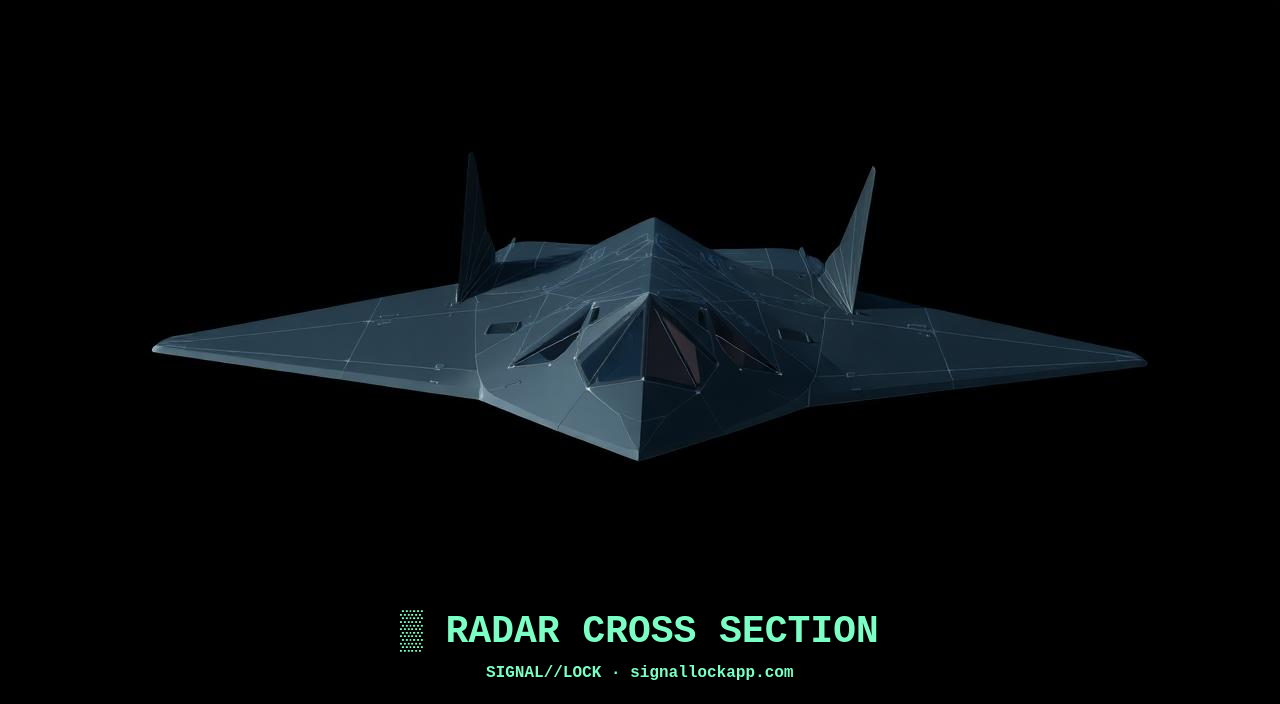
Faceting and curves
The F-117 used flat facets because 1970s computers couldn't simulate curved surfaces. The B-2 and F-22 use carefully shaped curves because better software solved the equations. Both achieve the same goal: no surface returns energy back toward the threat radar. Faces angle to deflect reflections sideways and upward, away from ground-based threats.
Edge alignment
Every straight edge on a stealth aircraft is aligned with one of a small number of master angles — typically the leading-edge sweep. This concentrates the edge diffraction into narrow beams pointing in known directions, leaving most of the sphere RCS-free. Wing tips, weapon bay doors, panel seams and antenna covers all follow the same angles.
Radar-absorbent materials
RAM coatings convert incoming microwave energy into heat through resistive losses. Modern RAM is a layered composite tuned to the threat band, applied centimetres thick on key surfaces. The maintenance cost is brutal — a B-2 needs hours of RAM repair after every flight.
Frequency dependence
Stealth is band-specific. F-22 and F-35 are optimised against X-band fire-control radars. Long-wavelength VHF radars (the Russian Nebo-M series) can detect them at much longer ranges because the wavelength is comparable to airframe features — they resonate. This is why low-frequency surveillance radars are seeing a revival.
The problem of engine inlets
Internal reflections within a jet engine's air intake represent the most significant challenge to low-observable design. The compressor face act as a massive, rotating corner reflector that returns energy directly to the source regardless of the aircraft's orientation. To mitigate this, modern stealth platforms like the F-35 and Su-57 employ S-ducts, which physically Curve the intake to ensure the radar waves cannot achieve a line-of-sight view of the engine face. The interior of these ducts is coated with RAM to absorb the energy as it bounces multiple times through the curve, significantly reducing the frontal RCS.
Historically, the SR-71 Blackbird addressed this issue as early as the 1960s by utilizing RAM on the transition structures of its engine nacelles. However, the most extreme solution remains the 'blocker' method used in the Boeing F/A-18E/F Super Hornet. This device uses a series of fixed vanes that obscure the engine face and are coated in absorbent materials. While less effective than a full S-duct found on the B-2, these blockers represent a necessary compromise for non-stealth airframes attempting to reduce their detection range against modern X-band interceptors.
Bistatic radar countermeasures
The fundamental strategy of faceting is based on the Monostatic Radar Equation, where the transmitter and receiver are at the same location. By deflecting energy away from the source, the aircraft remains invisible to conventional systems. However, bistatic radar systems—where the receiver is physically separated from the transmitter—can potentially detect these deflected beams. If a stealth aircraft deflects a pulse 45 degrees away from its nose, a receiver positioned at that specific angle can detect the reflection as easily as if the aircraft were a conventional target.
To counter this, design teams must ensure that spikes in RCS are extremely narrow and directed toward uninhabited or less-monitored sectors of the sky. This is why the planform alignment mentioned previously is so critical. Instead of dozens of small reflections, the aircraft produces two or four extremely powerful but thin spikes of energy. In a dynamic combat environment, the probability of a bistatic receiver being in the exact millisecond-long path of such a spike is statistically low, preserving the stealth aircraft's survivability even against multi-static sensor networks.
The traveling wave phenomenon
Surface waves represent a significant challenge in RCS design because they do not obey simple geometric reflection laws. When radar energy strikes a conductive edge at a shallow angle, it creates an electrical current that travels along the skin of the aircraft. If this 'traveling wave' encounters a discontinuity, such as a tail fin or a control surface gap, it re-radiates energy back toward the transmitter. This is why stealth designs prioritize extreme smoothness and integrate continuous planforms that minimize any abrupt change in surface impedance. Even a slightly misaligned screw head or a gap in a trailing edge can act as a localized antenna, significantly increasing the vehicle's detection range.
To mitigate these effects, engineers use graded-dielectric materials that slowly change the electrical properties of the skin toward the trailing edges. By tapering the conductivity, the traveling wave is gradually absorbed rather than reflecting off the physical end of the wing. In early designs like the F-117, this was managed by facet junctions, but modern aircraft like the F-35 rely on precision-milled tolerances in the thousandths of an inch. If the surface impedance is not perfectly managed, the aircraft exhibits 'glint,' where the radar return pulses as the aircraft moves, making it visible to sophisticated signal processing algorithms used in modern tracking systems.
Plasma and IR signature trade-offs
RCS reduction often conflicts with other stealth requirements, particularly thermal management. The high-performance engines required for supersonic flight produce massive heat signatures that long-wave infrared sensors can detect even when radar cannot. Furthermore, the ionization of air at hypersonic speeds can create a plasma sheath around the vehicle. While plasma can theoretically absorb radar waves under specific conditions, it is more often a liability; the dense ionized gas reflects electromagnetic energy like a mirror. Mastering the RCS of a vehicle requires balancing the geometry for X-band radar while simultaneously burying the engine exhaust to hide the heat from IRST (Infrared Search and Track) systems.
Historically, the U.S. investigated 'active' stealth using plasma generators to cloak non-stealthy aircraft in the 1960s, but the power requirements were prohibitive. Modern designers instead focus on the rear aspect of the RCS, which is the hardest to conceal. The serrated 'turkey feathers' on the F-35 engine nozzle are a direct result of this effort, ensuring that even the moving parts of the propulsion system conform to the master alignment angles. This multidisciplinary approach ensures the aircraft remains 'low observable' across the entire electromagnetic spectrum, not just the specific frequencies used by ground-based search radars.