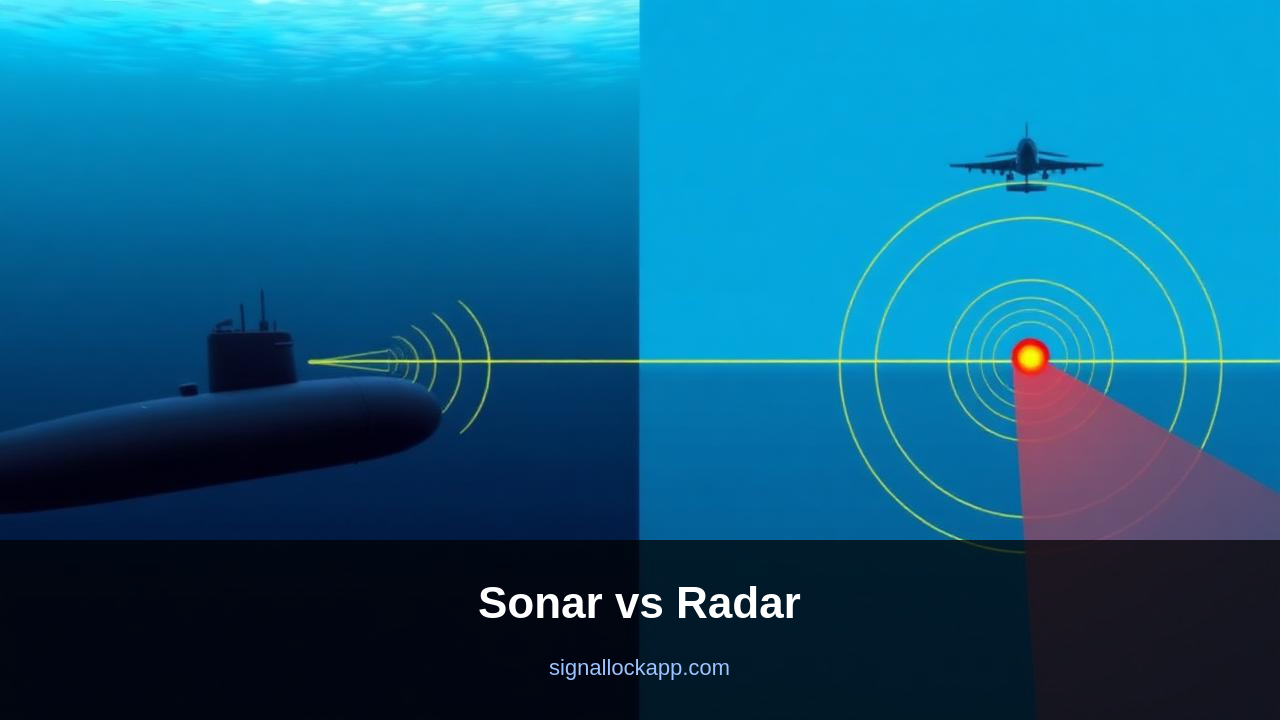
Why radio doesn't work underwater
Salt water absorbs radio waves within metres. A 100 MHz signal that travels 200 km in air dies in 1 metre of seawater. Sound is the opposite — air absorbs sound quickly, water carries it for hundreds of kilometres. The choice is forced by physics: above water, radar; below water, sonar.
Speeds and resolution
Radio travels at 300,000 km/s. Sound in seawater travels at about 1.5 km/s — 200,000 times slower. That means sonar has 200,000 times more time per pulse to resolve range, but a 1 km range fix that radar gets in 6 microseconds takes sonar over a second. Sonar trades latency for resolution.
Active vs passive
Active sonar sends a 'ping' and listens for the echo — analogous to radar. Passive sonar just listens, identifying ships by the unique acoustic signature of their propellers and machinery. There is no passive radar in the same sense, because targets don't naturally emit detectable radio waves (with one exception — passive radar can use ambient TV/cellular signals as illuminators).
Display conventions
Both systems borrowed the green-on-black PPI display from WW2 radar — sonar adopted it after 1945 because submariners trained on radar were already familiar with it. The waterfall display, where time runs down the screen and frequency runs across, came from sonar and migrated back to electronic-warfare radar.
Transducer constraints and beamwidth
The physical size of the transmitting hardware is governed by wavelength. Radar operates in the microwave spectrum, where wavelengths are measured in centimeters. This allows a relatively small parabolic dish or a phased array to focus energy into a narrow beam of a few degrees. Narrow beams provide high angular resolution, allowing operators to distinguish between two aircraft flying close together. Achieving a similar beamwidth with sonar is physically harder because acoustic waves have much longer wavelengths. Lower frequencies are necessary for long-range detection because high frequencies attenuate quickly in water, but low frequencies require massive transducer arrays to stay directional.
In practical terms, a 30 kHz sonar signal has a wavelength of 5 centimeters, similar to X-band radar. However, to achieve a 1-degree beamwidth at this frequency, a sonar transducer must be several meters wide. This is why submarines and surface ships often use 'towed arrays'—long cables lined with hydrophones that can span hundreds of meters. By increasing the physical aperture of the sensor, sonar systems can finally match the spatial precision that radar achieve with a much smaller footprint. This engineering trade-off defines the silhouette of modern naval vessels and the massive bulbous bows housing sonar domes.
The thermocline and signal refraction
Both systems suffer from environmental refraction, but the mechanisms differ. Radar waves are bent by atmospheric pressure and humidity, sometimes creating 'ducts' that allow signals to travel over the horizon. In the ocean, sonar is controlled by the thermocline—a distinct layer where water temperature drops rapidly. Because the speed of sound is highly dependent on temperature and pressure, these layers act like acoustic mirrors or lenses. A submarine can hide in a 'shadow zone' beneath a thermocline, where pings from a surface ship are refracted away, effectively making the sub invisible despite being only a few hundred meters away.
Navies utilize this vertical structure through Variable Depth Sonar (VDS). Unlike a fixed radar mast that cannot change its height to look under a cloud, a VDS system allows a ship to lower its sonar transducer on a cable to bypass the thermocline. Meanwhile, radar operators deal with 'clutter' from waves or rain, but they rarely face the total signal redirection found in the deep ocean's SOFAR channel. This deep sound channel allows low-frequency whalesong and seismic events to travel thousands of kilometers by trapping sound waves in a refractive waveguide, a phenomenon with no direct parallel in the terrestrial radar environment.
Frequency Selection and Wavelength Limits
In radar, engineers select frequencies based on the desired target size. High-frequency X-band radar (10 GHz) has a wavelength of 3 cm, allowing it to detect small rain droplets or bird flocks. However, these short waves are easily scattered by atmospheric moisture. Long-range early warning radars utilize the VHF or UHF bands (300 MHz to 3 GHz) because longer wavelengths of approximately 1 meter can bend over the horizon and penetrate storms, though they lack the precision for target tracking. The physical aperture of the antenna must scale with these wavelengths, necessitating the massive rotating arrays found on naval vessels and airport towers to maintain a tight, directional beam.
Sonar faces a more rigid constraint known as frequency-dependent absorption. Low-frequency sonar (below 1 kHz) can travel across entire ocean basins, but it requires transducers several meters wide to create a steerable beam. Conversely, high-frequency sonar (above 100 kHz) provides the sub-millimeter resolution required for seabed mapping and mine detection but loses all signal strength within a few hundred meters. This creates a hard trade-off: a submarine can either see a single rock in exquisite detail or detect a distant carrier group as a vague acoustic smudge, but physics rarely allows one system to accomplish both tasks simultaneously.
The Doppler Effect in Pursuit
The Doppler shift—the change in frequency caused by relative motion—serves different tactical roles in both systems. Radar uses the Doppler effect primarily for 'clutter rejection.' By filtering out signals with zero frequency shift, a pulse-Doppler radar can ignore the stationary ground or calm sea surface to isolate a moving aircraft. This enables the 'look-down/shoot-down' capability essential for modern interceptors. Without this processing, the return from the Earth's surface would wash out the much smaller return from a target, rendering the radar blind to low-flying threats that hide against the terrain.
In sonar, the Doppler shift is an primary tool for target identification and localization. Because the speed of sound is so low, even a slow-moving target creates a massive, easily measurable frequency shift. A 30-knot torpedo moving toward a stationary sensor will shift a 10 kHz ping by nearly 100 Hz— a change easily detectable by even basic hydrophones. Passive sonar operators analyze the 'narrowband' Doppler shift of specific engine components to determine if a target is turning toward or away from them long before a range can be established. This shift is so pronounced that it must be constantly corrected for in the sonar's own signal processing to prevent target blurring.