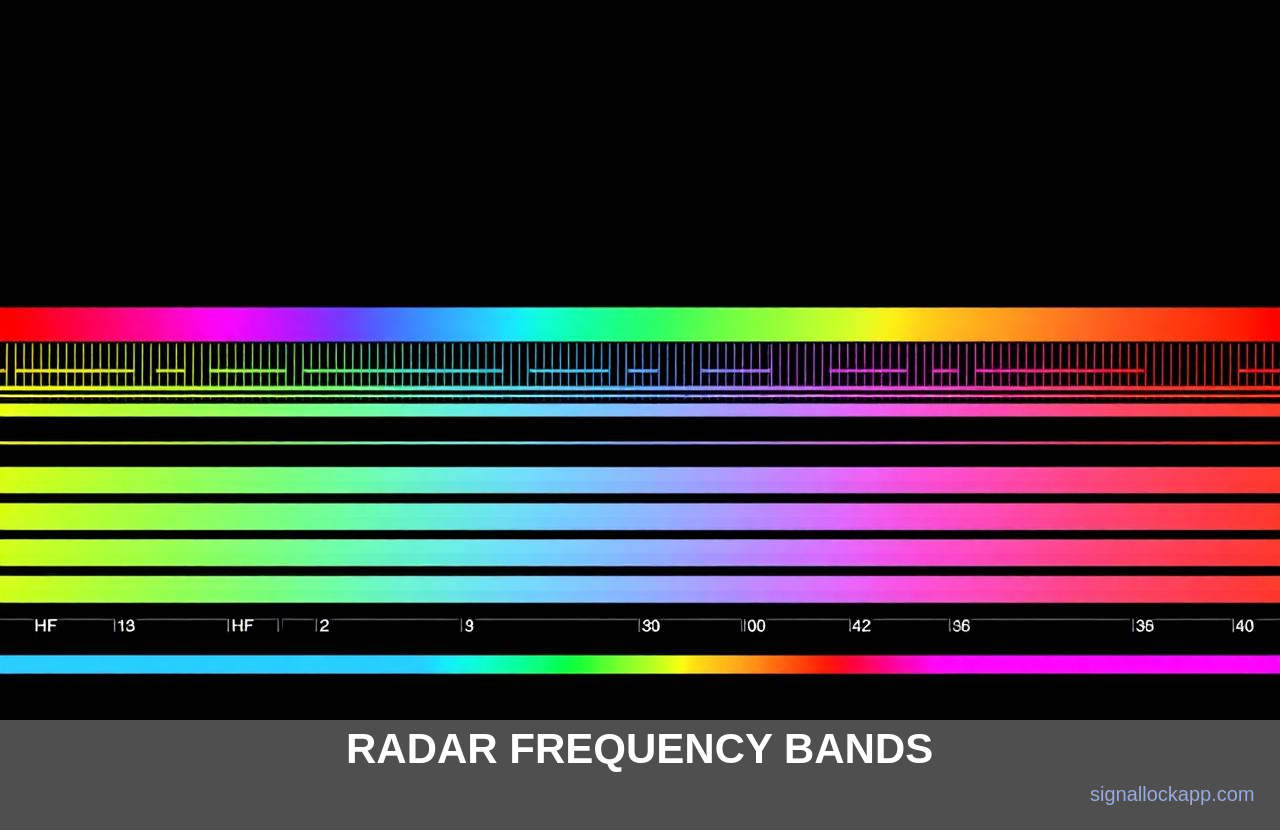
HF / VHF / UHF (3 MHz – 1 GHz)
Long wavelengths, long range, terrible resolution. Used for over-the-horizon radar that bounces off the ionosphere and for early warning. Can detect stealth aircraft because their RCS reduction breaks down at low frequency.
L-band (1–2 GHz)
Long-range air-traffic-control radar. 200 NM range, modest weather penetration, antennas roughly 10 m wide. Civilian en-route radar lives here.
S-band (2–4 GHz)
Weather radar (NEXRAD), terminal-area ATC, naval surface search. Good balance of range and weather visibility.
C-band (4–8 GHz)
Maritime, weather, satellite uplink. Many ship radars and the older NEXRAD predecessors.
X-band (8–12 GHz)
Most fighter radars, missile seekers, marine navigation, police speed guns. Sweet spot for compact high-resolution systems.
Ku / K / Ka (12–40 GHz)
Automotive cruise-control radar (Ka at 77 GHz), airport surface detection, high-resolution mapping. Heavily attenuated by rain — short range only.
W-band and above (75 GHz+)
Self-driving car sensors, missile seekers, imaging radar. Wavelength is millimetres — you can resolve a human-sized target at 100 m.
The Rain Fade Penalty: X-band vs. Ka-band
One of the most frequent trade-offs in modern radar design involves the trade-off between angular resolution and atmospheric attenuation. As frequency increases toward the Ka-band (27–40 GHz), the shorter wavelengths allow for extremely high-gain antennas within a small physical footprint, making them ideal for precision guided munitions and airport surface detection. However, these higher frequencies suffer from 'rain fade,' where the wavelength becomes comparable to the size of water droplets, causing significant scattering and absorption. In heavy precipitation, a Ka-band signal can lose over 10 dB of power per kilometer, effectively blinding the sensor compared to a lower-frequency X-band system.
To mitigate this, engineers often utilize frequency diversity or multi-band sensor fusion. While X-band (8–12 GHz) remains the standard for maritime navigation and tactical fire control due to its resilience against moderate rain and sea clutter, it cannot match the sub-meter range resolution achievable at Ka-band. Modern automotive radar systems have largely bypassed this debate by jumping to the 77 GHz range (W-band), where the trade-off is managed through massive computational processing and frequency-modulated continuous wave (FMCW) techniques to maintain proximity accuracy despite the high atmospheric loss.
The NATO vs. IEEE Nomenclature Conflict
A common point of confusion for systems integrators is the discrepancy between IEEE and NATO band designations. The IEEE system, established during and after World War II using letter codes like L, S, C, and X, was originally designed to keep radar operating frequencies secret. These codes were assigned somewhat arbitrarily to prevent the enemy from guessing the exact purpose or frequency of a new antenna. For example, 'S' stood for 'Short' and 'X' for 'Exotic.' Today, the IEEE standard is used globally for commercial and civil radar, providing a unified language for hardware manufacturers and spectral regulators like the FCC.
In contrast, the NATO nomenclature system (A through M bands) was established in 1970 to align military electronic warfare and band-usage reporting across the alliance. Under the NATO system, the 2–3 GHz range is referred to as the E-band and F-band, while the IEEE S-band encompasses portions of both. This overlap creates significant documentation errors when transitioning from tactical mission planning to civilian frequency deconfliction. When an engineer specifies 'L-band,' they must clarify whether they mean the IEEE 1–2 GHz range or the NATO 40–60 GHz range, as the latter is used for high-frequency satellite links.
The Pulse Compression Trade-off
In the transition from S-band to X-band, engineers must balance pulse width against range resolution. While lower frequencies like the L-band rely on high peak power to overcome noise, higher frequency bands utilize sophisticated pulse compression techniques to achieve centimeter-level accuracy without melting the hardware. By modulating the frequency of a long pulse—often called a 'chirp'—radar systems can process returned signals as if they were high-energy short pulses. This allows a modern X-band fire-control radar to distinguish between two aircraft flying in close formation, a feat impossible for the wide-beamed UHF arrays of the 1950s.
The shift toward Active Electronically Scanned Arrays (AESA) has fundamentally changed how these bands are utilized. Unlike older parabolic dishes that were physically constrained by wavelength-to-aperture ratios, AESA systems use thousands of tiny Transmit/Receive (T/R) modules. At X-band frequencies, these modules are small enough to be packed into the nose of a fighter jet, but as frequencies climb toward the Ka-band, the heat density becomes a massive engineering hurdle. Gallium Nitride (GaN) semiconductors are currently replacing Gallium Arsenide (GaAs) to provide the thermal conductivity required to keep high-frequency, high-resolution radars functional in compact aerodynamic housings.
The 'V-Band' Oxygen Absorption Paradox
The 60 GHz range, often cited as part of the V-band, presents a unique physical phenomenon: oxygen absorption. While most radar bands are chosen for their ability to penetrate the atmosphere, the V-band deliberately targets a frequency where O2 molecules resonate and absorb electromagnetic energy. This creates 'secure' short-range communication and radar links that cannot be intercepted or jammed from a distance, as the signal effectively disappears after a few kilometers. In the 1960s, this was a laboratory curiosity, but today it is the backbone of frequency-reuse strategies in high-density urban environments and satellite-to-satellite cross-links.
This absorption behavior highlights the distinction between 'all-weather' search radars and 'limited-range' industrial sensors. Engineers designing automotive parking sensors or factory floor safety grids often prefer the 60 GHz to 77 GHz range specifically because the signal does not propagate far enough to interfere with other systems miles away. This lack of propagation is not a failure of the band, but a primary design requirement for localizing interference. It allows for the proliferation of millions of millimeter-wave devices in a single city without the catastrophic spectrum congestion that plagues lower bands like L or S.